Is Coinbase Safe? What Its Licenses and Security Setup Actually Cover
Is Coinbase safe and legit? We check its licenses in the US, UK, Canada, and Australia, its security disclosures, and what \"safe\" leaves out.
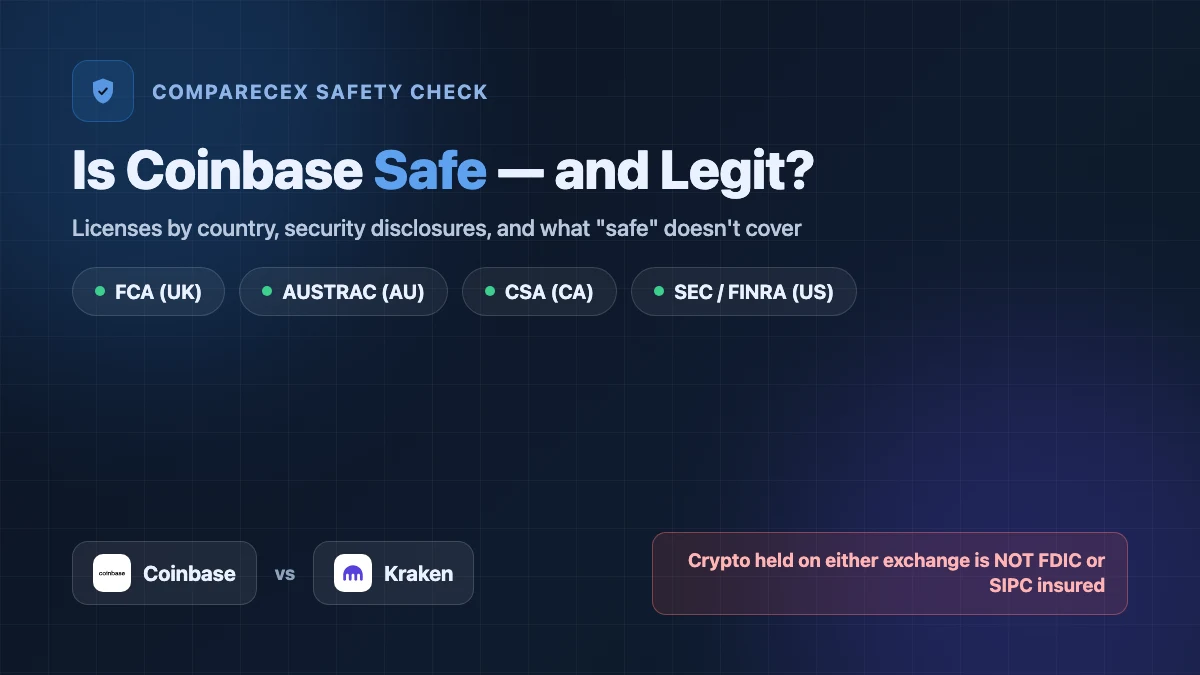
Coinbase is a licensed, publicly disclosed exchange with registrations confirmed by primary sources in the UK, Canada, and Australia, and a registered US entity tied to SEC and FINRA†. That answers "is Coinbase legit" in the narrow sense — it isn't an anonymous offshore operation, and its licenses are independently checkable. It doesn't answer "is Coinbase safe" the way most people mean it, because licensing doesn't insure your crypto holdings, and Coinbase has disclosed a real security incident. This article separates what's verified, what isn't, and what "safe" doesn't cover.
DISCLOSURE: CompareCEX may earn a commission when you sign up through our links. This does not influence our editorial scores.
RISK: Crypto assets are volatile and unregulated in many jurisdictions. Not financial advice.
Is Coinbase Regulated in the US, UK, Canada, and Australia?
Regulatory status is the most checkable part of "is Coinbase safe" — it comes from primary sources, not marketing copy. Here's what we verified directly from regulators and company disclosures as of September 6, 2026, compared against Kraken.
| Country | Coinbase | Kraken |
|---|---|---|
| United Kingdom | Registered VASP with the FCA; its EMI arm, CB Payments Ltd, holds Money Laundering Regulations registration 900635 (source) | FCA Registered Cryptoasset Firm plus a separate EMI registration; retail accounts cannot access derivatives or DeFi Earn (source) |
| Canada | Registered Restricted Dealer with the Canadian Securities Administrators (source) | Registered Restricted Dealer; retail accounts excluded from margin and derivatives (source) |
| Australia | Registered with AUSTRAC as a VASP and remittance provider (source) | Registered with AUSTRAC as a Digital Currency Exchange (source) |
| United States | Coinbase's own site lists SEC broker-dealer and FINRA self-regulatory affiliations for parts of its US business†; we could not verify a state-by-state money-transmitter breakdown, since Coinbase's license pages returned access-blocked responses during our check | FINRA self-regulatory member and SIPC-covered broker-dealer†; available in every US state except Maine and New York, per Kraken's own availability page (source) |
Two things matter here. "Restricted dealer" and "VASP" are real, checkable statuses you can look up on the regulator's own site — not vague marketing claims. But none of them are a safety guarantee: a restricted dealer license in Canada is narrower than a full investment dealer license, precisely because crypto platforms carry risks regular securities dealers don't.
Is Coinbase Legit? What Registration Actually Confirms
"Is Coinbase legit" and "is Coinbase safe" get asked as if they're the same question, but they check different things. Legitimacy is about identity and accountability: Coinbase is a US-headquartered company, founded in 2012, publicly traded, and registered with regulators in multiple countries†† — meaningfully different from an unregistered platform that could disappear with no legal entity to pursue.
What legitimacy doesn't confirm is that your funds are protected from hacks, company failure, or price loss. A legitimate company can still get breached, still hold assets in ways that carry counterparty risk, and still operate in an asset class most consumer-protection law wasn't written for. Legit answers "who am I dealing with," not "what happens if something goes wrong."
What Does Coinbase Disclose About Its Security Setup?
Coinbase's own published facts show a relatively simple retail product mix: spot trading, staking, and an "Earn" product are live, while margin and futures trading are not offered on the main platform†. That matters for safety because leveraged products carry liquidation risk that spot trading doesn't — fewer of those products means fewer ways your balance can go to zero from a single bad move.
On custody, Coinbase publishes proof of reserves only for its wrapped tokens such as cbBTC; there is no exchange-wide proof of customer balances†, and KYC is required to open an account†. Kraken, used here for comparison, publishes Proof of Reserves audits by an independent accounting firm, and clients can verify their own balance against the audit†. Both require KYC†. Proof of reserves answers "does the exchange hold what it says" — and on Coinbase that answer covers wrapped tokens, not customer balances. Coinbase's disclosures stop short of a real-time, third-party-audited reserve report.
Ready to try Coinbase?
Please check local regulations before signing up.
Has Coinbase Had a Security Incident?
Yes, and it's disclosed in an SEC filing, not just news coverage. Coinbase filed an 8-K on May 15, 2025, describing an extortion attempt after attackers paid overseas contractors and support staff to improperly access internal systems and customer data.
| What happened | Detail | Source |
|---|---|---|
| Data exposed | Names, addresses, phone numbers, emails, masked Social Security digits, masked bank details, government ID images, and account balance/transaction history | Coinbase 8-K, filed May 15, 2025 |
| Funds and credentials | Passwords and private keys were not compromised; no customer funds were accessed | Coinbase 8-K, filed May 15, 2025 |
| Users notified in one state | 69,461 | Maine Attorney General breach notification, May 2025 |
| Coinbase's own estimated cost | 180 million to 400 million US dollars for remediation and voluntary customer reimbursement | Coinbase 8-K, filed May 15, 2025 |
| Estimated cost per notified account (180M ÷ 69,461 to 400M ÷ 69,461) | roughly 2,590 to 5,760 US dollars | Calculated from the two rows above |
That last row is worth sitting with: even a breach where "no funds or private keys were taken" carried an estimated cost in the thousands of dollars per affected account, once Coinbase's own remediation range is divided by the number of people it reported to one state regulator. It was a support-channel social-engineering attack, not a technical hack of the trading system — a reminder that the weakest point in a regulated exchange's security is often people, not code.
What Does "Safe" NOT Mean on Coinbase?
This is the part most "is Coinbase safe" searches are really asking about, and it's the part regulation doesn't touch.
| Asset type on Coinbase | FDIC / NCUSIF / SIPC coverage | Source |
|---|---|---|
| USD cash sitting in your Coinbase wallet | May qualify for pass-through FDIC or NCUSIF insurance up to 250,000 US dollars per individual, since Coinbase holds it in pooled custodial bank accounts | Coinbase's insurance disclosure (coinbase.com/legal/insurance; help.coinbase.com) |
| Bitcoin, ETH, or any other crypto asset held on Coinbase | Zero — digital currency itself carries no FDIC, NCUSIF, or SIPC coverage and can lose value | Same source |
So "safe" on Coinbase doesn't mean deposit-insured like a bank account, protected from market losses, or immune to the kind of insider-driven breach described above. A UK, Canadian, or Australian registration doesn't extend US-style protections either — none of those regimes insure crypto assets; they regulate conduct, disclosure, and anti-money-laundering compliance, not asset value.
Common Mistakes People Make When Judging Coinbase's Safety
- Treating "regulated" as "insured." A VASP or restricted-dealer registration is a compliance status, not a guarantee your crypto balance is protected.
- Assuming US licensing covers everything. Coinbase's SEC/FINRA ties apply to specific parts of its business†; we couldn't verify a full state-by-state breakdown, and neither should you without checking.
- Confusing "no funds stolen" with "no cost." The May 2025 incident didn't touch customer funds, yet it still triggered a nine-figure remediation estimate and a state breach notification.
- Leaving 100% of holdings on one platform because it's the "safe" one. No single-exchange registration removes counterparty risk entirely, regardless of how many licenses it holds.
How Do You Decide How Much to Keep on Coinbase?
A trading principle is worth borrowing here even though this isn't a trading decision: always keep a backup instead of concentrating everything in one place, because a single point of failure with no fallback leaves no way to recover . Applied to custody, the same logic argues against treating any one exchange — Coinbase, Kraken, or otherwise — as the only place your holdings exist.
A short checklist before deciding how much to keep on Coinbase:
- Check what you actually need. If you only need spot buying and holding, the absence of margin/futures products† is a lower-complexity setup than a leveraged platform.
- Separate cash and crypto exposure. Only the USD cash portion has a path to pass-through deposit insurance; converting it to crypto removes that protection, as shown above.
- Re-check registration status periodically. Treat this article's country table as checked-on-date information, not permanent fact, and verify current status with the regulator before a large deposit.
- Read the actual incident disclosure, not just headlines. An SEC 8-K states specifically what was and wasn't compromised, which matters more than the fact that "a breach happened."
Related guides
- Coinbase fees explained — once you've weighed the safety side, this breaks down what Coinbase actually costs to trade on.
- Coinbase vs OKX — a licensing and fee comparison against an exchange with a very different regulatory footprint.
- Kraken exchange profile — the full profile behind the comparison points used throughout this article.
- Coinbase withdrawal delay: Aleo network incident — a separate, network-specific incident, not a platform-wide safety finding.
FAQ
Is Coinbase safe to use?
Coinbase holds checkable registrations in the UK, Canada, and Australia, discloses SEC/FINRA ties for parts of its US business†, and publishes proof of reserves only for its wrapped tokens such as cbBTC, not across customer balances†. It has also disclosed a real security incident (May 2025, SEC 8-K) involving customer data, though not funds or passwords. "Safe" here means regulated and disclosed, not risk-free or deposit-insured for crypto.
Is Coinbase legit or a scam?
Legit: a publicly traded, US-headquartered company founded in 2012, registered with regulators in multiple countries††. That rules out "anonymous scam platform," but doesn't mean every product on the platform is risk-free.
Does Coinbase insure my crypto if it's hacked or the company fails?
No. Crypto assets on Coinbase carry no FDIC, NCUSIF, or SIPC coverage. Only the USD cash portion of your balance may qualify for pass-through FDIC/NCUSIF coverage up to 250,000 US dollars per individual, per Coinbase's own insurance disclosure.
Is Coinbase safer than Kraken?
They disclose different things: Coinbase publishes proof of reserves only for wrapped tokens such as cbBTC†, while Kraken publishes independent accounting-firm Proof of Reserves audits that clients can check against their own balance†. Both require KYC† and both are registered in multiple countries above. Neither is categorically safer — they cover different parts of custody risk, and your own withdrawal habits matter more than either company's marketing.
See our best exchanges list for more comparisons, and read our affiliate disclosure for how we're funded.
RISK: Crypto assets are volatile and unregulated in many jurisdictions. Not financial advice.
Last updated: 2026-09-07