Coinbase Fees 2026: 0% to 0.60% Taker, Tiered by Volume
Coinbase fees run 0% to 0.40% maker and 0.05% to 0.60% taker, tiered by volume. A worked $10,000 example shows the real cost versus Binance and MEXC.
Watch the video version
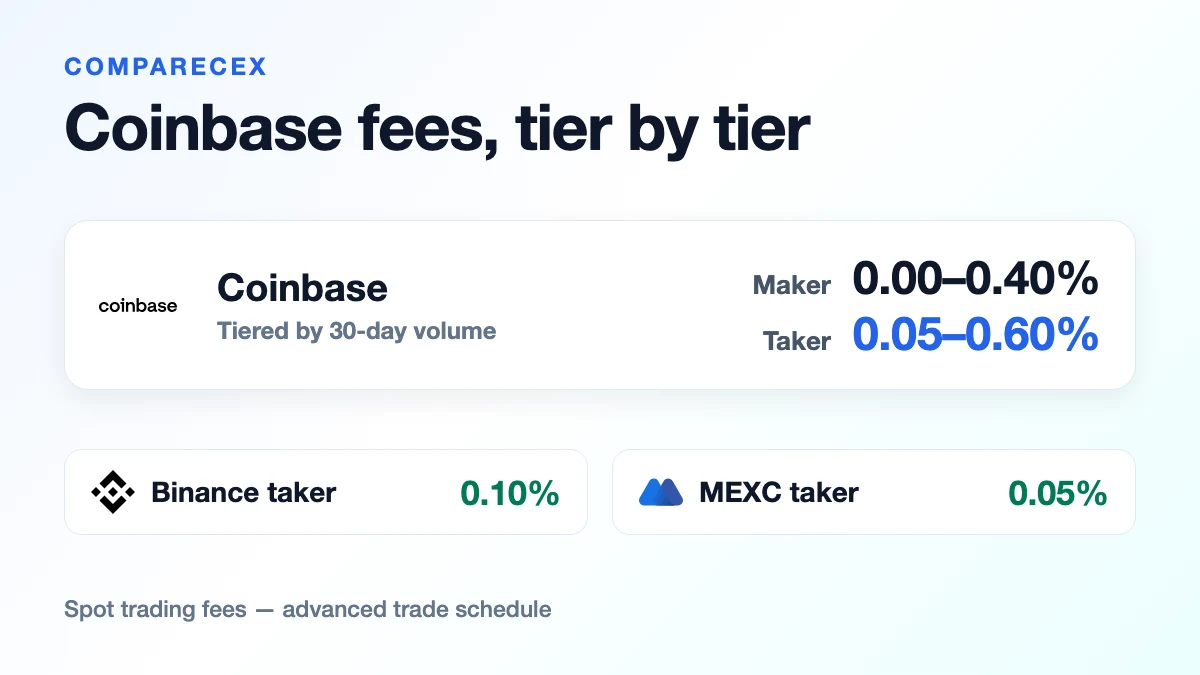
Coinbase charges a tiered trading fee that runs from 0% to 0.40% for maker orders and 0.05% to 0.60% for taker orders, based on your rolling 30-day trading volume††. Most retail accounts trade small enough volume to sit at the expensive end of that range, not the cheap end, which is why a "0.6% fee" headline undersells the actual cost most people pay. This article breaks the schedule down by trade type, runs a real dollar example, and compares Coinbase against two lower-fee exchanges so you can see the gap in actual money, not just percent.
DISCLOSURE: CompareCEX may earn a commission when you sign up through our links. This does not influence our editorial scores.
RISK: Crypto assets are volatile and unregulated in many jurisdictions. Not financial advice.
What Do Coinbase's Trading Fees Actually Look Like?
Coinbase's spot trading fees are not a flat rate. They scale down as your 30-day trading volume increases, which means the fee you pay depends entirely on how much you trade in a rolling month, not on the size of any single order.
| Order Type | Fee Range | Notes |
|---|---|---|
| Maker | 0% to 0.40%† | Tiered by 30-day volume, no fixed base rate |
| Taker | 0.05% to 0.60%† | Tiered by 30-day volume; higher end applies to smaller traders |
| Withdrawal fees | Not verified in our data | Varies by network and asset; check Coinbase's current schedule directly before withdrawing |
| Card purchase / "Simple Trade" spread | Not verified in our data | Coinbase's simplified buy flow reportedly bakes a spread into the displayed price, separate from the maker/taker schedule above; we do not have a verified number for this and will not estimate one |
| Coinbase One subscription | Not verified in our data | A paid tier said to waive some trading fees exists, but we have no verified figure for its cost or exact terms |
A trader placing a $500 order and a trader placing a $50,000 order at the same 30-day volume tier pay the identical percentage rate†. What differs between them is how much of their monthly volume total moves them toward the next tier down. If you have not placed enough volume this month to qualify for a lower bracket, you are paying the high end of that 0.05% to 0.60% taker range regardless of how big your account is†.
How Much Does a Round-Trip Trade Actually Cost You?
Here is the calculation with assumptions stated up front: a $10,000 account, a 1% risk-per-trade rule (meaning the most you are willing to lose on a bad trade is $100), and a full round trip, one entry and one exit, both filled as market (taker) orders on a $10,000 position at Coinbase's regular, non-discounted tier†.
- Coinbase, high end of the tier (typical for a low-volume account): 0.6% taker × 2 sides = 1.2% of $10,000 = $120†
- Coinbase, low end of the tier (requires high 30-day volume): 0.05% taker × 2 sides = 0.1% of $10,000 = $10†
- Binance, flat regular-tier rate: 0.1% taker × 2 sides = 0.2% of $10,000 = $20†
- MEXC, regular-tier rate: 0.05% taker × 2 sides = 0.1% of $10,000 = $10†
At the high end of its tier, which is where most retail traders actually sit, Coinbase's round-trip cost of $120 already exceeds the entire $100 you allowed yourself to lose on the trade†. That is before the market moves against you at all. Our knowledge base's core trading principle is blunt about this kind of number: the stop-loss on a single trade should never exceed 1% of the account, and a trade that is already down 1.2% in fees alone before it can even go wrong is a trade you likely should not be sizing the same way you would on a cheaper venue . Run your own trade size through our fee calculator rather than assuming which tier you fall into.
Ready to try Coinbase?
Please check local regulations before signing up.
Coinbase Fees vs Kraken
Coinbase and Kraken are two of the longest-running US-regulated exchanges, and their fee schedules look similar on the surface but diverge once you look at where most traders actually land.
| Exchange | Maker Fee | Taker Fee |
|---|---|---|
| Coinbase (tiered) | 0% to 0.40%† | 0.05% to 0.60%† |
| Kraken (entry tier, under $2,500 30-day volume) | 0.40%† | 0.80%† |
At the top of Coinbase's range, its maker fee (0.40%) matches Kraken's entry-tier maker fee exactly††. But Kraken's entry-tier taker fee of 0.80% is higher than even Coinbase's most expensive taker rate of 0.60%††. In practical terms, a small account making market orders on Kraken's default tier pays more per trade than the same account pays on Coinbase's worst tier. Neither is cheap compared to Binance or MEXC, but of the two, Kraken's starting tier is the pricier one for taker orders. See Binance vs Coinbase for the gap against a third exchange.
Why Are Coinbase Fees So High Compared to Binance and MEXC?
The short answer is that Coinbase's fee schedule is built around a wide volume-tiered range, and the vast majority of retail users never trade enough in a rolling 30-day window to reach the cheap end of it. Binance and MEXC publish a flat regular-tier rate that applies immediately to a new account: Binance at 0.10% maker and 0.10% taker††, and MEXC at 0% maker and 0.05% taker††. Coinbase's regular, low-volume tier sits well above both of those flat rates, at up to 0.40% maker and up to 0.60% taker††.
There is also a structural reason beyond the published schedule: Coinbase's simplified "buy/sell" flow in its main consumer app is widely understood to price in a spread on top of the stated trading fee, though we do not have a verified figure for that spread and will not estimate one here. If that reporting is accurate, a user trading through the simple flow rather than the advanced order book pays more than the table above suggests. In short, the "why" is a wide tiered range that punishes low-volume traders, plus a consumer interface that is not the same fee surface as advanced trading.
What Mistakes Do Traders Make About Coinbase's Fee Schedule?
- Assuming the tiered range applies to everyone equally. A quoted "0.05% fee" seen in marketing material typically describes the lowest tier, which requires substantial 30-day volume most retail accounts never reach†.
- Comparing only the maker or only the taker rate. A round trip touches both sides. Even at Coinbase's cheapest tier, the maker and taker legs of a single trade are charged separately††.
- Ignoring the withdrawal, card, and spread costs entirely. These are real costs for many users but are not part of the maker/taker schedule and are not verified in our data, so they should be checked directly on Coinbase before assuming the trading fee table above is the full picture.
- Not converting the fee into a percentage of the risk budget. Seeing "0.6%" and reading it as a small number skips the step of asking what share of a defined stop-loss that fee actually consumes on your trade size, the same reasoning behind capping stop-loss size at 1% of the account .
- Treating Coinbase and its "Advanced Trade" interface as the same fee surface. The advanced order book is where the maker/taker schedule in this article applies most cleanly; the simplified consumer buy flow may carry a different, unverified cost structure.
How Do You Cut Your Coinbase Fee Bill? (4 Steps)
- Check your actual 30-day trading volume on Coinbase's account dashboard rather than guessing which tier you are in.
- Use limit orders instead of market orders where possible. Coinbase's maker fee can be as low as 0% at higher tiers, well under its taker range of 0.05% to 0.60%††, though a limit order still carries the risk of not filling.
- Compare your real trade size against a lower-fee exchange using our fee calculator before assuming the difference is negligible; on a $10,000 round trip the gap between Coinbase's high tier and MEXC's regular rate can be over $100, as shown above.
- Read the methodology behind how we verify exchange fee data, and cross-check Coinbase's current published schedule directly, since tiered fees change over time and this article reflects the data as sourced.
If you are still deciding which platform fits your trading style and fee sensitivity, our maker vs taker fees guide explains the mechanics behind both sides of every trade, and our lowest-fee exchange roundup ranks platforms by actual regular-tier cost rather than marketing copy.
Related guides
- OKX vs Coinbase — how Coinbase's schedule compares with a lower-fee global exchange.
- Bybit vs Coinbase — the same fee gap, measured against a derivatives-first exchange.
- Binance vs Kraken — Kraken appears in the comparison above; this is the full head-to-head.
- Coinbase withdrawal delay: Aleo network incident — a separate, unrelated network-specific incident, not a fee issue.
FAQ
Why are Coinbase fees so high?
Coinbase's schedule is tiered from 0% to 0.40% maker and 0.05% to 0.60% taker based on 30-day volume††, and most retail accounts never trade enough in a rolling month to reach the cheap end. That leaves the typical low-volume user paying rates several times higher than flat-fee competitors like Binance at 0.10%/0.10%†† or MEXC at 0%/0.05%††. An unverified spread on Coinbase's simplified buy flow may add further cost on top.
Does Coinbase charge fees for holding crypto?
We do not have verified data on custody or holding fees for standard Coinbase accounts, so we will not state a number. If a subscription tier like Coinbase One affects this, check Coinbase's current terms directly rather than relying on third-party summaries.
Is Coinbase Advanced Trade cheaper than the regular Coinbase app?
The 0% to 0.40% maker and 0.05% to 0.60% taker schedule in this article†† applies to Coinbase's advanced order-book interface. The simplified buy/sell flow reportedly carries an additional, unverified spread on top of that, so confirm current terms on Coinbase before assuming either interface is cheaper.
Can I lower my Coinbase fees without switching exchanges?
Partly. Increasing your 30-day trading volume moves you toward the cheaper end of the tier, and using limit orders shifts trades toward the lower maker rate instead of the taker rate†. Neither changes the underlying schedule, and for a low-volume account the gap versus a flat-fee exchange like MEXC or Binance typically remains, as shown in the round-trip example above.
See our best exchanges list for more comparisons, and read our affiliate disclosure for how we're funded.
RISK: Crypto assets are volatile and unregulated in many jurisdictions. Not financial advice.
Last updated: 2026-10-14