Maker vs Taker Fees: What They Really Cost You Per Trade
Maker vs taker fees compared across 8 exchanges with verified data, plus a real dollar calculation showing when fees eat your entire risk budget.
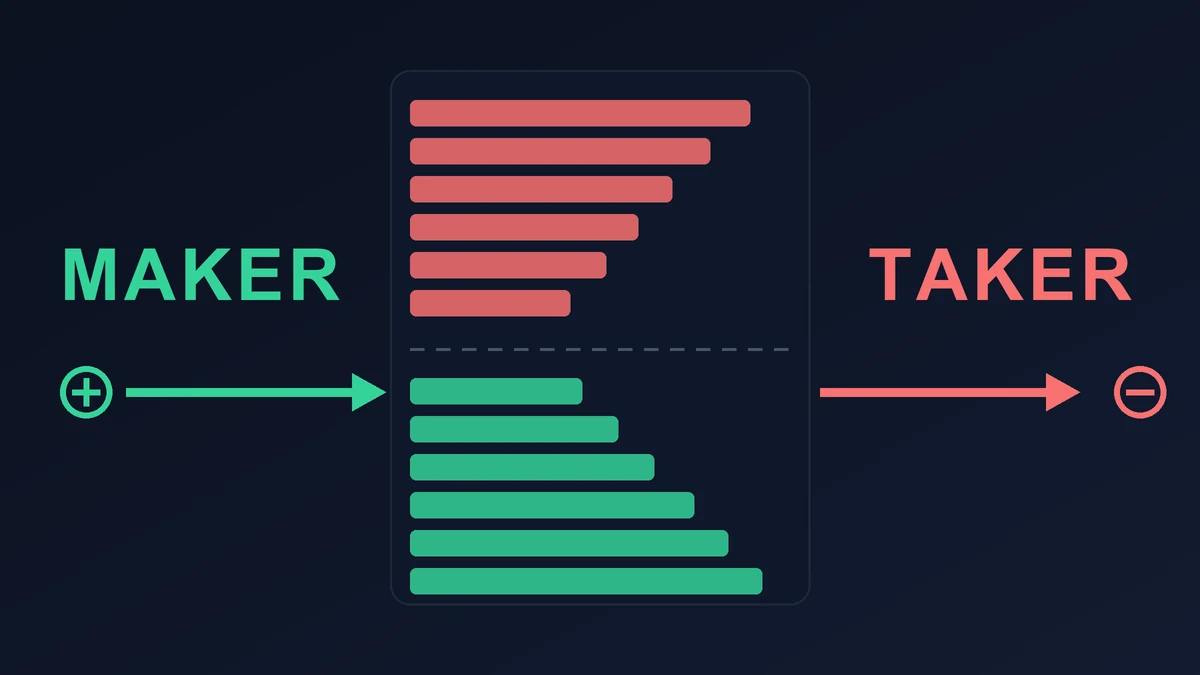
A maker fee is charged when your order adds liquidity to the order book — a limit order that sits and waits to be filled. A taker fee is charged when your order removes liquidity immediately: a market order, or a limit order that fills instantly against existing depth. Across the eight exchanges we track, regular-tier maker fees run from 0% to 0.40% and taker fees from 0.05% to 0.80%†††. MEXC sits at the cheap end with 0% maker and 0.05% taker††; Binance, Bybit, KuCoin and Bitget all charge a flat 0.10% on both sides††††; Kraken's entry tier is the most expensive at 0.40% maker and 0.80% taker††. The percentage alone tells you little. What matters is how much of your risk budget those fees consume on a full round trip — entry plus exit — at your actual trade size and trading frequency, which is what the worked example below measures.
DISCLOSURE: CompareCEX may earn a commission when you sign up through our links. This does not influence our editorial scores.
What Are Maker vs Taker Fees Exactly?
Exchanges split trading fees into two categories because they want depth in the order book. A maker order does not execute immediately, it rests on the book (think a limit buy below current price) and adds to the liquidity other traders can trade against. A taker order executes immediately against existing orders (a market order, or a limit order priced to fill right away), removing liquidity. Because makers help the market function, exchanges usually charge them less, and sometimes pay a small rebate. Takers pay more because they consume the liquidity someone else provided.
The real cost is not the headline percentage. It is the percentage multiplied by your trade size, multiplied by how many times you enter and exit a position, multiplied by how many trades you place per month. A 0.1% fee, the regular-tier rate charged by Binance and Bybit alike††, sounds negligible until you run it through that full chain.
What Do Maker and Taker Fees Cost on 8 Major Exchanges?
| Exchange | Maker Fee | Taker Fee |
|---|---|---|
| Binance | 0.10%† | 0.10%† |
| Bybit | 0.10%† | 0.10%† |
| OKX | 0.08%† | 0.10%† |
| KuCoin | 0.10%† | 0.10%† |
| Bitget | 0.10%† | 0.10%† |
| MEXC | 0%† | 0.05%† |
| Kraken (entry tier, $0+ 30-day volume) | 0.40%† | 0.80%† |
| Coinbase | 0–0.40% (tiered)† | 0.05–0.60% (tiered)† |
These are regular/VIP0 spot rates, not promotional or high-volume tiers — the maker and taker sides are charged separately on every fill. Kraken's entry tier is the outlier here; the dated source behind its numbers sits on our Kraken profile, and Binance vs Kraken works through what that gap costs over a month of trading. If you want a live estimate on your own trade size, run it through our fee calculator instead of eyeballing the table.
How Much Does a Round-Trip Trade Actually Cost?
Here is the calculation, assumptions stated up front: a $10,000 account, a 1% risk-per-trade rule (meaning you allow yourself to lose at most $100 on a losing trade), and a full round trip using taker orders (one entry, one exit, both filled as market orders) on a $10,000 position at each exchange's regular, non-discounted tier†.
- Kraken (entry tier): 0.8% taker × 2 sides = 1.6% of $10,000 = $160†
- Binance or Bybit: 0.1% taker × 2 sides = 0.2% of $10,000 = $20††
- MEXC: 0.05% taker × 2 sides = 0.1% of $10,000 = $10†
Compare each number to your $100 risk budget. On MEXC, the round trip costs 10% of your allowed loss. On Binance or Bybit, it costs 20%. On Kraken at the entry tier, the round trip costs $160, which is more than the entire $100 you were prepared to lose on the trade†. That is not a rounding error, it means the fee alone can exceed your risk limit before the market even moves against you.
Why Does Measuring Fees in Percent Miss the Real Cost?
Most comparisons stop at the percentage. The more useful way to think about it is in units of R, the risk you allow yourself per trade. If your rule is "risk 1% of the account per trade," then a fee is not "0.1%," it is "10% of my R" or "160% of my R" depending on the exchange and trade size, as shown above with Kraken's 0.80% entry-tier taker rate†. Framing fees this way exposes a distortion that percentage comparisons hide: a trader risking $500 per trade barely notices a $20 fee, while a trader risking $50 per trade sees that same $20 fee eat 40% of their allowed loss.
There is a second, less obvious driver of fee cost. The trading framework in our knowledge base estimates that markets range rather than trend roughly 60–80% of the time — the author's rule of thumb, not a measured statistic — which means a large share of trades placed during those stretches add no edge, only cost . The real fee burden for most retail traders does not come from the percentage rate at all, it comes from the number of unnecessary trades placed while chasing a market that is not actually going anywhere. Cutting your trade count in a sideways market often saves more than switching to a lower-fee exchange like MEXC, at 0.05% taker†, ever will.
Ready to try MEXC?
Not available in United States.
See a verified alternative →Why Does Fee Structure Change So Much for Active Traders?
- Maker rebates exist on some platforms. Bybit documents a maker rebate option at the regular tier†, which can turn providing liquidity into a small credit rather than a cost, though eligibility details should be checked directly on the exchange.
- Volume tiers move the number, but not for everyone. Coinbase's schedule spans 0–0.4% maker and 0.05–0.6% taker depending on 30-day volume††, meaning a low-volume trader pays the high end while a high-volume trader pays close to zero. Most retail accounts sit at the low-volume, high-fee end of that range.
- Frequency multiplies everything. A trader placing 5 round trips a month on Kraken's entry tier pays roughly $800 in fees on $10,000 trades; the same trader placing 50 round trips pays roughly $8,000. The fee schedule did not change, only the number of times it applied.
- Zero-maker structures flip the incentive. MEXC charges 0% on the maker side†, so a trader who consistently uses limit orders instead of market orders removes the maker portion of their cost entirely, though the order still needs to actually fill.
What Mistakes Do Traders Make About Fees?
- Quoting only the entry fee. A "0.1% fee" headline usually means one side. Both entry and exit incur a fee, so the real round-trip cost is double the quoted rate unless the exchange states otherwise.
- Comparing headline percentages without checking the tier. A rate advertised as low may only apply above a 30-day volume threshold most retail accounts never reach, as with Coinbase's tiered schedule††.
- Ignoring slippage. The gap between the price you expect and the price you actually get on a market order is a separate cost from the fee, and on thin order books it can exceed the fee itself. It is not part of the fee calculation above and should be tracked separately.
- Not converting the fee into R. Seeing "0.1%" and thinking "cheap" skips the step of asking what percentage of your actual risk budget that fee consumes on your typical trade size .
- Blaming fees for a trade-count problem. Traders who overtrade sideways markets often assume switching exchanges will fix their results, when the larger issue is placing trades that had no edge to begin with .
How Do You Cut Your Fee Burden? (5 Steps)
- Pull your last 30 days of actual trades, not a guess. Count how many round trips you placed.
- Calculate your real monthly fee spend: number of round trips × (entry fee % + exit fee %) × average trade size.
- Convert that total into a percentage of your risk budget for the month, not just a dollar figure, so you can see whether fees are quietly consuming your edge.
- Compare exchanges on your actual trade size using the fee calculator, not the advertised headline rate.
- Check whether your position size is appropriate for your account with the position size calculator before assuming the exchange is the problem.
If you are still deciding which platform fits your trading style, our exchange finder walks through the tradeoffs, and our methodology explains how we verify every number in this article.
Binance vs Bybit vs MEXC: Which Fee Structure Fits You?
If you trade small size infrequently, the fee difference between Binance, Bybit, and MEXC is small in absolute dollars, and picking based on features may matter more, see Binance vs Bybit. If you trade larger size or more frequently, MEXC's 0% maker and 0.05% taker rate†† compounds into a meaningful gap versus Binance's 0.1%/0.1%††, see the full breakdown in Binance vs MEXC. If you are weighing a higher-fee, longer-established platform against a lower-fee one, Binance vs Kraken covers that gap directly, and Kraken's entry-tier taker rate of 0.80%† is the highest in this comparison.
Related guides
- Coinbase fees explained — the widest maker-to-taker spread of any exchange in the table above.
- lowest-fee crypto exchanges — the same rates ranked by what they cost on a real trade.
- Bybit vs OKX — two exchanges where the maker side of the schedule matters most.
- Best crypto exchange with low fees — six exchanges' maker and taker rates compared on one real round-trip trade.
- Hyperliquid vs OKX — why a perpetuals maker/taker rate can't be compared directly to a spot rate.
- Bitget fees explained — a flat-rate exchange where maker and taker land on the same number.
- Best crypto exchange for day trading — why this maker/taker gap matters more for frequent traders than buy-and-hold.
FAQ
Does a maker rebate mean I get paid to trade?
On exchanges that offer it, yes in principle, a maker order can earn a small credit instead of paying a fee. Bybit lists a maker rebate option at the regular tier†; MEXC's maker fee is 0%, meaning no charge but also no rebate†. Rebate terms vary and should be confirmed on the exchange's current fee schedule.
Why do ads say "0.1% fee" when my actual cost was double that?
Ads typically quote one side of the trade, such as Binance's 0.1% regular-tier rate†. Unless stated otherwise, assume the round-trip cost (entry plus exit) is roughly double the quoted single-side rate.
Does my VIP tier carry over if I switch exchanges?
No. Fee tiers are calculated per exchange based on your rolling 30-day volume on that specific platform. A new account on any exchange starts at the regular, highest-fee tier.
Can I avoid taker fees entirely by only using limit orders?
Partly. A limit order priced at the current market can still fill as a taker if it matches an existing order instantly. True maker-only execution means placing orders that sit and wait, which carries the risk the order never fills or only fills partially while the market moves away from you.
See our best exchanges list for more comparisons, and read our affiliate disclosure for how we're funded.
RISK: Crypto assets are volatile and unregulated in many jurisdictions. Not financial advice.
Last updated: 2026-09-06