Head-to-head
Binance vs Bybit
Availability in United States is unclear — Từ terms footer, báo cáo ghi cần xác minh đầy đủ tại Binance Help Center.
Source · checked 2026-09-04

Which is better for beginners?
Binance scores higher for beginners (82.1 vs 62.1 out of 100).
Side-by-side
Availability in your region is unclear — check local regulations.
CompareCEX may earn a commission when you sign up through our links. This does not influence our editorial scores.
Not available in United States.
See a verified alternative →Binance vs Bybit: Which Exchange Is Better in 2026?
Binance vs Bybit compared on fees, KYC, features and card support using verified data — see which fits your trading needs in 2026.
Last verified: See our sources
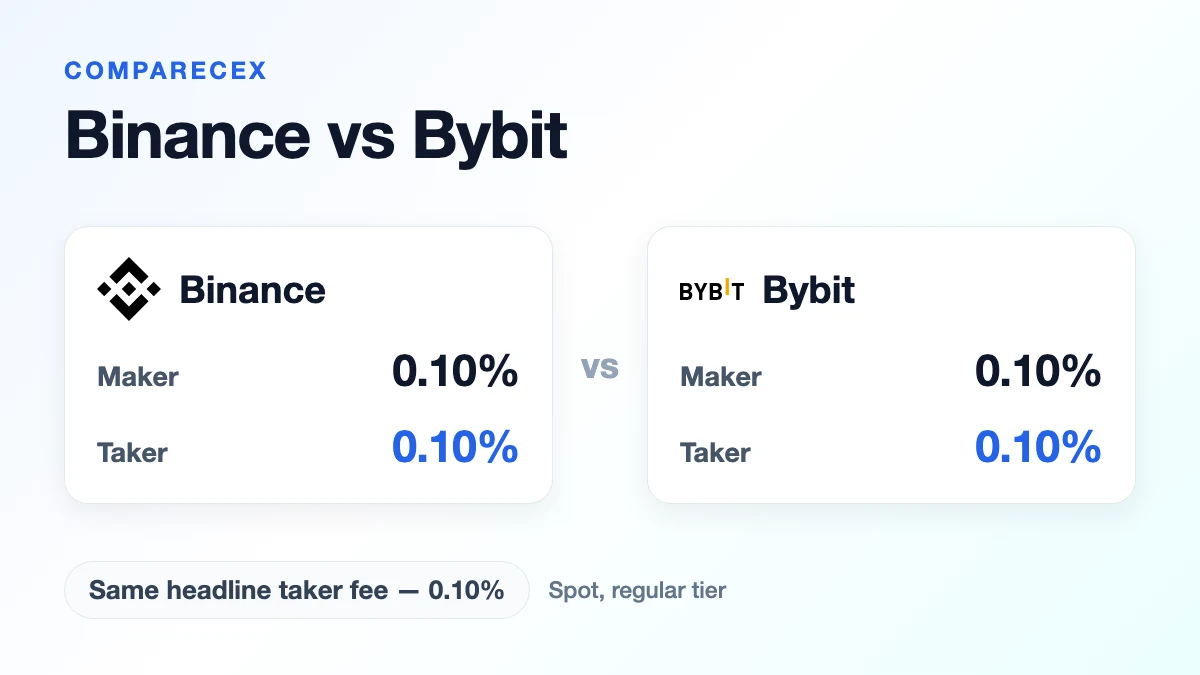
Binance and Bybit are both centralized exchanges (CEX) that require identity verification (KYC) and charge the same standard spot fee of 0.1% for makers and takers at the base tier††. The real differences show up in the tools built around the exchange: Binance offers a debit card and a P2P marketplace†, while Bybit does not offer either but includes built-in copy trading†. There is no single "better" exchange — the right one depends on whether you value more payment options or a simpler, futures-focused platform. This guide compares them criterion by criterion using only verified data, so you can match the platform to your own needs.
DISCLOSURE: CompareCEX may earn a commission when you sign up through our links. This does not influence our editorial scores. RISK: Crypto assets are volatile and unregulated in many jurisdictions. Not financial advice.
What Is the Real Difference Between Binance and Bybit?
Binance was founded in 2017 and is headquartered in Abu Dhabi under an ADGM financial services license†††. Bybit was founded a year later, in 2018, and is based in Singapore††. Binance reports around 250 million registered users as of January 2025 and lists roughly 350 coins†† — we don't have equivalent verified figures for Bybit's user base or coin count, so we won't guess them. Both platforms require KYC for full account access†† and offer 24/7 support, though Binance uses live chat plus a help center while Bybit relies on a help center and support tickets††.
| Criterion | Binance | Bybit |
|---|---|---|
| Founded | 2017† | 2018† |
| HQ / License | Abu Dhabi, UAE (ADGM/FSRA)†† | Singapore† |
| KYC required | Yes† | Yes† |
| Spot maker / taker fee (base tier) | 0.1% / 0.1%†† | 0.1% / 0.1%†† |
| Spot / Futures / Margin | Yes / Yes / Yes† | Yes / Yes / Yes† |
| Staking | Yes† | Yes† |
| P2P trading | Yes† | Not offered† |
| Debit/credit card | Yes† | Not offered† |
| Copy trading | Not verified in our data | Yes† |
| Languages supported | 40† | 10† |
| Support | 24/7 live chat + help center† | 24/7 help center + ticket† |
| Proof of reserves | Yes† | Not verified in our data |
For full breakdowns, see our individual reviews: Binance review and Bybit review.
How Do Binance vs Bybit Fees Compare? (Spot & Futures)
Spot trading fees
At the standard, non-VIP tier (VIP0), Binance charges 0.1% maker and 0.1% taker on spot trades, per its official fee schedule††. Bybit charges the same 0.1% maker and 0.1% taker at its regular tier, and it also offers a maker rebate program for higher-volume users, per Bybit's own help center††. On paper, spot trading fees are identical between the two at entry level — the deciding factor is usually payment method fees (card, P2P) and how much fee discount you can unlock through higher trading volume or native-token holdings, which is exchange-specific and not something we can quantify without checking your account tier.
Futures trading fees
Both exchanges publish separate futures fee schedules, but at the time of writing our Knowledge Graph only holds verified spot fee data for Binance and Bybit — we don't have confirmed futures maker/taker rates for either platform in this dataset. Rather than guess, we recommend checking each exchange's live fee page directly before opening a futures position, and running the numbers through our fee calculator once you know your expected trade size and holding period.
Binance vs Bybit: Card, P2P and Copy Trading — Who Has More Tools?
If a card for spending crypto balances or a P2P marketplace for buying/selling with local payment methods matters to you, Binance currently supports both, while Bybit supports neither, according to each exchange's own feature listing††. On the other hand, Bybit includes built-in copy trading, letting users mirror other traders' positions, a feature not confirmed in our data for Binance†. Binance also supports more languages (40 vs. Bybit's 10)††, which can matter if you don't trade in English.
Binance vs Bybit vs OKX: How Does a Third Exchange Compare?
Readers often widen the search to "binance vs bybit vs okx" once they see the first two are close on fees. We don't yet have verified OKX data in this Knowledge Graph, so we won't compare numbers we can't confirm. If OKX is on your shortlist, check our best exchanges roundup or use the find my exchange tool to filter by the features that matter most to you, and read our OKX review separately before relying on any specific fee figure.
What Do Beginners on Reddit Say About Binance vs Bybit?
Searches for "binance vs bybit reddit" usually come from people looking for real-user opinions rather than marketing pages. We don't treat forum threads as a data source — opinions on Reddit aren't verified numbers, and posts can be outdated or biased by referral links. If you read community discussions, treat them as anecdotes, not fact-checked comparisons, and cross-check any specific claim (fee %, withdrawal issue, region availability) against the exchange's official page or our reviews before trusting it.
This is also where a small habit from trading discipline transfers well to platform research: instead of reacting to the loudest opinion in a thread, write down what you actually verified and where you verified it — a simple decision log, not unlike the trade-journaling habit traders use to separate confirmed facts from assumptions . Applied to exchange selection, that means noting the fee tier, the KYC requirement, and the feature you actually checked yourself, rather than repeating a Reddit comment as if it were current.
So, Binance vs Bybit — Which Is Better for You? (Step-by-Step)
There's no universal winner; match the platform to your situation:
- List what you actually need. Card spending? P2P deposits? Copy trading? Cross-check against the table above.
- Compare your real fee tier, not just the base rate — both start at 0.1%/0.1% on spot††, but volume-based discounts differ by platform.
- Check KYC requirements match your country — both platforms require verification††, so neither suits users looking to avoid ID checks entirely.
- Run your expected trade size through the fee calculator to see the actual dollar cost, not just the percentage.
- Read the full reviews — Binance and Bybit — for withdrawal limits, supported coins, and security details beyond this comparison.
- Still unsure? Use find my exchange to filter by your priorities instead of guessing.
Ready to try Binance?
Availability in your region is unclear — check local regulations.
CompareCEX may earn a commission when you sign up through our links. This does not influence our editorial scores.
Ready to try Bybit?
Not available in United States.
See a verified alternative →Common Mistakes When Comparing Binance and Bybit
- Comparing only the headline fee percentage. Both list 0.1%/0.1% at base tier††, but card fees, P2P spreads, and network withdrawal fees aren't captured in that single number — check the full fee page before assuming one is cheaper overall.
- Trusting a fee number without writing down its source or date. Fee schedules change. A habit borrowed from trading journals — logging exactly what you checked and when, instead of relying on memory or a screenshot from months ago — reduces the chance you're comparing outdated numbers .
- Switching platforms every time a slightly lower fee appears. Chasing the "best deal" of the week without a consistent process for evaluating a platform (KYC, security, supported features) mirrors a common trading mistake: results come from following a rule-based process, not from reacting to whichever option looks best in the moment .
- Assuming feature parity. P2P and card support exist on Binance but are not confirmed for Bybit†† — don't assume both exchanges offer the same tools just because they're both large CEXs.
Related guides
- Bybit vs OKX — how Bybit holds up against the other derivatives-first exchange.
- Bybit vs Coinbase — the same question asked from the regulated-exchange side.
- Bybit vs MEXC — if altcoin listings matter to you more than brand size.
FAQ
Is Binance or Bybit safer?
Binance publicly states it maintains proof of reserves†; we don't have an equivalent verified proof-of-reserves fact for Bybit in our data, so we can't make a direct safety comparison on that point alone. Check each platform's latest security disclosures directly, and see our methodology for how we score security.
Does Bybit have a debit card like Binance?
No — based on each platform's own feature listing, Binance offers a card and Bybit does not††.
Can I use Binance or Bybit without KYC verification?
No. Both platforms require KYC for account access, per their own verification policies††.
Is Binance or Bybit cheaper for spot trading?
At the base tier, both charge the same 0.1% maker and 0.1% taker spot fee††††. Your actual cost depends on your volume tier and payment method — use the fee calculator to compare your specific case.
This article is educational content, not investment advice. All exchange data is sourced from the Knowledge Graph and cited inline; where a figure wasn't verified, we said so instead of guessing. See our affiliate disclosure and methodology for how we build and score comparisons. Updated: 2026-09-04.
Affiliate link — we may earn a commission. How we're funded
Visit Binance