Lowest Fee Crypto Exchange: Real Cost Ranked at 3 Trade Sizes
8 exchanges ranked by round-trip taker fees at $500, $5,000, and $50,000, plus the regulatory tradeoff cheapest platforms don't put on their fee page.
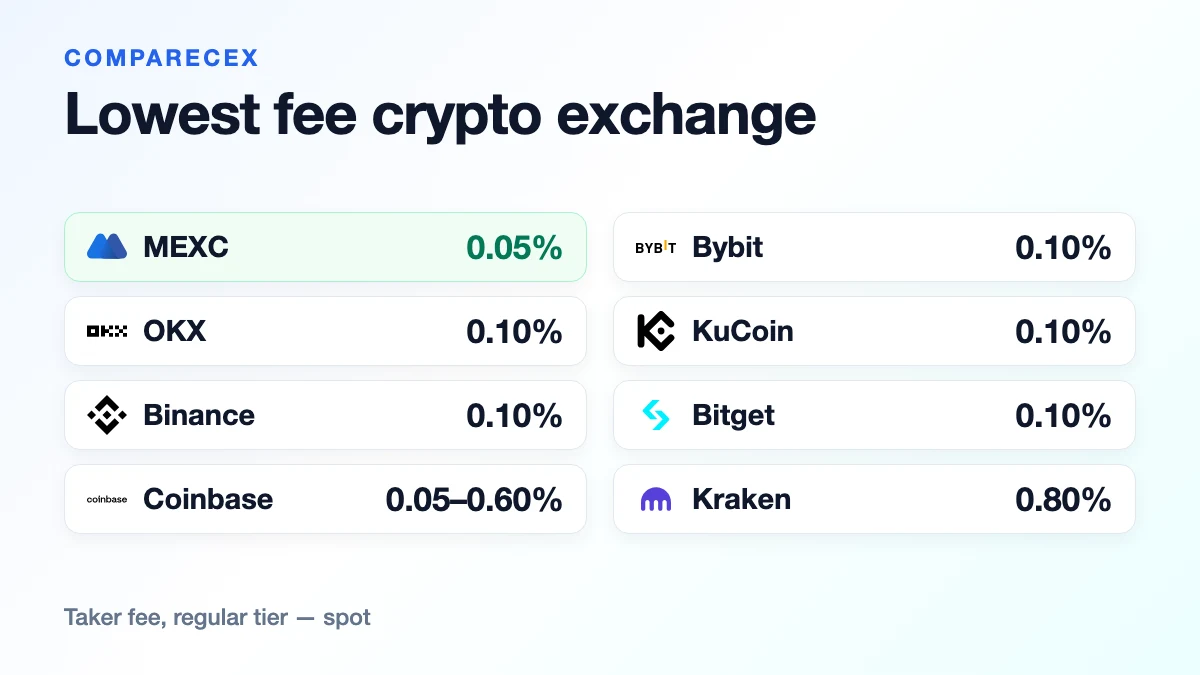
MEXC is the lowest fee crypto exchange in our tracked set, charging 0% maker and 0.05% taker on spot trades††. Binance, Bybit, KuCoin, and Bitget tie behind it at a flat 0.10% maker and 0.10% taker††††, OKX sits close with 0.08% maker and 0.10% taker††, and Kraken's entry tier is the most expensive at 0.40% maker and 0.80% taker††. Coinbase runs a tiered schedule from 0–0.40% maker to 0.05–0.60% taker depending on 30-day volume††, so where it lands against the flat-fee exchanges depends entirely on how much you trade. The percentage alone does not tell you what a trade actually costs; the ranking below converts it into dollars at three real trade sizes.
DISCLOSURE: CompareCEX may earn a commission when you sign up through our links. This does not influence our editorial scores.
RISK: Crypto assets are volatile and unregulated in many jurisdictions. Not financial advice.
Which Exchange Is Cheapest at Small, Medium, and Large Trade Sizes?
All fee schedules quote a single side of a trade. A real position has two sides: you pay once to enter, once to exit. The table below shows the regular, non-discounted spot rate for each exchange††.
| Exchange | Maker Fee | Taker Fee |
|---|---|---|
| MEXC | 0%† | 0.05%† |
| OKX | 0.08%† | 0.10%† |
| Binance | 0.10%† | 0.10%† |
| Bybit | 0.10%† | 0.10%† |
| KuCoin | 0.10%† | 0.10%† |
| Bitget | 0.10%† | 0.10%† |
| Coinbase | 0–0.40% (tiered)† | 0.05–0.60% (tiered)† |
| Kraken (entry tier) | 0.40%† | 0.80%† |
Now the number that actually matters: a full round trip, both sides filled as taker (market) orders, at the regular tier, on three trade sizes.
| Exchange | $500 round trip | $5,000 round trip | $50,000 round trip |
|---|---|---|---|
| MEXC | $0.50† | $5.00† | $50.00† |
| Binance / Bybit / KuCoin / Bitget / OKX | $1.00† | $10.00† | $100.00† |
| Coinbase (retail, high end of tier) | $6.00† | $60.00† | $600.00† |
| Kraken (entry tier) | $8.00† | $80.00† | $800.00† |
The math: taker fee times two sides times the trade size. On MEXC that is 0.05% x 2 = 0.10% of the position†; on Kraken's entry tier it is 0.80% x 2 = 1.60%†; on Binance, Bybit, KuCoin, Bitget, and OKX (taker sides are identical at 0.10%) it is 0.10% x 2 = 0.20%††. At $50,000 that spread is the difference between a $50 fee and an $800 fee for the exact same trade.
How Does Trade Size Change Who Wins?
At $500 the dollar gap between MEXC and Kraken is $7.50, small enough that most traders will not feel it. At $50,000 the same percentage gap is $750, which is a meaningfully different number for anyone building a position that size. This is why "lowest fee" is not a fixed answer, it is a function of how much you actually trade, not the headline percentage on the exchange's marketing page. Run your own trade size through our fee calculator rather than trusting the table alone, since Coinbase's tiered structure in particular moves with your 30-day volume††.
Coinbase is the clearest example of why tier matters. A trader who has not built up 30-day volume pays close to the 0.60% taker ceiling†, landing near Kraken's territory. A high-volume trader on the same exchange can pay close to the 0.05% floor†, landing near MEXC. Same exchange, same fee schedule, a roughly 12x difference in what you actually pay depending on your own volume.
What Do You Give Up for the Lowest Fees?
Cheap fees and a thick regulatory file are not the same axis, and the two do not always move together. Binance holds a financial services license from the FSRA under ADGM (Abu Dhabi)† and publishes proof of reserves†. OKX also publishes proof of reserves†. Coinbase is registered with the SEC as a broker-dealer and holds FINRA self-regulatory status†, but publishes proof of reserves only for its wrapped tokens such as cbBTC, not across customer balances†. Kraken holds FINRA and SIPC status through its US entity†.
For MEXC, Bybit, KuCoin, and Bitget, we have no equivalent license fact in our records. That is a gap in our data, not a finding that these exchanges are unlicensed or unsafe, and it should not be read as a recommendation to avoid them. It means: before moving meaningful size onto the exchange with the cheapest fee, check that exchange's own regulatory disclosures directly rather than assuming the fee page tells the whole story. The pattern worth noticing is that the two cheapest platforms in this ranking, MEXC at 0.05% taker† and the 0.10% taker group†, are also the ones where our knowledge base holds the thinnest regulatory paper trail. That tradeoff is worth weighing against how much capital you are willing to route through them.
Are Withdrawal Fees Part of the Real Cost Too?
Yes, and this is where this comparison has a gap: we do not have verified withdrawal fee data for any of the eight exchanges in our records. Withdrawal fees are typically flat per-network charges rather than percentage-based, so they matter more for small, frequent transfers than for the trading fees compared above. If withdrawal cost matters to your workflow, check the current fee schedule directly on each exchange before moving funds, since these numbers change without much notice and we are not going to publish a figure we cannot verify.
What Mistakes Do Traders Make When Chasing the Lowest Fee?
- Assuming the cheapest exchange fixes a trading problem it cannot fix. A lower fee shaves a fraction of a percent off every trade; it does nothing about the number of trades you place. A trader placing 40 round trips a month because they cannot sit still has an overtrading problem, and MEXC's 0.05% taker rate† will not offset the cost of the 30 extra trades that had no edge.
- Sizing the position to the fee instead of the risk. The 1% guardrail in our trading knowledge base treats stop-loss size as the hard limit on a trade, not the exchange's fee schedule . Picking the cheapest exchange and then oversizing a position past your own risk limit loses more than the fee ever saved.
- Comparing headline rates without checking the tier. Coinbase's 0.05% floor only applies at high 30-day volume†; most retail accounts sit closer to the 0.60% ceiling.
- Ignoring the regulatory side of the tradeoff. Picking a platform on fee alone, with no equivalent license fact checked, is a different risk decision than picking one with visible regulatory standing like Coinbase† or Kraken†.
How Do You Choose the Right Low-Fee Exchange for Yourself? (5 Steps)
- Write down your typical trade size, not your account balance. A small trader and a large trader are optimizing a different problem.
- Write down your monthly round-trip count from your actual trade history, not a guess.
- Multiply size x round trips x round-trip fee percentage for each exchange on your shortlist, using the table above as a starting point and the fee calculator for exact numbers at your own size.
- Check the regulatory disclosure of the exchange separately from its fee schedule. The cheapest fee and the deepest regulatory paper trail are not always the same platform.
- Confirm withdrawal terms directly on the exchange before moving funds, since we do not have verified withdrawal fee data to compare here.
If you are undecided between platforms, our exchange finder walks through the tradeoffs by trade size and feature need, and our methodology explains how every number above is sourced and verified.
Ready to try MEXC?
Not available in United States.
See a verified alternative →Binance vs Kraken vs Coinbase: Where Does the Fee Gap Matter Most?
At small trade sizes the dollar gap between any two of these exchanges is close to trivial. At larger, more frequent trade sizes it compounds fast: Binance vs Kraken breaks down what Kraken's 0.80% entry-tier taker rate† costs over a month of trading against Binance's flat 0.10%†, and Binance vs Coinbase covers the same gap against Coinbase's tiered schedule†. Our full writeup on how maker and taker fees work mechanically, including the maker rebate some exchanges offer, is in Maker vs Taker Fees.
Related guides
- Binance vs MEXC — the head-to-head behind the cheapest two names in the ranking.
- Coinbase fees explained — why the most expensive platform in this ranking costs what it does.
- Bybit vs MEXC — if you want the low-fee option with derivatives attached.
- Best crypto exchange with low fees — the same six-exchange fee gap, worked through the round-trip dollar math.
- Hyperliquid vs OKX — a self-custody perp DEX not in this ranking, with a lower base maker/taker rate than any exchange here.
- Bitget fees explained — the worked-dollar breakdown behind Bitget's position in this ranking.
- Cheapest crypto broker — the same fee components, walked through a step-by-step comparison method instead of a single ranking.
FAQ
Is the exchange with the lowest fee always the cheapest choice overall?
No. The fee table above only covers trading fees. Spread, slippage on thin order books, and unverified withdrawal costs all add to the real total, and a platform with a thinner regulatory file carries a different kind of cost that does not show up in a percentage at all.
Why does my actual fee not match the advertised rate?
Advertised rates are usually the best-case tier or a single side of the trade. Coinbase's 0.05% floor, for example, only applies at higher 30-day volume†; most accounts pay closer to the ceiling until they trade enough to move down a tier.
Does trading more to get a lower fee tier actually save money?
Only if the trades themselves have an edge. Trading more purely to reach a fee discount adds cost from the extra fees paid to get there, and the framework in our knowledge base treats unnecessary trade volume, not the fee rate, as the bigger drain on most accounts .
Can I get MEXC's rate on another exchange by negotiating or using a referral code?
Some exchanges run referral-linked fee discounts or temporary promotions, but these sit outside the regular tiers listed here and change without much warning. Check the current terms directly on the exchange rather than assuming a referral rate matches what is published on the standard fee schedule.
See our best exchanges list for further comparisons, and read our affiliate disclosure for how this site is funded.
RISK: Crypto assets are volatile and unregulated in many jurisdictions. Not financial advice.
Last updated: 2026-09-06