Kraken Review: Fees, Security, and Who It's Actually For
An independent Kraken review: sourced fees, licences by country, KYC rules, and product range — no star rating we can't back up with data.
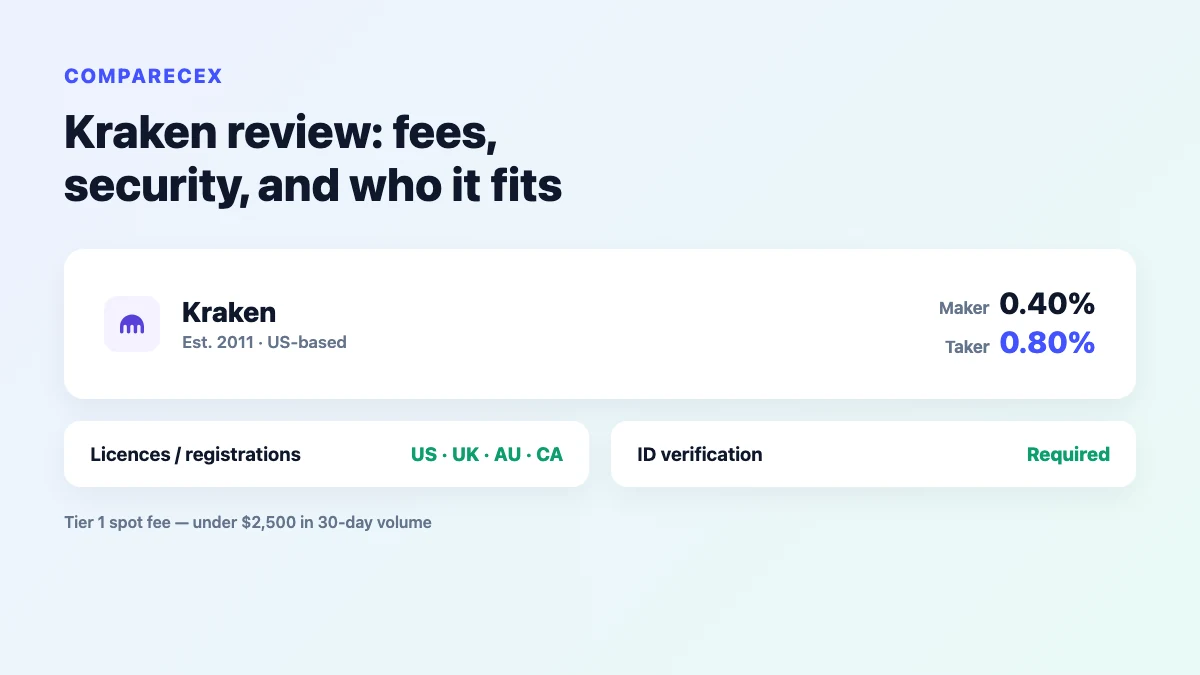
Kraken suits traders who want spot, margin, futures, and staking on one long-running, multi-country-regulated exchange and are not chasing the lowest possible fee. It is a weaker fit if you trade small size often and care most about the headline cost per trade, if you live in Maine or New York, or if you need a published proof-of-reserves attestation before you deposit. Kraken has operated since 2011 out of San Francisco††, which makes it one of the older exchanges still running under its original brand, but "old and regulated" is not the same claim as "cheapest" or "most transparent," and this review keeps those three questions separate.
DISCLOSURE: CompareCEX may earn a commission when you sign up through our links. This does not influence our editorial scores.
RISK: Crypto assets are volatile and unregulated in many jurisdictions. Not financial advice.
We are not publishing a star rating for Kraken here: our knowledge base does not carry a scored CompareCEX Score field for this exchange, and inventing one would be exactly the kind of unverified number this site refuses to run.
How Much Does Kraken Actually Charge?
Kraken's regular spot tier, Tier 1, charges 0.40% maker and 0.80% taker for any account under $2,500 in rolling 30-day volume††. That taker rate is higher than Coinbase's most expensive tier (0.60%)† and well above Binance's flat regular-tier rate of 0.10% maker and 0.10% taker††. In practical terms, a low-volume trader placing market orders pays more per trade on Kraken than on either of those two alternatives. We keep the full tier table, worked dollar examples, and the separate consumer-app rate out of this article — see Kraken fees explained for that breakdown, or run your own trade size through our fee calculator.
Our knowledge base's core trading discipline card is blunt about what this means for position sizing: a method built around capping stop-loss risk at roughly 1% of the account treats every cost that eats into that 1% as a real deduction from what a trade can lose before it is even wrong . Kraken's Tier 1 taker fee of 0.80%† on one side of a round trip is not a rounding error against a 1% risk budget — it is most of it, before the market has moved at all.
Ready to try Kraken?
Please check local regulations before signing up.
What Can You Actually Do on Kraken?
Kraken supports spot trading, margin, futures, and staking on one account, but it does not offer copy trading or peer-to-peer trading†. The platform lists roughly 600 tradable assets† and ships iOS and Android apps, with support available 24/7 through a help center and ticket system†. That product spread is wider than a spot-only exchange, but if copy trading or P2P is the feature you actually want, Kraken is not built for it.
Is Kraken Regulated, and Is It Safe?
Kraken's own disclosures reference FINRA, a self-regulatory authority, and SIPC, a broker-dealer protection scheme, in the US†. Separately, per Kraken's own country-availability page (checked 2026-09-06), Kraken is registered with the UK's FCA as a cryptoasset firm and e-money institution (retail accounts there cannot access derivatives or the DeFi Earn product), holds an AUSTRAC digital currency exchange registration in Australia, and operates in Canada as a Restricted Dealer without margin or derivatives access.
On custody, Kraken's own materials describe an emphasis on self-custody wallet options rather than a published proof-of-reserves attestation†. We do not have a verified proof-of-reserves figure for Kraken and will not estimate one. This review does not cover past security incidents in detail — see Is Kraken safe? for that analysis with dated sources.
Does Kraken Require ID Verification?
Yes. Kraken requires government ID and proof of address for verified accounts†. There is no anonymous or no-KYC tier for the exchange covered in this review, and any product marketed as a way around that requirement is not something we can verify or recommend.
Where Is Kraken Available?
The table below reflects Kraken's own availability page, checked 2026-09-06, not an inference from a general "not blocked" list.
| Country | Status | Note |
|---|---|---|
| United States | Allowed, with exceptions | Available in every state except Maine and New York |
| United Kingdom | Allowed | FCA-registered cryptoasset firm and EMI; retail cannot access derivatives or DeFi Earn |
| Australia | Allowed | AUSTRAC digital currency exchange registration |
| Canada | Allowed, with restrictions | Registered as a Restricted Dealer; no margin or derivatives access |
If your country is not listed, we do not have a verified source for its status and will not guess.
Kraken: Pros and Cons
| Pros | Cons |
|---|---|
| Operating continuously since 2011, out of the US†† | Tier 1 taker fee (0.80%) is higher than Coinbase's top tier and Binance's flat rate††† |
| Spot, margin, futures, and staking on one account† | No copy trading or P2P trading† |
| Registered or licensed touchpoints in the US, UK, AU, and CA | No published proof-of-reserves attestation† |
| 24/7 support via help center and ticket system† | Excluded in Maine and New York; margin and derivatives blocked in Canada |
What Mistakes Do People Make When Choosing Kraken?
- Assuming Kraken's regular fee is close to a flat-fee competitor's rate. At Tier 1, Kraken charges roughly eight times Binance's flat taker rate (0.80% vs. 0.10%)††, and that gap only closes at higher 30-day volume.
- Assuming every US state is covered. Kraken is available across the US except Maine and New York specifically — not a blanket "US-approved" status.
- Assuming margin and futures work the same everywhere. Kraken's feature set includes both globally†, but Canadian accounts are restricted from margin and derivatives regardless of what the general feature list shows.
- Treating "regulated" as "insured." FINRA self-regulatory status and SIPC broker-dealer references† are not the same guarantee as deposit insurance on crypto holdings; check Kraken's current terms directly for what is and is not covered.
- Skipping ID verification and expecting full account access. Kraken requires government ID and proof of address†; there is no verified path around that on this exchange.
Related guides
- Kraken fees explained — the full Tier 1 through Tier 5 schedule, the separate consumer-app rate, and worked dollar examples.
- Is Kraken safe? — security history, custody model, and dated sources behind that question.
- Binance vs Kraken — a full head-to-head against the flat-fee exchange referenced above.
FAQ
Is Kraken good for beginners?
Kraken's product range (spot, margin, futures, staking) and multi-country registrations suit someone who wants one account for a while, but its Tier 1 taker fee of 0.80%† is high for a beginner making small, frequent trades. A beginner who only needs spot trading at the lowest cost may find our beginner-friendly exchange picks a better starting point.
How much are Kraken's fees?
Kraken's Tier 1 (under $2,500 in 30-day volume) spot fee is 0.40% maker and 0.80% taker††. See Kraken fees explained for the full tier table and dollar examples.
Is Kraken available in my country?
Kraken serves the US except Maine and New York, the UK (FCA-registered, no derivatives for retail), Australia (AUSTRAC-registered), and Canada (Restricted Dealer, no margin or derivatives), per Kraken's own availability page checked 2026-09-06. We do not have a verified status for countries outside this list.
Does Kraken require identity verification?
Yes. Government ID and proof of address are required for a verified account†. There is no verified no-KYC tier on this exchange.
See our best exchanges list for more comparisons, and read our affiliate disclosure for how we're funded.
RISK: Crypto assets are volatile and unregulated in many jurisdictions. Not financial advice.
Last updated: 2026-09-07