Is Kraken Safe? A Fact-Checked Look at Licenses and Custody
Is Kraken safe? We check its country-by-country licenses, custody setup, proof-of-reserves claim, and regulatory record against sourced, dated facts.
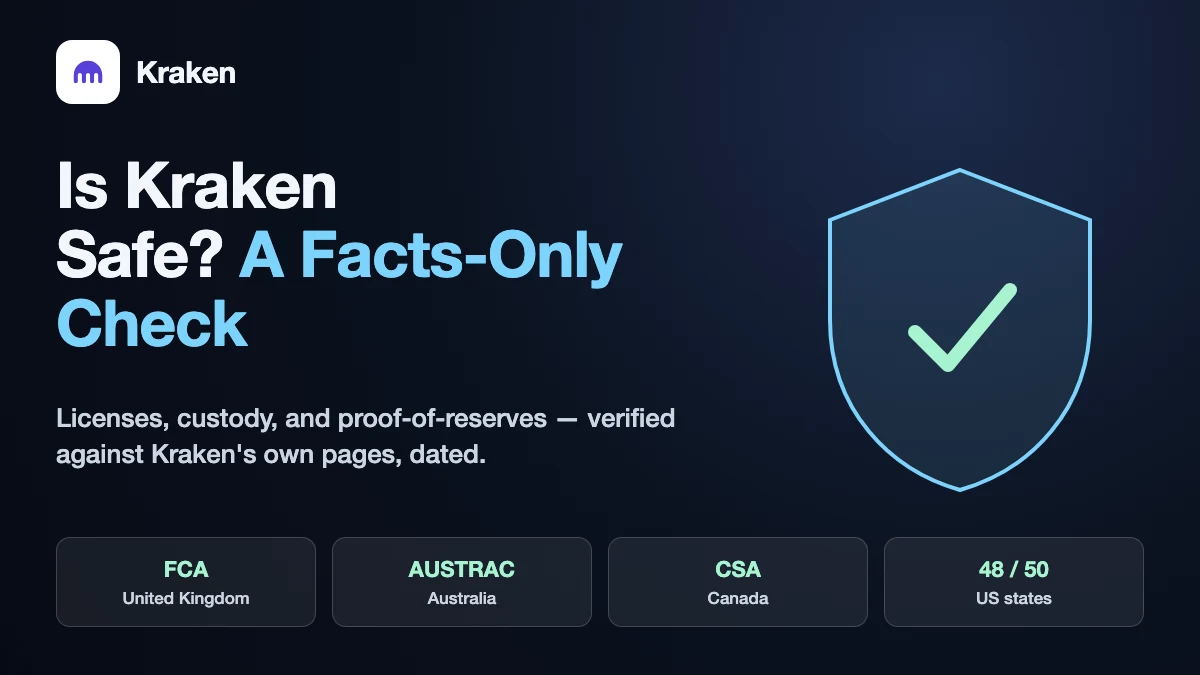
Kraken is safe in the sense that matters most for a beginner: it is a licensed, registered exchange in the UK, Australia, Canada, and most of the US, and it has operated since 2011 without collapsing or losing customer funds in a hack†. But "safe" is not one yes/no fact — it depends on what you mean: legal registration, custody of your coins, or protection if something goes wrong. This article checks each of those separately, with sources and dates, so you can judge for yourself rather than trust a headline.
DISCLOSURE: CompareCEX may earn a commission when you sign up through our links. This does not influence our editorial scores.
RISK: Crypto assets are volatile and unregulated in many jurisdictions. Not financial advice.
Is Kraken Legit, or Just Old?
Kraken was founded in 2011†, making it one of the oldest crypto exchanges still operating — older than Binance, Coinbase's public listing, and every exchange that has since collapsed, including FTX, Celsius, and Voyager. Its parent entity, Payward, Inc., is headquartered in San Francisco†. A platform that has processed withdrawals through multiple crypto crashes for over a decade has survived stress tests many newer exchanges never faced.
Longevity is not proof of safety going forward, though — it means Kraken hasn't failed yet, not that its licenses, custody practices, or security team stay the same quality tomorrow. Treat "founded in 2011" as one data point; the licensing and custody sections below carry more weight for "is Kraken legit."
What Licenses Does Kraken Actually Hold, Country by Country?
Regulatory status is the clearest, most checkable part of "is Kraken safe." Kraken's own support page states specific registrations for four major markets, confirmed directly on Kraken's site as of September 7, 2026:
| Country | Kraken's status | What it means |
|---|---|---|
| United Kingdom | FCA Registered Cryptoasset Firm (Payward Limited, FRN 928768) | Registered under UK anti-money-laundering rules; not the same as full FCA authorization of a bank |
| Australia | AUSTRAC-registered Digital Currency Exchange and Remittance Dealer (Bit Trade Pty Ltd) | Registered with Australia's financial crime regulator, required to operate legally |
| Canada | Restricted Dealer, registered with the Ontario Securities Commission and other provincial securities regulators | Allowed to offer trading, but under Canada's securities rules, not a full investment-dealer license |
| United States | Available in every state except Maine and New York | 48 of the 50 states can open an account; New York and Maine residents cannot |
Source: Kraken — availability of services by country, checked September 7, 2026.
Being registered is not the same as being insured or risk-free. A "Restricted Dealer" in Canada or a "Registered Cryptoasset Firm" in the UK means Kraken has met a compliance bar and reports to that regulator — it does not mean the regulator guarantees you'll get your money back if Kraken has a problem. Registration reduces the risk of outright fraud; it does not remove market or custody risk.
How Does Kraken Handle Custody and Proof of Reserves?
This is where "is Kraken safe" gets more specific than licensing. Two separate things matter: who holds your coins day to day, and whether Kraken proves it actually has the coins it says it does.
Kraken publishes Proof of Reserves audits carried out by an independent accounting firm, and clients can verify their own balance against the audit†. Checking Kraken's own security page on September 7, 2026, the current wording is more specific: Kraken says it "periodically works with an external auditor to perform Proof of Reserves audit" — no exact dates or frequency published, so treat this as a documented practice, not a live, continuously verifiable guarantee.
Kraken also requires identity verification (government ID and proof of address) before you can trade†, and its account security options include FIDO2/passkey two-factor authentication and no SMS-based account recovery, according to the same security page. That closes off SIM-swap attacks, a common way individual accounts get drained — but it protects your login, not the exchange's reserves.
| Custody question | What we found |
|---|---|
| Does Kraken publish proof-of-reserves audits? | Kraken states it periodically works with an external auditor, without listing exact dates (Kraken security page, checked 2026-09-07) |
| Does Kraken require ID verification? | Yes, government ID and proof of address† |
| What 2FA options exist? | Passkeys / FIDO2, plus standard app-based 2FA; no SMS recovery (Kraken security page, checked 2026-09-07) |
| How many assets does Kraken list? | About 600, Kraken's own approximate figure† — more listings do not by themselves mean better custody |
What Does "Kraken Is Safe" Not Cover?
This is the part most reviews skip. Kraken's US entity is registered with FINRA as a self-regulatory participant and with SIPC as a broker-dealer†. SIPC protection covers cash and securities at a brokerage that fails financially — it does not extend to crypto assets, so this registration does not mean your Bitcoin or Ethereum balance is insured the way FDIC covers a bank deposit.
Registration also does not stop price volatility, prevent a phishing attack on your own login, or cover a mistake like sending funds to the wrong address. The SEC has also taken enforcement action against Kraken directly, over its crypto staking-as-a-service program, which it said operated as an unregistered securities offering; Kraken agreed to stop offering it in the US (SEC press release, February 9, 2023). That's a regulatory action, not a hack or loss of customer funds — but it shows "regulated" does not mean "never in a regulator's crosshairs."
| Date | Regulator | Action | Outcome |
|---|---|---|---|
| February 9, 2023 | US SEC | Charged Kraken's staking-as-a-service program as an unregistered securities offering | Settlement of disgorgement, interest, and penalties totaling $30 million; Kraken stopped the US staking program (SEC press release) |
| What "Kraken is safe" means | What it does NOT mean |
|---|---|
| Registered/licensed in UK, AU, CA, most of US | Full deposit insurance on your crypto balance |
| No public record of a customer-fund-losing hack | Immunity from regulatory action (see 2023 SEC settlement) |
| Government ID verification required for accounts | Protection from you being phished or scammed |
| Periodic external proof-of-reserves audits claimed | A live, continuously public, audited reserve dashboard |
How Does Kraken's Safety Profile Compare to Coinbase?
Coinbase is a similarly long-running, US-based exchange, and the two mainly differ in how each proves reserves and which US regulator they answer to††. For the full side-by-side, see our Coinbase vs Kraken comparison; for background on each platform individually, see our Coinbase fees guide and Kraken profile.
A Decision Checklist Before You Trust Any Exchange With Funds
- Check your own country's status directly on the exchange's site, not a third-party blog — rules change, and the table above reflects one date (2026-09-07).
- Look for a specific proof-of-reserves claim, and note whether it lists dates or is described as "periodic" with no schedule, as Kraken's currently is.
- Read what the registration actually covers. "Registered" and "regulated" are not the same as "insured." Confirm whether any protection applies to crypto specifically, not just cash.
- Search the regulator's own site for enforcement history (SEC, CFTC, FCA, AUSTRAC) before assuming a long track record means a clean one.
- Turn on the strongest 2FA option offered (passkey or app-based, not SMS) — this protects you from the most common individual account attacks regardless of the exchange's own security.
- Never keep every coin you own on one exchange without a backup. The same logic that says never put your whole account into one low-cap position without a backup applies to platforms: a self-custody wallet as backup means one exchange's problem doesn't touch everything you own .
Common Mistakes People Make When Judging Kraken's Safety
- Treating "founded in 2011" as proof nothing can go wrong. A long track record lowers risk; it does not eliminate it, and several exchanges with long histories have still failed.
- Assuming SIPC or FINRA registration insures crypto. These registrations relate to Kraken's US broker-dealer and self-regulatory status†, not to deposit insurance on digital assets.
- Confusing "periodic audits" with a live, continuously verifiable reserve. Kraken's own page does not commit to a fixed audit schedule as of this check.
- Ignoring your own country's specific status. Being "safe" in the UK or Australia says nothing about whether your own state or province is even served — check the table above against where you actually live.
- Skipping personal account security. Most individual losses on regulated exchanges come from phishing or weak account security, not from the exchange itself failing.
Ready to try Kraken?
CompareCEX may earn a commission when you sign up through our links. This does not influence our editorial scores.
Related guides
- Kraken profile — full fee, feature, and coin-listing breakdown for Kraken.
- Binance vs Kraken — how Kraken's regulation and custody stance compares to a non-US-headquartered exchange.
- Best exchanges for beginners — where licensing and custody fit into picking a first exchange.
- Best crypto broker for beginners — the full checklist to run before opening any first account, Kraken included.
- Best no-KYC exchanges — Kraken's KYC requirement is the norm across every exchange we track, not an outlier.
FAQ
Is Kraken legit?
Yes, based on verifiable facts: Kraken has operated since 2011†, holds registrations in the UK, Australia, and Canada, and serves 48 of the 50 US states, according to its own support page (checked 2026-09-07). Legitimacy here means "registered and operating," not "risk-free" — read the custody and "what safety doesn't cover" sections above before assuming legitimacy equals full protection.
Has Kraken ever been hacked?
We found no official, regulator, or major-press source confirming a hack that resulted in a loss of customer funds at Kraken as of this review. Kraken did settle with the SEC in February 2023 over its staking program, a regulatory action, not a hack (SEC press release). Always check Kraken's own status page and recent news before trading, since this can change.
Is Kraken safer than Coinbase?
Neither is objectively "safer" across every measure. Coinbase publishes proof of reserves only for its wrapped tokens such as cbBTC, not across customer balances†; Kraken describes periodic third-party audits without a published schedule. Both hold similar categories of US registration (FINRA, plus SEC for Coinbase and SIPC for Kraken)††. Compare the specific factor that matters to you rather than picking one as universally safer.
Does being regulated mean my money is insured on Kraken?
No. Kraken's FINRA and SIPC registrations relate to its US broker-dealer and self-regulatory status†, and SIPC coverage is built for cash and securities, not crypto assets. No fact in our data set shows deposit insurance on crypto balances held at Kraken.
See our best exchanges list for more comparisons, and read our affiliate disclosure for how we're funded.
RISK: Crypto assets are volatile and unregulated in many jurisdictions. Not financial advice.
Last updated: 2026-09-07
Affiliate link — we may earn a commission. How we're funded
Visit Kraken