Best Crypto Broker for Beginners: What to Check Before You Sign Up
There is no single best crypto broker for beginners. Here are the criteria that actually matter for a first account, a 30-day starting checklist, and the habits that matter more than the platform.
Last verified: See our sources
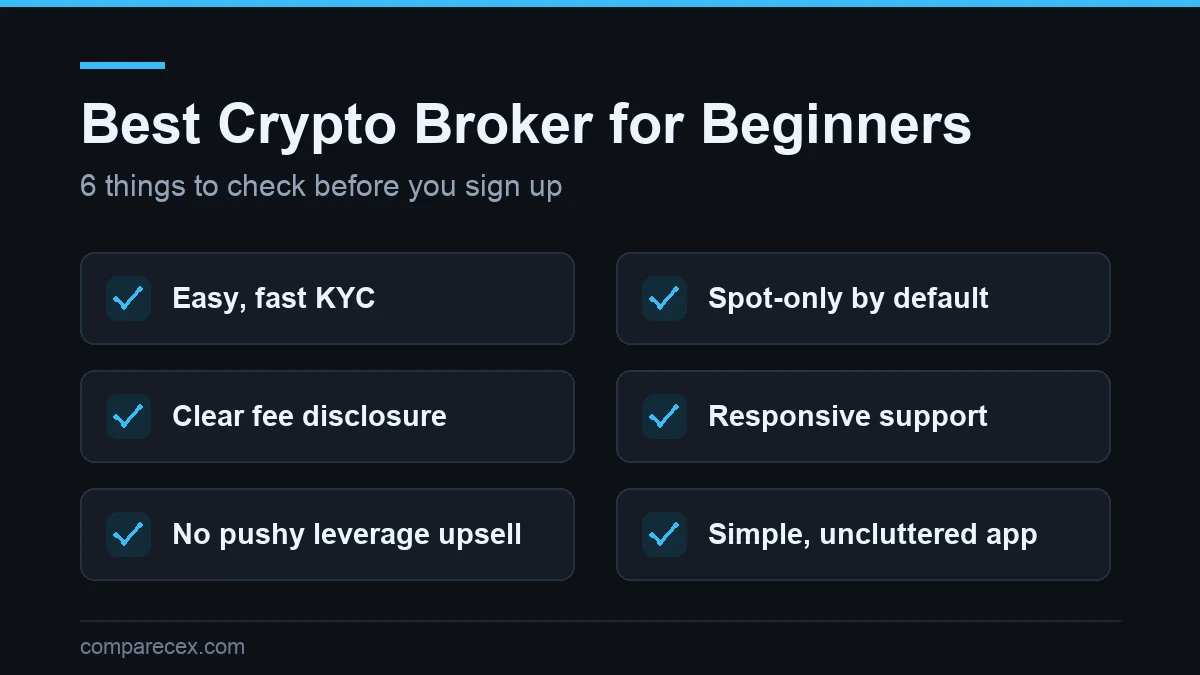
There is no single crypto broker that is "best" for every beginner, because the things that decide a good first account — which country you live in, how you want to deposit, and whether the platform quietly pushes you toward products you don't understand — are personal, not universal. The useful question is not "which broker won this year," it is "which broker lets a first-timer make a small mistake without it becoming an expensive one." This guide gives you the beginner-specific criteria to check, a first-30-days checklist, and the three habits that matter more than the logo on your app.
DISCLOSURE: CompareCEX may earn a commission when you sign up through our links. This does not influence our editorial scores. RISK: Crypto assets are volatile and unregulated in many jurisdictions. Not financial advice.
Why Isn't There One "Best" Crypto Broker for Beginners?
Most "best broker" lists optimise for the wrong thing. They rank on trading fees, which is a sensible metric for someone placing hundreds of orders a month and close to irrelevant for someone placing their first five. A beginner's real exposure sits somewhere else entirely: account-security hygiene, understanding what they actually bought, and not being nudged into leveraged products in the first week because a banner offered it.
There's also a timing problem with static rankings. Fee schedules, country availability, and supported deposit methods change without notice, so an article that freezes a table of exchange-specific figures is wrong within months and the reader has no way of knowing. CompareCEX handles this by scoring platforms against a fixed rubric and publishing the sourced, dated numbers on a live scorecard instead — you can see current rankings on the best exchanges page, and the scoring rules on our methodology. This article deliberately stays on the part that doesn't go stale: how to judge a platform yourself.
What Should a Beginner Actually Check Before Signing Up?
These are the criteria that separate a forgiving first account from a punishing one. Note the third column — every item is something you can verify before you deposit anything.
| Criterion | Why It Matters for a First Account | How to Verify It Yourself |
|---|---|---|
| Country availability and licensing | A platform that isn't licensed where you live can restrict withdrawals or close registrations later | Check your own regulator's public register, not the platform's marketing page |
| KYC process and timing | Identity verification failing after you deposit is the most common beginner stall | Complete verification fully before sending any money |
| What the account does by default | A spot-only default is a safer starting point than an account with margin enabled from day one | Read the signup flow: does it offer leverage, futures, or "boosted" products before you've placed one trade? |
| Fee disclosure clarity | Beginners are usually charged more via spread and card-purchase markups than via the headline trading fee | Compare the instant-buy price against the order-book price for the same asset, and model it in our fee calculator |
| Security controls you can turn on | Most first-year losses among beginners are account-access failures, not bad trades | Look for app-based or hardware two-factor, a withdrawal address allowlist, and a per-device login log |
| Support responsiveness | You will need support during a withdrawal delay, which is the worst time to discover it's slow | Open a real ticket with a real question before you fund the account |
| Withdrawal path back out | An account you can't exit easily isn't a beginner account | Withdraw a small amount early, on purpose, and time how long it takes |
| Practice or demo mode | Being able to rehearse an order type without money is genuinely useful — but don't assume it exists | Check the platform's own product pages; treat it as a "check for," not a given |
What Should Your First 30 Days Look Like?
A beginner's checklist isn't a platform-versus-platform technical comparison. It's a sequence designed so that any mistake you make happens while the stakes are small.
- Shortlist on availability and licensing first. Anything you can't legally and fully use where you live is out, regardless of how good its fees look. Find My Exchange narrows by country and experience level.
- Finish verification before you deposit. Complete KYC, then stop. If it stalls, you've lost time instead of money.
- Harden the account before funding it. Turn on app-based or hardware two-factor authentication, set a withdrawal address allowlist, use a password unique to this account, and check which email address is attached to recovery.
- Deposit a deliberately small first amount — small enough that losing all of it changes nothing about your month. This is a test of the platform, not an investment.
- Do a full round trip on purpose. Buy something, sell it, and withdraw part of the proceeds back to your bank or wallet. You are testing timing, friction, and total cost end to end, not the trade.
- Compare what it actually cost against the advertised fee. Run the same trade through the fee calculator; the gap between what you expected and what you paid is usually spread, not the listed fee.
- Ignore every product you don't yet need. Margin, futures, "earn" products, and leverage upsells are noise at this stage. If you later decide derivatives are for you, read them up properly first — our guide on choosing a futures platform covers what changes.
- Cross-check your shortlist against verified scores on /best/ before committing more money, since that page publishes only exchange-level data we can source and date.
Ready to try top-pick?
Please check local regulations before signing up.
Where Can You See Verified Numbers for Specific Exchanges?
You'll notice this guide names no exchange alongside a fee figure. That's editorial policy: every exchange-specific number we publish has to be sourced and dated, and a static article is the wrong container for figures that change on the provider's schedule rather than ours. Our affiliate disclosure explains how commission relationships stay separate from scoring. For sourced comparisons of named platforms, use the best-of scorecard with the methodology page, which shows how each score is built and when it was last refreshed.
What Habits Matter More Than Which Broker You Pick?
The platform decision is the smallest decision you will make this year. Three habits do more work than any comparison table.
Give yourself the supervisor a beginner account doesn't come with. There is a useful idea buried in how funded-trading challenges are structured: their real product isn't capital, it's an outside party enforcing limits at both ends — you're removed after a set drawdown, and you're also stopped after hitting a set monthly gain, so greed has a ceiling and not just fear . A brand-new broker account is the opposite of that. Nothing stops you topping up after a bad week, and nothing stops you giving back a good month in its last three days. You can copy the mechanism for free: decide, in writing, before you fund the account, on a loss level that ends your month and a gain level that also ends your month. The same source has a smaller test worth stealing — if you promised yourself the smaller starting deposit and then quietly signed up for the larger one, you've already learned something about your own discipline at a stage where it costs nothing to learn it.
Own the decision instead of inheriting it. A recurring rule in the same knowledge base is that responsibility can't be delegated: someone else's recommendation is calibrated to their capital, their position sizing, their target, their timeframe and their entry — none of which are yours . Beginners usually meet this rule twice. First when picking a broker from an influencer's referral link, and again a few weeks later when copying a trade from the same person. The same material also sets out the order in which to look for your own mistakes — knowledge, then mindset, then tactics, then psychology — which is worth internalising early, because the instinct to blame the platform or the tool comes long before the instinct to check the first three.
Keep a market journal, not just a trade journal. The distinction is the point: a trade journal only has entries on days you traded, while a written record of what the market was doing has an entry every day, including the days you did nothing — and the days you did nothing are where the pattern recognition actually comes from . That source also asks you to hand-write three questions before any entry: why this move, what do I think the odds are, and might there be a better setup after this one. Writing it down is what makes the difference, because thinking it through "in your head" lets emotion quietly edit the reasoning after the fact. For a first-time trader, this costs a few minutes a day and is the single cheapest thing on this page.
What Are the Common Mistakes When Choosing a First Broker?
- Picking on trading fee alone. At beginner order sizes the spread on an instant-buy button and the card-purchase markup usually dwarf the maker/taker rate.
- Depositing before finishing verification, then discovering the account can't be fully used from your country.
- Enabling margin or futures "just to look at it" in week one, on the account holding all your funds.
- Using SMS-based two-factor because it was the default offered, instead of an app or hardware key.
- Never testing a withdrawal until the day you urgently need one.
- Chasing a signup bonus and inheriting a platform that fails two of the criteria in the table above.
Frequently Asked Questions
Is a "crypto broker" the same thing as a crypto exchange?
Not exactly, and the difference matters for beginners. A broker-style product usually sells you the asset at a quoted price, while an exchange matches your order against other users on an order book. Many consumer platforms offer both in the same app — a simple "buy" screen and an advanced trading screen — and the simple screen is frequently the more expensive of the two for the identical trade.
Do I need a regulated platform as a beginner?
Regulation in your own jurisdiction gives you defined complaint and recourse channels, which is worth more to a beginner than to an experienced trader. It does not remove market risk. The U.K.'s FCA maintains a consumer warning page on cryptoasset risk, and the U.S. CFTC publishes customer advisories on digital asset trading — both are worth reading before you choose.
How much should a beginner start with?
We won't give a figure, because the only sensible answer depends on your own finances. The usable rule is structural rather than numerical: start with an amount whose total loss would not change any decision you make this month, and treat the first deposit as a test of the platform rather than a position.
Should a beginner use leverage or futures on their first account?
Leveraged products introduce liquidation risk that spot buying does not have, and they're a materially different skill set. If you want to understand what changes before going near them, Investopedia's futures contract explainer is a plain-language starting point, and our futures platform guide covers what to check on the platform side.
This guide is for education only and is not financial, legal, or tax advice. Always verify current exchange terms directly on the provider's own site before funding an account.
Related guides
- OKX Fees Explained: Spot Maker, Taker and What You Actually PayOKX charges 0.08% maker and 0.10% taker on regular spot trades, checked against Binance and Bybit with $1,000 and $5,000 examples.
- MEXC Fees Explained: Is Spot Trading Really Zero-Fee?MEXC charges 0% maker and 0.05% taker on spot trading per its own fee page, compared with Binance and Bybit's flat 0.10%/0.10% rates, with $1,000 and $5,000 worked examples.
- KuCoin Fees Explained: Trading, Withdrawal, and the KCS DiscountKuCoin's regular spot fee is 0.10% maker and taker, matching Binance's regular tier, checked with $1,000 and $5,000 round-trip examples.