OKX Fees Explained: Spot Maker, Taker and What You Actually Pay
OKX charges 0.08% maker and 0.10% taker on regular spot trades, checked against Binance and Bybit with $1,000 and $5,000 examples.
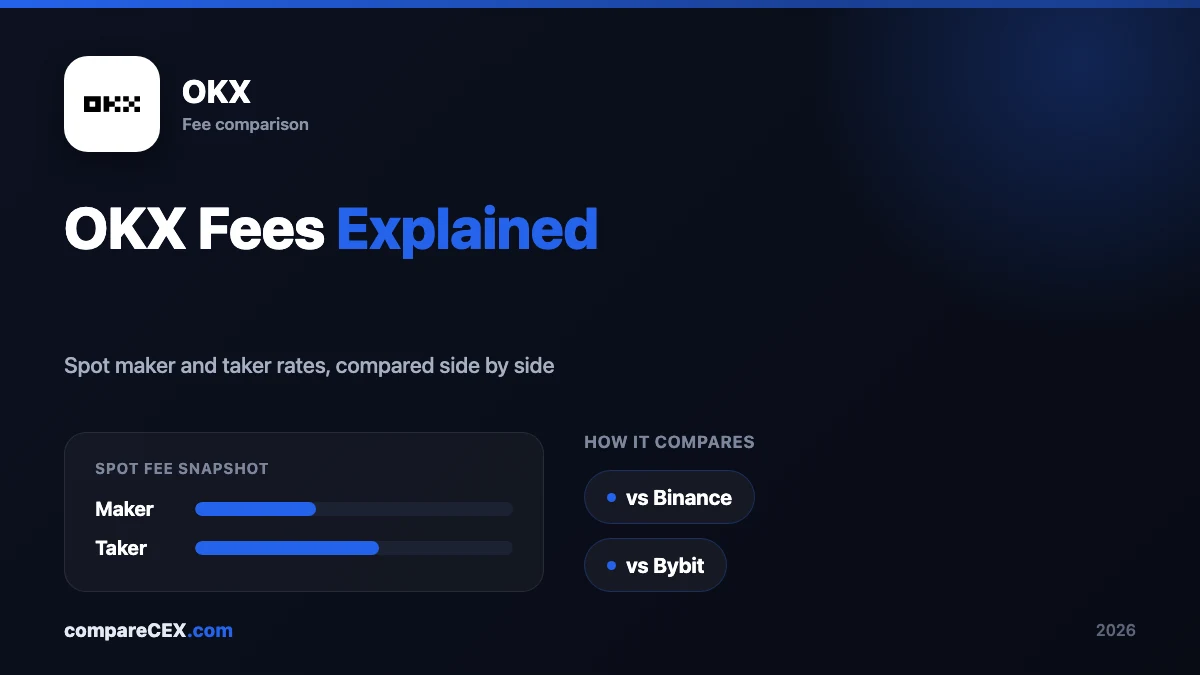
OKX's regular spot trading fee is 0.08% for maker orders and 0.10% for taker orders, with the maker rate coming in lower than Binance's and Bybit's regular 0.10%/0.10% schedule††††. This article breaks down what those rates mean in dollars on a $1,000 and a $5,000 trade, compares OKX against Binance and Bybit side by side, and flags the one thing about US access we could not confirm from our data.
DISCLOSURE: CompareCEX may earn a commission when you sign up through our links. This does not influence our editorial scores.
RISK: Crypto assets are volatile and unregulated in many jurisdictions. Not financial advice.
What Are OKX's Regular Trading Fees?
OKX's entry-level tier, sometimes labeled VIP0, already splits maker and taker rates rather than charging one flat number for both.
| Item | Rate | Source |
|---|---|---|
| Maker fee (regular, spot) | 0.08%† | OKX official fee update notice |
| Taker fee (regular, spot) | 0.10%† | OKX official fee update notice |
| Binance maker/taker (regular) | 0.10% / 0.10%†† | Binance official fee schedule |
| Bybit maker/taker (regular) | 0.10% / 0.10%†† | Bybit official fee schedule |
| KYC | Required† | OKX KYC requirements guide |
| Withdrawal fees | Not verified in our data | Varies by network and asset; check OKX's current fee page before withdrawing |
The gap between OKX and its two closest rivals sits entirely on the maker side: OKX's 0.08% maker rate is 20% cheaper than Binance's or Bybit's 0.10% maker rate, while all three exchanges charge the same 0.10% on taker orders††††††. That means the exchange you pick barely matters if you only place market orders, but it starts to matter if your strategy leans on limit orders that sit in the book and get filled as maker.
How Much Does a Small Trade Cost You?
Here is a round-trip calculation with the assumptions stated up front: a $1,000 position, both the entry and the exit filled as market (taker) orders, at each exchange's regular, non-discounted rate†.
- OKX, taker round trip: 0.10% taker × 2 sides = 0.20% of $1,000 = $2.00†
- Binance, taker round trip: 0.10% taker × 2 sides = 0.20% of $1,000 = $2.00†
- Bybit, taker round trip: 0.10% taker × 2 sides = 0.20% of $1,000 = $2.00†
At this size, if you trade market orders on both legs, the three exchanges cost the exact same $2.00, because all three charge 0.10% taker†††. The fee schedule only splits apart once you look at maker orders, which the next example covers.
How Does the Cost Compare on a Larger, Maker-Order Trade?
Same method, scaled up and switched to limit (maker) orders on both legs: a $5,000 position, full round trip, both entry and exit filled as maker†.
- OKX, maker round trip: 0.08% maker × 2 sides = 0.16% of $5,000 = $8.00†
- Binance, maker round trip: 0.10% maker × 2 sides = 0.20% of $5,000 = $10.00†
- Bybit, maker round trip: 0.10% maker × 2 sides = 0.20% of $5,000 = $10.00†
On a $5,000 position filled entirely with limit orders, OKX's regular maker rate saves you $2.00 against both Binance and Bybit, purely because 0.08% is 20% lower than 0.10%†††. Our knowledge base's core risk rule caps a single trade's stop-loss at 1% of the account, so on a $5,000 position sized against a $5,000 account, the maximum you'd risk on a bad trade is $50 . An $8 or $10 round-trip fee is a small slice of that $50 budget either way, but the difference compounds if you place limit orders often — it is a rate gap on every trade, not a one-time saving. Run your own position size and order type through our fee calculator instead of assuming which exchange wins.
Ready to try OKX?
CompareCEX may earn a commission when you sign up through our links. This does not influence our editorial scores.
Does the Maker Fee Difference Actually Matter for Most Traders?
It depends on how you place orders. If you mostly buy and sell with market orders — tapping "buy now" instead of setting a limit price — you pay the taker rate, and OKX, Binance, and Bybit all charge the identical 0.10%†††. The exchange choice on fees alone is a wash for that trading style.
If your strategy uses limit orders that wait in the order book — a common approach for traders who want a specific entry price rather than the current market price — OKX's 0.08% maker rate is consistently cheaper than the 0.10% maker rate at Binance and Bybit†††. Our maker vs taker fees guide explains the mechanical difference between the two order types if you're not sure which one your trades actually use.
Is OKX Available to Traders in the United States?
We could not verify this from our data. OKX's Cayman Islands headquarters† and KYC requirement† are documented in our knowledge graph, but we found no verified knowledge-graph fact confirming or denying US resident access at the account-opening level. When we checked OKX's own terms and country-restrictions pages directly on 2026-09-13, we did not find a single, current statement we could cite with confidence, so we are not stating one here. If you are in the US, check OKX's current terms of service and available-countries list directly on okx.com before signing up, rather than assuming it is or isn't open to you.
What Mistakes Do Traders Make About OKX's Fees?
- Assuming maker and taker are the same rate. OKX splits them: 0.08% maker versus 0.10% taker, unlike a flat single-rate schedule††.
- Comparing OKX's maker rate to a competitor's taker rate. That comparison always favors OKX unfairly; compare maker-to-maker and taker-to-taker, as the tables above do.
- Assuming the maker discount applies to market orders. It doesn't — placing a market order fills immediately and always pays the taker rate, regardless of exchange†.
- Ignoring withdrawal costs. These sit outside the maker/taker schedule and are not verified in our data — check OKX's current withdrawal page before moving funds.
- Assuming US availability without checking. We could not verify this fact from official sources as of 2026-09-13; confirm directly with OKX rather than assuming either way.
How Do You Lower Your OKX Fee Bill?
- Use limit orders where your strategy allows it to capture OKX's lower 0.08% maker rate instead of the 0.10% taker rate††.
- Compare your real trade size and order type against Binance and Bybit using our fee calculator — the gap only shows up on maker orders, as demonstrated above.
- Read our OKX review for the fuller picture beyond fees, including security and supported features.
- Read the methodology behind how we verify exchange fee data, and cross-check OKX's current schedule directly, since fee updates happen without much notice.
Our OKX vs Binance comparison and OKX vs Bybit comparison go beyond fees into supported coins, regulation, and account features. You can also see how OKX stacks up in our best low-fee exchanges list or start directly at OKX's exchange profile, with Binance's profile alongside it for reference.
Common Mistakes
- Quoting a single "OKX fee" number without saying whether it's maker or taker — the two rates differ††.
- Comparing this article's regular-tier rates to a VIP-tier number quoted elsewhere; VIP tiers need trading volume most retail accounts don't reach and are not covered here.
- Forgetting that a "round trip" (buy plus sell) charges the fee twice, not once — the worked examples above always use two-sided math.
- Treating an unverified fact, like US availability, as confirmed just because it seems likely; check the official source instead.
FAQ
Is OKX cheaper than Binance?
On maker orders, yes — OKX's 0.08% beats Binance's 0.10%††. On taker orders, both charge the identical 0.10%, so there's no difference for market-order trading††.
Does OKX charge the same fee as Bybit?
On taker orders, yes, both charge 0.10%††. On maker orders, OKX's 0.08% is lower than Bybit's 0.10%††.
Does OKX charge withdrawal fees?
We do not have verified data on withdrawal fees for specific assets and networks, so we will not state a number here. Check OKX's current withdrawal fee schedule directly before moving funds off the exchange.
RISK: Crypto assets are volatile and unregulated in many jurisdictions. Not financial advice.
Last updated: 2026-09-13
Related guides
- Bybit Fees Explained: What You Actually Pay Per TradeBybit's regular spot fee is 0.10% maker and taker, tying Binance and beaten only by OKX's 0.08% maker rate, verified with $1,000 and $5,000 examples.
- Best Crypto Exchange Australia: 3 AUSTRAC-Registered PicksThe three exchanges we verified as AUSTRAC-registered, compared on spot fees, product menu and the structural limits that hold undisciplined traders back.
- Best Crypto Exchange Canada: 2 CSA Restricted Dealers ComparedThe only two exchanges verified as registered Restricted Dealers in Canada, compared on spot fees, product limits, and the margin-trading ban.