Head-to-head
Coinbase vs Kraken


Which is better for beginners?
Coinbase scores higher for beginners (72.4 vs 66.1 out of 100).
Side-by-side
| Criteria | Coinbase | Kraken |
|---|---|---|
| Type | cex | cex |
| Maker fee | 0.00%–0.40% (tiered by 30-day trading volume) | 0.40% |
| Taker fee | 0.05%–0.60% (tiered by 30-day trading volume) | 0.80% |
| KYC | Required | Required |
Please check local regulations before signing up.
CompareCEX may earn a commission when you sign up through our links. This does not influence our editorial scores.
Kraken vs Coinbase: Which Exchange Wins in 2026?
Kraken vs Coinbase compared on maker/taker fees, KYC, product menus, and country access, with verified data and real $1,000 and $10,000 trade examples.
Last verified: See our sources
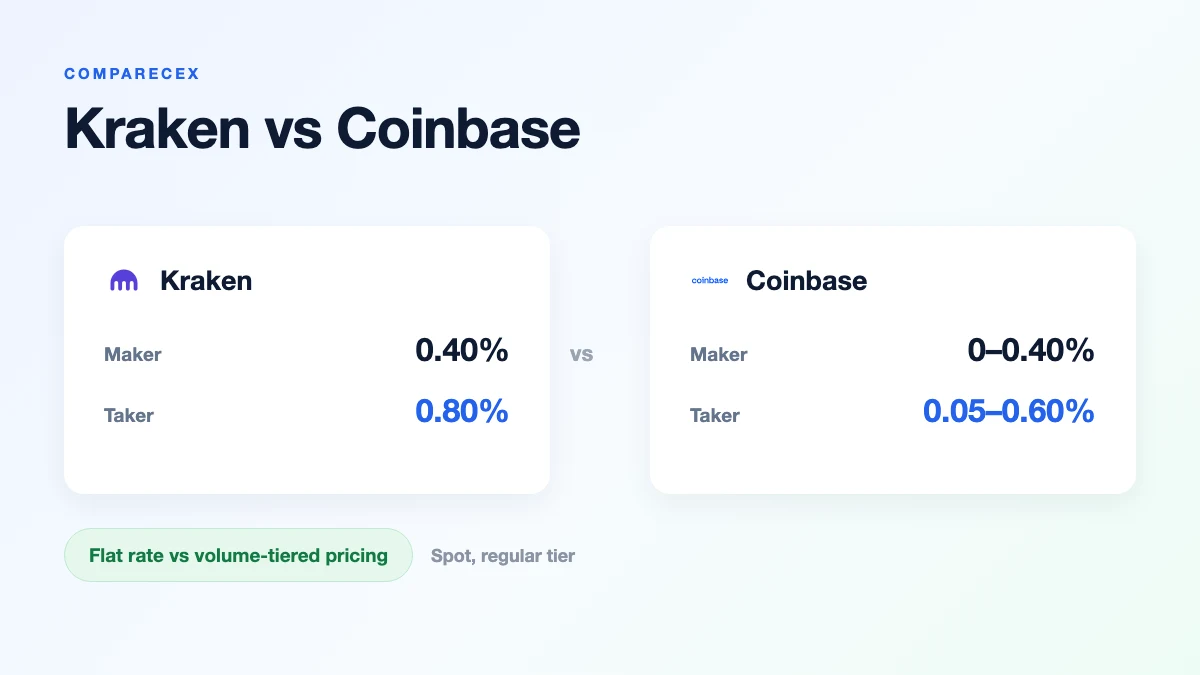
Kraken's regular Tier 1 fee (under $2,500 in 30-day volume) is a flat 0.40% maker and 0.80% taker††. Coinbase's fee is not flat — it is tiered from 0% to 0.40% maker and 0.05% to 0.60% taker depending on your rolling 30-day volume††. In short: a low-volume trader on Coinbase can pay less than Kraken's flat rate at the cheap end of that range, or slightly more at the expensive end, while Kraken's cost is the same for every trader who hasn't cleared $2,500 in monthly volume. This article breaks down both fee schedules with dollar examples, compares what you can actually trade on each platform, and covers KYC and country access using only sourced data.
DISCLOSURE: CompareCEX may earn a commission when you sign up through our links. This does not influence our editorial scores.
RISK: Crypto assets are volatile and unregulated in many jurisdictions. Not financial advice.
Kraken vs Coinbase: Which Exchange Is Right for You?
Both exchanges are long-running, US-based platforms that require identity verification, but they are not interchangeable. Kraken was founded in 2011 and is based in San Francisco under Payward, Inc., operating with FINRA self-regulatory status and an SIPC-linked broker-dealer entity†††. Coinbase was founded a year later in 2012, is also based in San Francisco, and holds SEC broker-dealer and FINRA self-regulatory registrations†††. Kraken's confirmed feature set includes spot, futures, and margin trading in addition to staking and a card product†; Coinbase's confirmed feature set covers spot trading, staking, and an "Earn" program, but our data does not show futures or margin as available on Coinbase†.
Before you lean on any single article to decide, remember that a comparison reflects the reviewer's own capital, goals, and risk tolerance — not automatically yours . Use the numbers below as a starting filter, then confirm current terms directly on each exchange.
How Do Kraken and Coinbase Fees Compare?
| Criterion | Kraken | Coinbase |
|---|---|---|
| Founded | 2011† | 2012† |
| HQ / entity | San Francisco, Payward Inc.† | San Francisco, California† |
| Regulation | FINRA self-regulatory status; SIPC broker-dealer† | SEC broker-dealer; FINRA self-regulatory† |
| Regular maker fee | 0.40% flat (Tier 1, <$2.5K/30d)† | 0% to 0.40%, tiered by 30-day volume† |
| Regular taker fee | 0.80% flat (Tier 1, <$2.5K/30d)† | 0.05% to 0.60%, tiered by 30-day volume† |
| KYC | Required: government ID + proof of address† | Required† |
| Coins listed | ~600 (approx.)† | Not verified in our data |
| Core products | Spot, futures, margin, staking, card† | Spot, staking, Earn, advanced trading; no futures or margin confirmed† |
| Proof of reserves | Yes, independent accounting-firm audits; clients can verify their own balance† | Only for wrapped tokens such as cbBTC; no exchange-wide customer-balance proof† |
| Support | Help center + ticket, 24/7† | Email, ticket, help center, 24/7† |
| Mobile app | iOS and Android† | iOS and Android† |
Example — a $1,000 order: On Kraken's flat Tier 1 rate, a $1,000 maker order costs 0.40% = $4.00, and a $1,000 taker order costs 0.80% = $8.00††. On Coinbase, the same $1,000 maker order costs between $0 (0% at the cheap end) and $4.00 (0.40% at the expensive end); the taker order costs between $0.50 (0.05%) and $6.00 (0.60%)††. A low-volume Coinbase account sitting at the pricey end of its range pays roughly the same maker fee as Kraken, but still less on the taker side.
Run your own order size through our fee calculator instead of estimating, since both schedules depend on your specific 30-day volume.
What Does a Round-Trip Trade Actually Cost on Each Exchange?
Here is a round trip — one entry and one exit, both filled as market (taker) orders — on a $10,000 position, with a $10,000 account and a 1% risk-per-trade rule (meaning the most you're willing to lose on a bad trade is $100), priced at each exchange's regular, non-discounted tier††:
- Kraken, flat Tier 1 rate: 0.80% taker × 2 sides = 1.6% of $10,000 = $160†
- Coinbase, high end of its tier (typical for a low-volume account): 0.60% taker × 2 sides = 1.2% of $10,000 = $120†
- Coinbase, low end of its tier (requires high 30-day volume): 0.05% taker × 2 sides = 0.1% of $10,000 = $10†
At either exchange's regular tier, the round-trip cost already exceeds the entire $100 you allowed yourself to lose on the trade — Kraken's $160 is 60% over that budget, and Coinbase's high-tier $120 is 20% over it††. Our knowledge base's core trading principle is blunt about this: a stop-loss should never exceed 1% of the account, and a trade that's already down more than that in fees alone, before the market can move against you, is a trade you likely shouldn't be sizing the same way you would on a cheaper venue .
Ready to try Kraken?
CompareCEX may earn a commission when you sign up through our links. This does not influence our editorial scores.
Ready to try Coinbase?
Please check local regulations before signing up.
What Can You Actually Trade on Kraken vs Coinbase?
Based on confirmed feature data, Kraken's product menu is broader: spot, futures, margin, staking, and a card product†. Coinbase's confirmed menu covers spot trading, staking, an "Earn" rewards program, and an advanced trading interface, but our data does not show futures or margin as available on the platform†. If your plan includes trading futures or using margin in the same account where you hold spot positions, Kraken's data supports that; Coinbase's does not, based on what we've verified.
On security, the two differ in proof-of-reserves scope: Kraken publishes audits by an independent accounting firm that clients can check against their own balance, while Coinbase publishes proof of reserves only for its wrapped tokens such as cbBTC, not an exchange-wide proof of customer balances††. Neither confirmed fact tells you about insurance funds or historical incident response — check each exchange's security page directly for that.
How Strict Is KYC on Kraken vs Coinbase?
Both platforms require identity verification before you can trade — neither offers an anonymous or KYC-free path††. Kraken's documented verification requires a government-issued ID and proof of address†. Coinbase's data confirms KYC is required but does not specify the exact document list in our source†. In practice, expect the same basic steps at both: submit a photo ID, and be ready to provide a proof-of-address document if asked, before you can deposit or trade at full limits.
Is Kraken or Coinbase Available in Your Country?
Country access is not something to guess at, so here is only what each exchange's own compliance pages confirm (checked 2026-09-06):
| Country | Kraken | Coinbase |
|---|---|---|
| United Kingdom | Registered FCA Cryptoasset Firm plus an EMI license; retail accounts do not get derivatives or DeFi Earn | Registered as a VASP with the FCA; CB Payments Ltd holds a separate EMI license (MLR reference 900635) |
| Australia | Registered AUSTRAC Digital Currency Exchange | Registered with AUSTRAC as both a VASP and a remittance provider |
| Canada | Registered Restricted Dealer; no margin or derivatives offered to Canadian accounts | Registered Restricted Dealer under Canadian securities regulators |
| United States | Available in every state except Maine and New York | We could not verify current US state-level access from Coinbase's own site; the relevant page returned an access error when checked |
These come from Kraken's availability-by-country page and Coinbase's own registration announcements for the UK, Canada, and Australia. Rules change, so confirm your own country's status on the exchange's site before signing up — a licensing page from a few months ago can already be out of date.
What Mistakes Do People Make Comparing Kraken and Coinbase?
- Assuming Kraken's headline fee is the only rate available. The 0.40%/0.80% figures above are the regular Tier 1 rate; higher 30-day volume moves you to a cheaper tier, which this article does not cover in full††.
- Reading Coinbase's tiered range as one fixed number. A "0.05% fee" quoted in marketing material is the cheap end of the range that most retail accounts never reach — the realistic number for a low-volume account is closer to the top of the 0.05%–0.60% taker range†.
- Comparing only the maker or only the taker side. A round trip touches both, and the gap between the two legs is larger on Kraken (0.40% vs 0.80%) than it needs to be if you default to market orders††.
- Assuming both exchanges offer the same products. Kraken's confirmed data includes futures and margin; Coinbase's does not††. Don't discover this after you've already funded an account for a strategy the platform doesn't support.
- Treating a review as a personal recommendation. Advice — including this article — is filtered through someone else's capital and goals, not yours automatically .
Verdict by User Type
- Cost-focused traders using market orders on small accounts: Coinbase's tiered schedule can beat Kraken's flat 0.80% taker fee at the cheap end of its range, but matches or slightly beats it even at the expensive end (0.60% vs 0.80%)††.
- Traders who want futures or margin in the same account as spot: Kraken's confirmed feature set supports this; Coinbase's does not, based on our data††.
- Users who want a platform with a stated proof-of-reserves program: Kraken publishes one covering client balances and lets clients verify their own balance against its audit; Coinbase's covers only wrapped tokens such as cbBTC††.
- UK, Australian, or Canadian users: Both exchanges hold confirmed local registrations in all three markets — check the specific license type in the table above, since retail restrictions (like Kraken's UK derivatives limit) differ by country.
Read the full reviews before deciding: Kraken review and Coinbase review. See how we score exchanges in our methodology, and how affiliate links work on this site in our affiliate disclosure.
Related guides
- Coinbase fees explained — the full fee breakdown for Coinbase alone, including withdrawal and spread caveats this article doesn't cover.
- Maker vs taker fees explained — why Kraken and Coinbase publish two different rates for the same trade.
- Binance vs Kraken — see how Kraken's regular tier stacks up against a third, lower-fee exchange.
FAQ
Is Kraken cheaper than Coinbase?
It depends on your Coinbase tier. Kraken's flat Tier 1 rate is 0.40% maker / 0.80% taker††. Coinbase ranges from 0% to 0.40% maker and 0.05% to 0.60% taker depending on your 30-day volume††. A low-volume Coinbase account sitting at the expensive end of its range still pays less on taker orders than Kraken's flat rate, and about the same on maker orders.
Does Kraken or Coinbase have more coins listed?
Kraken's own figure is roughly 600 coins†. We do not have a verified coin count for Coinbase in our data, so we won't estimate one — check each exchange's current asset list directly.
Can I trade futures on Coinbase the way I can on Kraken?
Based on confirmed feature data, Kraken supports futures and margin trading†. Our data does not show futures or margin as available on Coinbase†. Confirm current product availability on Coinbase directly before assuming it matches Kraken's offering.
Do both exchanges require KYC everywhere?
Both require identity verification to open an account††. Neither offers a way to trade at full limits without it. Country-level access still varies — see the availability table above before assuming either platform serves your location the same way it serves someone else's.
See our best exchanges list for more comparisons, and read our affiliate disclosure for how we're funded.
RISK: Crypto assets are volatile and unregulated in many jurisdictions. Not financial advice.
Last updated: 2026-09-07
Affiliate link — we may earn a commission. How we're funded
Visit Kraken