Head-to-head
Hyperliquid vs OKX
Availability in United States is unclear — Nguồn bên thứ ba (community guide).
Source · checked 2026-09-04

Which is better for beginners?
Hyperliquid scores higher for beginners (93.7 vs 82.6 out of 100).
Side-by-side
Availability in your region is unclear — check local regulations.
CompareCEX may earn a commission when you sign up through our links. This does not influence our editorial scores.
CompareCEX may earn a commission when you sign up through our links. This does not influence our editorial scores.
Hyperliquid vs OKX: Perp DEX vs CEX Compared (2026)
Hyperliquid vs OKX compared on custody, KYC, and fees — a self-custody perp DEX against a licensed CEX, with sourced data and real trade examples.
Last verified: See our sources
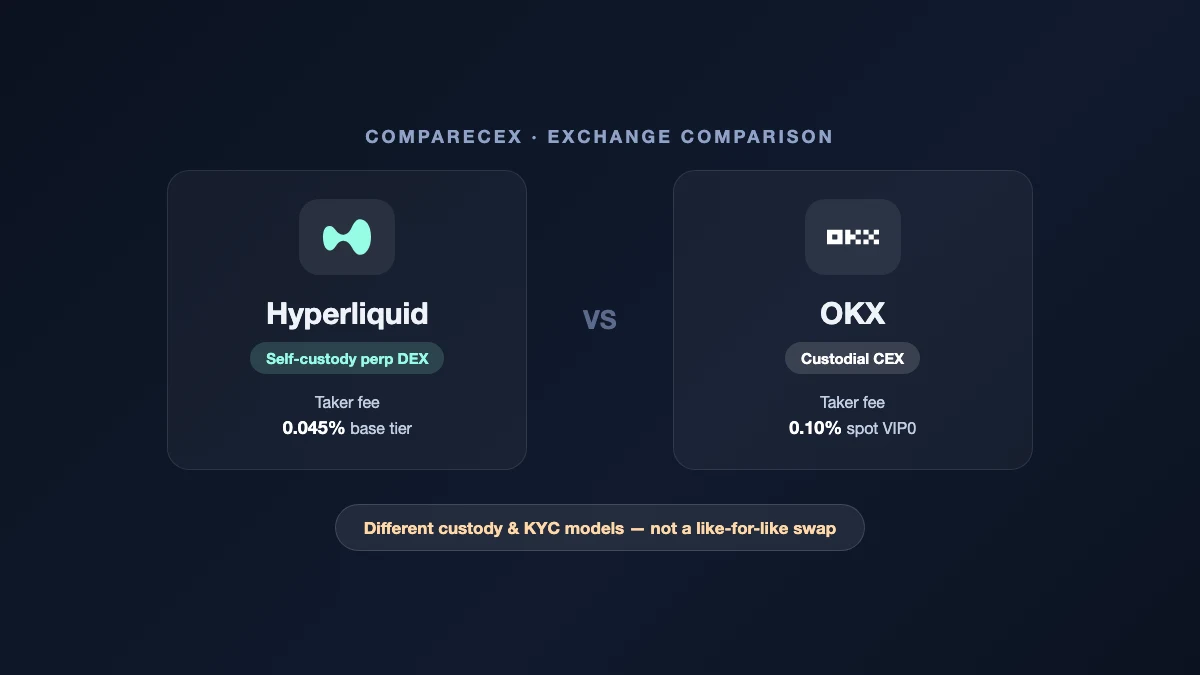
Hyperliquid and OKX are not the same kind of product. Hyperliquid is a self-custody perpetual futures DEX that does not require identity verification to trade, while OKX is a centralized exchange (CEX) that requires KYC and holds your funds in its own custody while you trade††††. If you want spot trading, margin, staking, or a broad product menu with a licensed US entity, OKX is built for that; if you want perpetual futures directly from your own wallet without submitting ID, Hyperliquid is built for that††. This article compares custody, KYC, fees, and country access using sourced data only.
DISCLOSURE: CompareCEX may earn a commission when you sign up through our links. This does not influence our editorial scores.
RISK: Crypto assets are volatile and unregulated in many jurisdictions. Not financial advice.
Hyperliquid vs OKX: Why Custody and KYC Matter More Than Fees Here
Hyperliquid was founded in 2023† and runs on its own EVM-compatible chain†. It is non-custodial: you connect a self-custody wallet and trade perpetual futures directly on-chain, and the protocol never takes custody of your funds the way a centralized exchange does†. Both an official Hyperliquid source and a third-party tracker in our data describe identity verification as not required††, though regulatory treatment of no-KYC perpetuals platforms is still evolving — treat this as the protocol's current design, not a permanent guarantee.
OKX, by contrast, was founded in 2017†, is based in the Cayman Islands†, and requires KYC before you can trade†. As a centralized exchange, OKX takes custody of the funds you deposit while you hold a position open — a materially different risk profile than holding your own private keys†.
Because Hyperliquid is self-custody and does not require KYC††, there is no compliance desk, no account freeze, and no cooling-off period between you and a leveraged position — the prop-firm insight is that discipline holds best when an outside rule enforces it, not willpower alone . Borrow that same mechanism yourself: set a fixed monthly drawdown stop (stop trading once you're down 5%) and a matching profit stop (stop once you're up 10%), and treat both as non-negotiable, the way a funded-account trader treats a rule someone else imposed .
How Do Hyperliquid and OKX Fees Compare?
| Criterion | Hyperliquid | OKX |
|---|---|---|
| Type | Perpetual futures DEX† | Centralized exchange† |
| Founded | 2023† | 2017† |
| HQ / entity | Not verified in our data (non-custodial protocol) | Cayman Islands† |
| Custody | Self-custody — you keep your wallet keys† | Custodial — OKX holds deposited funds† |
| KYC | Not required† | Required† |
| Maker fee, base tier | 0.015% perpetuals, tier 0† | 0.08% spot, VIP0† |
| Taker fee, base tier | 0.045% perpetuals, tier 0† | 0.10% spot, VIP0† |
| Core products | Perpetual futures, spot, limit orders† | Spot, futures, margin, staking, copy trading, P2P, earn† |
| Proof of reserves | Not applicable in the CEX sense — funds stay in your own wallet† | Yes† |
| Coins / markets | Not verified in our data | ~300 (approx.)† |
| Mobile app | Not verified in our data | iOS and Android† |
OKX's confirmed fee data in our Knowledge Graph is for spot trading; its perpetual futures tiers are not verified in our data, so we do not estimate them.
Example — a $1,000 order: On Hyperliquid's base tier, a $1,000 maker order on a perpetual position costs 0.015% = $0.15, and a $1,000 taker order costs 0.045% = $0.45††. On OKX's confirmed spot base tier, the same $1,000 maker order costs 0.08% = $0.80, and a taker order costs 0.10% = $1.00††. Hyperliquid's base maker rate is about one-fifth of OKX's spot maker rate and its taker rate is under half of OKX's spot taker rate — but this compares a perpetuals fee to a spot fee, not the same product††.
Run your own position size through our fee calculator instead of assuming these base-tier numbers hold at every volume level.
What Does a Round-Trip Perpetual Position Cost on Hyperliquid vs OKX's Spot Market?
Here is a round trip — one entry and one exit, both filled as taker orders — on a $10,000 position, priced at each platform's base, non-discounted tier††:
- Hyperliquid, base tier, perpetual position: 0.045% taker × 2 sides = 0.09% of $10,000 = $9 in trading fees†.
- OKX, base tier, spot market (only verified reference point): 0.10% taker × 2 sides = 0.2% of $10,000 = $20 in trading fees†.
This fee comparison ignores two things that matter more than the trading fee once leverage is involved on Hyperliquid: the funding rate paid or received periodically on an open perpetual position, and the liquidation price that leverage creates. Neither figure is fixed, and this article is not recommending any specific leverage level or position size — the point of the example above is fee math, not a trade recommendation.
Ready to try Hyperliquid?
Availability in your region is unclear — check local regulations.
CompareCEX may earn a commission when you sign up through our links. This does not influence our editorial scores.
Ready to try OKX?
CompareCEX may earn a commission when you sign up through our links. This does not influence our editorial scores.
What Can You Actually Trade on Hyperliquid vs OKX?
Hyperliquid's confirmed feature set covers perpetual futures, spot trading, and limit orders†. It runs its own EVM-compatible chain† and has an associated governance token, HYPE† — a token with its own price risk; this article does not recommend buying it. OKX's confirmed feature set is far broader: spot, futures, margin, staking, copy trading, P2P, and an earn program†. If you only trade perpetuals and want self-custody, Hyperliquid's narrower menu may be enough; if you want margin, staking, or an earn program in one account, our data shows only OKX supports that††.
OKX states that it publishes proof of reserves — a claim about a custodian proving it holds what it owes depositors†. Hyperliquid's self-custody model removes that question, since the protocol never holds your funds† — but it shifts private-key security fully onto you, with no support desk to call if you lose access.
Is Hyperliquid or OKX Available in Your Country?
Country access is where a perp DEX and a CEX diverge the most, so here is only what each platform's own compliance pages confirm.
OKX operates through a licensed US entity: OKX Inc. holds a FinCEN Money Services Business registration (NMLS #1767779) and money transmitter licenses across 48 US jurisdictions, but does not serve New York, Texas, American Samoa, Guam, the Northern Mariana Islands, or the US Virgin Islands, per OKX's own US licenses page (checked 2026-09-06). OKX's risk and compliance disclosure also lists Canada as a Restricted Location (checked 2026-09-06); we could not confirm its UK or Australia access from an official source.
Hyperliquid holds no licenses in that sense, since it is a non-custodial protocol, not a company taking custody of client funds — there is no official "restricted states" page in our research. A third-party community guide lists several countries, including the US, as restricted for Hyperliquid, but because that source isn't official, our data marks it unverified (grey status) rather than fact. If you're in a jurisdiction with active enforcement attention on offshore perpetuals platforms, confirm your own access directly instead of relying on any comparison article, including this one.
What Mistakes Do People Make Comparing a Perp DEX to a CEX?
- Comparing Hyperliquid's perpetuals fee straight against OKX's spot fee as if they were the same product. Hyperliquid's confirmed rate is for perpetual futures; OKX's confirmed rate is for spot††. OKX's own perpetual futures fee schedule is not verified in our data.
- Treating "no KYC" as risk-free. Not needing ID doesn't remove smart-contract risk, protocol risk, or the fact that a leveraged perpetuals platform has no regulator or ombudsman to complain to if something goes wrong†.
- Assuming OKX's proof-of-reserves claim and Hyperliquid's self-custody model solve the same problem. OKX's proof of reserves verifies a custodian holds what it owes you†; Hyperliquid's self-custody removes that question by never taking custody at all† — but it adds key-management responsibility that a CEX handles for you.
- Assuming Hyperliquid's country restrictions mirror OKX's. The two platforms have unrelated compliance models; OKX's confirmed US and Canada status is not a stand-in for Hyperliquid's own unverified, third-party country data.
- Sizing a Hyperliquid perpetual position the same way you'd size a spot buy on OKX. Leverage and funding rates change the real risk of a Hyperliquid position in ways a spot trade on OKX does not†.
Verdict by User Type
- Traders who want to keep custody of their own funds and trade perpetuals without KYC: Hyperliquid's confirmed model supports this††.
- Users who want spot trading, margin, staking, or an earn ecosystem with a published proof-of-reserves program: OKX's confirmed feature set and security data support this††.
- US-based users: OKX operates through a FinCEN-registered US entity in most states, excluding New York, Texas, and a few territories, per its own licensing page; Hyperliquid's US access is not confirmed from an official source in our research.
- Cost-focused traders comparing headline numbers: Hyperliquid's perpetuals rate is lower than OKX's spot rate, but that is not a same-product comparison††.
Read more before deciding: the OKX review covers its full feature set. Hyperliquid has no full review page on CompareCEX yet, so cross-check anything unverified here against Hyperliquid's own documentation. See our methodology and affiliate disclosure.
Related guides
- Maker vs taker fees explained — why Hyperliquid and OKX publish two different rates for makers and takers, and why that gap matters more once leverage is involved.
- The cheapest crypto exchange by fees — see how OKX's spot rate stacks up against seven other centralized exchanges.
- Coinbase vs OKX — compare OKX against a second custodial, KYC-required exchange instead of a self-custody DEX.
FAQ
Is Hyperliquid safer than OKX?
"Safer" depends on which risk you mean. Hyperliquid removes custodial risk because it never holds your funds — you trade from your own wallet†. OKX removes some of the operational risks of self-custody, like a lost private key, and publishes a proof-of-reserves program†, but you are trusting a company to hold your funds and process withdrawals correctly†. Neither model removes market risk or leverage risk.
Do I need to complete KYC to use Hyperliquid?
Not based on the data available: both an official Hyperliquid source and a third-party tracker in our data describe identity verification as not required††. OKX requires KYC before you can trade†. Regulatory treatment of no-KYC perpetuals platforms is still evolving, so confirm the current rules for your own country before assuming this stays the same.
Can I trade spot on Hyperliquid the way I can on OKX?
Hyperliquid's confirmed feature set includes spot trading alongside perpetual futures and limit orders†, but OKX's confirmed menu is broader — spot, futures, margin, staking, copy trading, P2P, and earn†. If you need margin or staking in the same account as spot, our data shows only OKX offers that.
Which exchange has lower fees, Hyperliquid or OKX?
On the numbers we can verify, Hyperliquid's base perpetuals rate (0.015% maker / 0.045% taker) is lower than OKX's base spot rate (0.08% maker / 0.10% taker)††††. That is a perpetuals-versus-spot comparison, not like for like.
See our best exchanges list for more comparisons, and read our affiliate disclosure for how we're funded.
RISK: Crypto assets are volatile and unregulated in many jurisdictions. Not financial advice.
Last updated: 2026-09-07
Affiliate link — we may earn a commission. How we're funded
Visit Hyperliquid