Head-to-head
Binance vs Bitget
Availability in United States is unclear — Từ terms footer, báo cáo ghi cần xác minh đầy đủ tại Binance Help Center.
Source · checked 2026-09-04

Which is better for beginners?
Binance scores higher for beginners (82.1 vs 76.2 out of 100).
Side-by-side
Availability in your region is unclear — check local regulations.
CompareCEX may earn a commission when you sign up through our links. This does not influence our editorial scores.
Not available in United States.
See a verified alternative →Binance vs Bitget: Which Exchange Is Better in 2026?
Binance vs Bitget compared on fees, features, KYC and support using verified data. See which exchange fits beginners, active traders or futures users.
Last verified: See our sources
DISCLOSURE: CompareCEX may earn a commission when you sign up through our links. This does not influence our editorial scores.
Binance vs Bitget: which is better?
For most beginners, Binance is the stronger all-round pick because it has more registered users, more listed coins, and a full P2P and card feature set†††. Bitget is a solid alternative if you want copy trading built in, since Binance's feature list in our Knowledge Graph does not list copy trading†. Both charge the same standard spot trading fee, so the real difference comes down to features, regulation, and what you personally plan to trade.
Binance vs Bitget fees: how much do you actually pay?
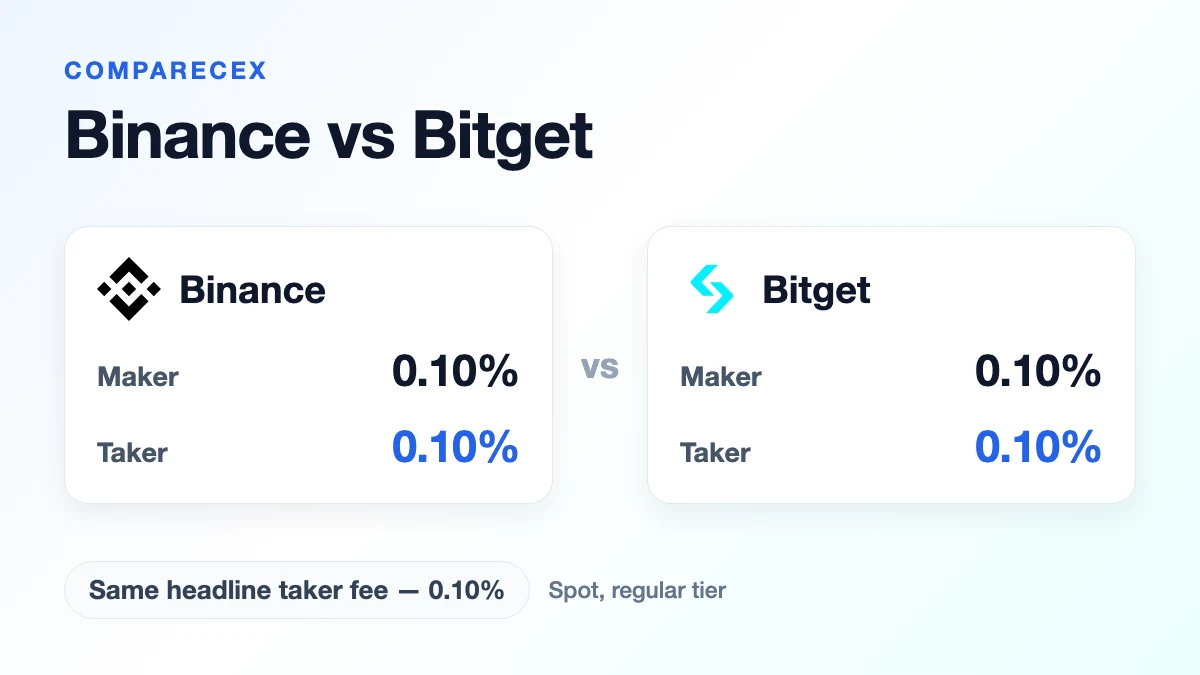
At the regular (VIP0) tier, both exchanges charge the same headline spot trading fee:
| Fee type | Binance | Bitget |
|---|---|---|
| Maker fee | 0.1%† | 0.1%† |
| Taker fee | 0.1%† | 0.1%† |
Example: If you place a $1,000 spot market order (a taker order) on either exchange at the regular tier, the fee is about $1 (0.1% of $1,000)††. If you place a $500 limit order that sits on the order book (a maker order), the fee is about $0.50 on either exchange††.
Fee tiers usually drop as your 30-day trading volume or holdings of the exchange's native token increase, but our Knowledge Graph only confirms the base VIP0/regular tier — higher-tier discounts are not verified here. Always check the live fee schedule before trading, and use our fee calculator to estimate your real cost across different order sizes.
Binance vs Bitget vs Bybit: how does a third option compare?
Readers often widen the search to "binance vs bitget vs bybit" once they realize most large exchanges post similar headline fees. We don't have Bybit's fee and feature data verified in our Knowledge Graph yet, so we can't compare it here with real numbers. If Bybit is on your shortlist, check our dedicated Binance vs Bybit comparison once it's published, or use Find My Exchange to filter by the features you actually need.
Binance or Bitget: which one fits your situation?
| User type | Better fit | Why |
|---|---|---|
| Complete beginner | Binance | Largest reported user base (~250 million registered users as of January 2025) and support in 40 languages, which usually means more guides and community help†† |
| Trader who wants copy trading | Bitget | Copy trading is a listed feature; it's not listed for Binance in our data† |
| Someone who wants to buy crypto with a card or use P2P | Binance | Card and P2P are listed features; Bitget's feature list does not include either†† |
| Trader who prioritizes a long track record | Binance | Founded 2017 vs Bitget founded 2018†† — a one-year difference, not a major gap |
| Someone focused on a licensed home base | Binance | Holds an FSRA (ADGM, Abu Dhabi) financial services license, per our data†. We do not have a verified regulatory license on file for Bitget |
Ready to try Binance?
Availability in your region is unclear — check local regulations.
CompareCEX may earn a commission when you sign up through our links. This does not influence our editorial scores.
Ready to try Bitget?
Not available in United States.
See a verified alternative →What do KYC, security, and support look like on each?
Both platforms require identity verification (KYC) before you can trade or withdraw at higher limits††. Both offer 24/7 support through a help center and live chat††. Binance also publishes proof-of-reserves data, according to our records† — we do not have a verified proof-of-reserves entry for Bitget. Bitget lists bank transfer, card, and crypto as payment methods†, and offers a dedicated iOS and Android app†.
Is "Binance vs Trust Wallet" the same kind of comparison?
No — this is a common but mismatched search. Binance is a centralized exchange (CEX) where a company holds your funds and matches your trades†. Trust Wallet is a self-custody wallet, where you (not a company) control the private keys. Comparing "Binance vs Bitget" is an apples-to-apples exchange comparison; "Binance vs Trust Wallet" is really a custodial-vs-self-custody question, which is a different decision about who holds your crypto, not which exchange has lower fees.
What does the "Binance vs Bitget Reddit" conversation actually tell you?
Reddit threads on this topic are opinion, not verified data — we don't treat forum posts as a source for exchange numbers on this site. If you search this, treat it as a way to find questions to verify yourself (e.g., "does X exchange support my country?"), not as a source for fees or security claims. Cross-check anything you read there against the exchange's official fee page or our exchange review pages before deciding.
Common mistakes when comparing Binance and Bitget
- Copying someone else's setup instead of checking your own situation. A trading rule that fits someone else's capital, risk tolerance, and country availability may not fit yours — treat comparisons as a starting point, not a final answer .
- Assuming "lower headline fee" means "cheaper for me." Both exchanges show the same 0.1%/0.1% base rate here†† — the real cost depends on order type, volume tier, and withdrawal fees, which is why a fee calculator matters more than a single number.
- Choosing an exchange first and building trading habits second. One overlooked idea from experienced traders: write down why you're making a decision before you act, rather than deciding in your head — the same logic applies to picking an exchange. A short written note on why you chose Binance or Bitget (fees, features, country support) makes it easier to review that decision later instead of second-guessing it emotionally .
- Starting with a large deposit before testing the platform. Testing a small amount first — and treating that small test as a discipline exercise rather than a shortcut to profit — is a habit worth borrowing from how disciplined traders size up any new environment before committing real capital .
- Ignoring KYC and regulation status. Both platforms require KYC††, and only Binance has a verified regulatory license in our data†. Skipping this check can matter more than a 0.01% fee difference.
How to choose between Binance and Bitget in 3 steps
- List what you actually need. Do you need P2P, a card, or copy trading? Check the feature table above against your use case.
- Estimate your real trading cost. Use the fee calculator with your typical order size and order type (maker vs taker) instead of assuming the base rate applies to everything.
- Confirm availability and requirements in your country. KYC is required on both††, so check what documents you'll need before you sign up. For a full side-by-side across more exchanges, try Find My Exchange or browse our best exchanges list.
Learn more
Read our full Binance review and Bitget review for the complete feature breakdown, check how we score exchanges in our methodology, and see how affiliate links work on this site in our affiliate disclosure.
Related guides
- Binance vs OKX — the other large exchange people weigh against Binance when copy trading and futures tools are the deciding factor.
- Binance vs MEXC — if the regular-tier spot fee, not the feature list, is what you are optimising for.
- maker vs taker fees explained — why the two rates in the fee table above apply to different order types.
FAQ
Is Binance safer than Bitget?
We can only compare what's verified: Binance reports proof-of-reserves and holds an FSRA (ADGM) license in our data††. We do not have a verified proof-of-reserves or license entry for Bitget, which doesn't mean it lacks one — it means we haven't confirmed it. Check each exchange's own security page directly.
Which has lower fees, Binance or Bitget?
At the regular tier, both charge the same 0.1% maker and 0.1% taker fee on spot trading††††. Fees can change with volume tiers or token discounts — verify the live schedule before trading.
Can I use both Binance and Bitget?
Yes, nothing in our data suggests they're exclusive. Many traders hold accounts on more than one exchange to compare execution or access different features like copy trading (Bitget) versus P2P and card payments (Binance)††.
Is Bitget good for beginners?
It can work for beginners who specifically want copy trading, since that's a listed feature†. It supports 15 languages compared to Binance's 40††, so language support may matter for some readers.
RISK: Crypto assets are volatile and unregulated in many jurisdictions. Not financial advice.
Educational content only. This article does not recommend buying, selling, or trading any asset. Data last checked: 2026-09-04.
Affiliate link — we may earn a commission. How we're funded
Visit Binance