Binance Fees Explained: What You Actually Pay Per Trade
Binance's regular spot fee is 0.10% maker and taker, cut to 0.075% with BNB, verified against Kraken and Coinbase with $500 and $5,000 examples.
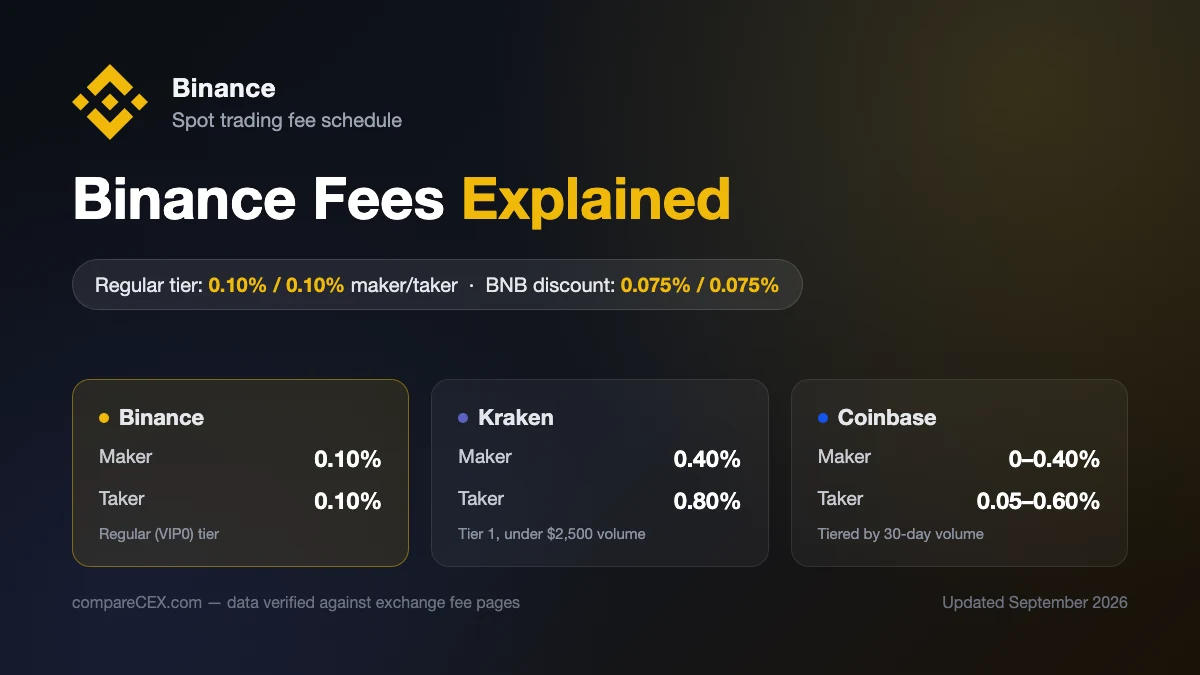
Binance's regular spot trading fee is a flat 0.10% for maker orders and 0.10% for taker orders, with no minimum 30-day volume required††. Paying fees in BNB cuts both rates by 25%, to 0.075% maker and 0.075% taker, per Binance's own fee page (binance.com/en/fee/trading, checked 2026-09-07). This article breaks down the regular and BNB-discounted rates, runs two dollar examples at $500 and $5,000, and compares Binance against Kraken and Coinbase so you can see the gap in actual money.
DISCLOSURE: CompareCEX may earn a commission when you sign up through our links. This does not influence our editorial scores.
RISK: Crypto assets are volatile and unregulated in many jurisdictions. Not financial advice.
What Are Binance's Regular Trading Fees?
Unlike exchanges that scale fees down as volume grows, Binance's entry-level "Regular User" tier already charges a flat rate that beats most competitors' cheapest tier.
| Item | Rate | Source |
|---|---|---|
| Maker fee (Regular) | 0.10%† | Binance official fee schedule |
| Taker fee (Regular) | 0.10%† | Binance official fee schedule |
| Maker/taker with BNB discount | 0.075% / 0.075% | binance.com/en/fee/trading, checked 2026-09-07 |
| VIP tier structure | VIP0 (regular) through VIP9 | binance.com/en/fee/trading, checked 2026-09-07 |
| VIP9 maker/taker | 0.011% / 0.023% | binance.com/en/fee/trading, checked 2026-09-07 |
| KYC | Required† | Binance support/help center |
| Withdrawal fees | Not verified in our data | Varies by network and asset; check Binance's current schedule before withdrawing |
The 0.10%/0.10% regular rate applies the moment you open an account; you do not need to hit a volume threshold to get it, which is the opposite of how Coinbase's tiered schedule works††. Binance publishes 10 tiers, Regular (VIP0) through VIP9, and VIP9 pays 0.011% maker and 0.023% taker, roughly a tenth of the regular rate (binance.com/en/fee/trading, checked 2026-09-07). Reaching VIP9 needs volume far beyond most retail accounts, so the number that matters for most readers is the regular 0.10%/0.10% rate, not the VIP9 figure sometimes quoted in marketing content.
How Much Does a Small Trade Actually Cost You?
Here is a round-trip calculation with the assumptions stated up front: a $500 position, both the entry and the exit filled as market (taker) orders, at Binance's regular, non-discounted rate†.
- Binance, regular rate: 0.10% taker × 2 sides = 0.20% of $500 = $1.00†
- Binance, with BNB discount: 0.075% taker × 2 sides = 0.15% of $500 = $0.75 (binance.com/en/fee/trading, checked 2026-09-07)
- Kraken, Tier 1 (under $2,500 30-day volume): 0.80% taker × 2 sides = 1.60% of $500 = $8.00†
- Coinbase, high end of its tier: 0.60% taker × 2 sides = 1.20% of $500 = $6.00†
At this size, Kraken's round-trip cost is 8x Binance's regular rate, and Coinbase's high-tier cost is 6x higher†††. The dollar gap looks small at $500, but it's the same percentage gap that matters more as your position grows.
How Does the Cost Compare on a Larger Trade?
Same method, scaled up: a $5,000 position, full round trip, both legs filled as taker orders†.
- Binance, regular rate: 0.20% of $5,000 = $10.00†
- Binance, with BNB discount: 0.15% of $5,000 = $7.50 (binance.com/en/fee/trading, checked 2026-09-07)
- Kraken, Tier 1: 1.60% of $5,000 = $80.00†
- Coinbase, high end of its tier: 1.20% of $5,000 = $60.00†
- Coinbase, low end of its tier (requires high 30-day volume): 0.10% of $5,000 = $5.00†
Our knowledge base's core risk rule caps the stop-loss on a single trade at 1% of the account, so on a $5,000 position sized against a $5,000 account, the maximum you'd risk on a bad trade is $50 . Kraken's $80 round-trip fee already exceeds that entire risk budget before the market moves against you at all†. Binance's regular fee of $10 consumes a fifth of that budget, and the BNB-discounted $7.50 consumes even less†. Run your own position size through our fee calculator instead of assuming which exchange is cheaper.
Ready to try Binance?
Availability in your region is unclear — check local regulations.
CompareCEX may earn a commission when you sign up through our links. This does not influence our editorial scores.
Do VIP Tiers and the BNB Discount Actually Help Retail Traders?
The BNB discount helps almost everyone who qualifies, because it applies at the regular tier with no extra volume required: hold enough BNB to cover the fee, and Binance pays it out at a 25% reduced rate (binance.com/en/fee/trading, checked 2026-09-07). That is different from Coinbase's volume tiers, where the discount only appears after you have already traded enough in a rolling 30-day window††.
The VIP tiers above Regular are a different story. Moving even to VIP1 or VIP2 requires 30-day spot volume most individual traders never reach (binance.com/en/fee/trading, checked 2026-09-07). For most readers comparing "Binance fees" against other exchanges, the number that applies is the regular 0.10%/0.10% rate††, or 0.075%/0.075% with BNB — not the VIP9 figure sometimes quoted in unrelated marketing comparisons.
Is Binance.com the Same Thing as Binance.US?
No, and this matters if you trade from the United States. The fee schedule, VIP tiers, and BNB discount here all come from Binance's global platform at binance.com††. Binance.US is a separate company serving US residents under different terms, and its schedule is not covered by the facts cited here. When we checked Binance.US's fee page directly on 2026-09-07, it returned an access error, so we could not confirm its current rates. Our compliance research on Binance's country-level status also found no clear, current policy statement from Binance.com toward US users as of 2026-09-06 — only a terms-of-service footer reference. If you are in the US, check Binance.US's schedule directly rather than assuming these numbers apply to you.
What Mistakes Do Traders Make About Binance's Fees?
- Quoting the VIP9 rate for a new account. 0.011%/0.023% needs volume far beyond most retail traders; a typical account pays the regular 0.10%/0.10% tier††.
- Forgetting the BNB discount requires holding BNB. The 0.075%/0.075% rate is not automatic — it only applies with BNB in your account to pay fees from (binance.com/en/fee/trading, checked 2026-09-07).
- Comparing binance.com's schedule to a Binance.US account. These are different platforms with different terms; this article covers binance.com, not Binance.US, which we could not verify directly.
- Ignoring withdrawal costs. These are not part of the maker/taker schedule and are not verified in our data — check Binance's current withdrawal page before moving funds.
- Checking only one side of a round trip. A single order pays the taker rate once; a full round trip pays it twice, which is why the examples above use two-sided math†.
How Do You Lower Your Binance Fee Bill?
- Hold BNB and enable fee payment in BNB to move from 0.10%/0.10% down to 0.075%/0.075% on every trade (binance.com/en/fee/trading, checked 2026-09-07).
- Use limit orders where your strategy allows it. Binance's maker fee is priced the same as taker at the regular tier, but a limit order still carries the risk of not filling†.
- Compare your real trade size against Kraken and Coinbase using our fee calculator — the gap changes with trade size and which side of Coinbase's tier you fall into, as shown above.
- Read the methodology behind how we verify exchange fee data, and cross-check Binance's current schedule directly, since discounts and tiers change over time.
Our Kraken fees guide and Coinbase fees guide break down each exchange's own schedule the same way, and our maker vs taker fees guide explains why the same trade is charged two different rates depending on order type.
Related guides
- Kraken fees explained — the same worked-example method applied to Kraken's Tier 1 schedule.
- Coinbase fees explained — how Coinbase's volume-tiered pricing compares to Binance's flat regular rate.
- Binance vs Kraken — the full head-to-head beyond fees, including coins listed and regulation.
- Binance CEA Industries (BNCB) listing (Sept 2026) — a new trading pair, not a fee or promotion change.
- Binance ETH wallet maintenance (Aug 2026) — a withdrawal-side operational notice, also unrelated to the fee schedule above.
- Binance alternatives — where to look if the fee schedule above isn't the fit you need.
- Bitget fees explained — the same worked-example method applied to Bitget's own flat rate.
- Best Binance staking options for beginners — Binance's staking plans, a separate product from the trading fees above.
FAQ
Are Binance's fees really just 0.10%?
At the regular tier, yes — 0.10% maker and 0.10% taker on spot trades, with no volume requirement††. Paying fees in BNB lowers both to 0.075% (binance.com/en/fee/trading, checked 2026-09-07). Rates below that require VIP tiers most retail accounts do not reach.
Does the BNB discount still work in 2026?
As of our check on 2026-09-07, Binance's own fee page still lists a 25% fee discount for paying with BNB, bringing the regular 0.10%/0.10% rate†† down to 0.075% maker and 0.075% taker. Confirm on Binance's current fee page before relying on this, since discount programs can change.
Is Binance available to US residents?
Binance's global platform at binance.com and Binance.US are separate entities, and we could not verify Binance.US's current fee schedule when we checked its page directly on 2026-09-07. We also could not confirm an official, current statement on this from Binance.com itself as of 2026-09-06. If you are in the US, check Binance.US directly rather than assuming the numbers in this article apply.
Does Binance charge withdrawal fees?
We do not have verified data on withdrawal fees for specific assets and networks, so we will not state a number here. Check Binance's current withdrawal fee schedule directly before moving funds off the exchange.
See our best exchanges list for more comparisons, and read our affiliate disclosure for how we're funded.
RISK: Crypto assets are volatile and unregulated in many jurisdictions. Not financial advice.
Last updated: 2026-09-07
Affiliate link — we may earn a commission. How we're funded
Visit Binance