Binance Review 2026: Fees, Security, and Who It's Actually For
An honest Binance review: verified fees, licences, KYC rules and country access, including why US and Canadian residents need to check before signing up.
Last verified: See our sources
Binance review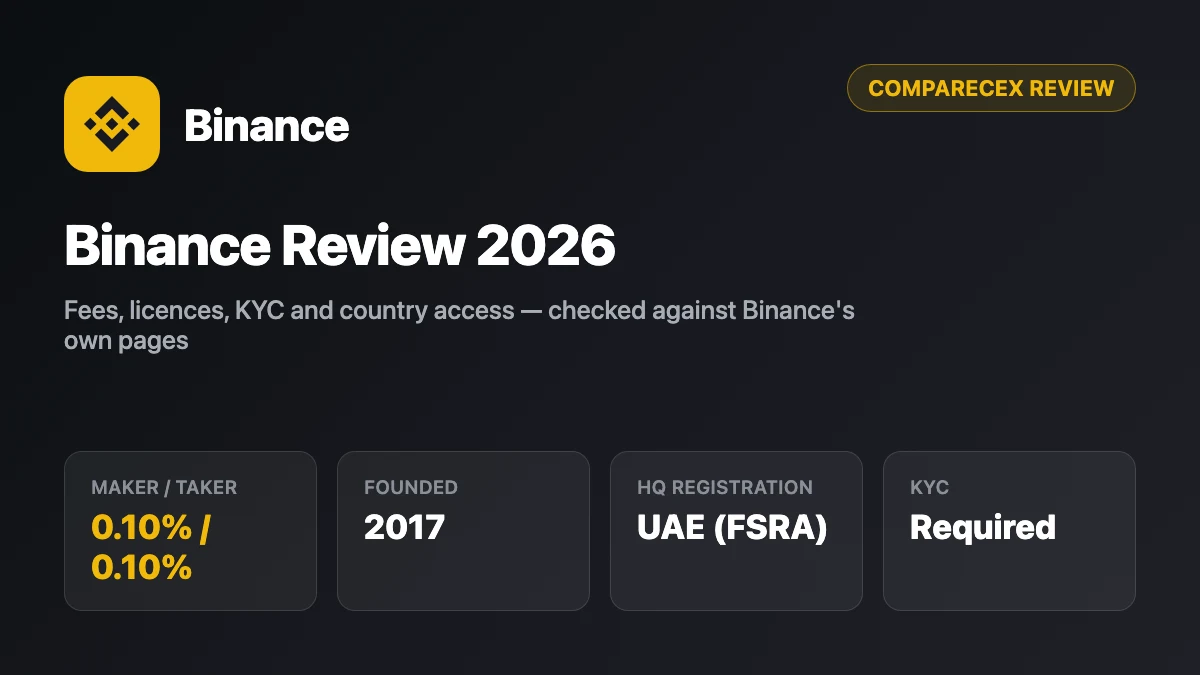
Binance suits an active trader who wants the widest product range on one account and a flat, low regular-tier fee, and is comfortable doing their own country-access and licence checks before funding an account. It's a weaker fit if you want a single home regulator you can point to, or if you're in the US or Canada: Binance's own terms page does not clearly state current access for either country, and the standalone US entity, Binance.US, is a separate company we have not independently verified — so don't assume the global platform in this review works for you without checking Binance's current terms yourself. This review covers what we could verify about Binance's fees, products, licensing, KYC and country coverage.
DISCLOSURE: CompareCEX may earn a commission when you sign up through our links. This does not influence our editorial scores.
RISK: Crypto assets are volatile and unregulated in many jurisdictions. Not financial advice.
Who Should Use Binance, and Who Should Skip It?
Binance suits a trader who wants spot, futures, margin, staking, P2P and card products in one account†, has operated since 2017†, and lists over 350 coins† — more breadth than most single-exchange competitors offer. Its regular-tier fee is a flat 0.10% maker and 0.10% taker with no minimum volume requirement††, which beats Coinbase's low-volume tier outright and undercuts Kraken's entry tier as well††.
Skip Binance, or at least slow down before funding an account, if you are in the US or Canada. Binance's own terms footer does not give a clear, current statement on access for either country when checked directly, and Canada in particular has been reported to have lost Binance service in 2023 — but that report comes from a Binance Square community post, not an official company announcement, so we are not treating it as confirmed. If you're in the US, note that Binance.US operates as a legally separate company from the global Binance platform reviewed here, and we have no verified data on its current fees, products or licensing to include in this article. Either way, check Binance's current country-access terms yourself before you deposit.
What Are Binance's Trading Fees?
Binance charges a flat regular-tier fee of 0.10% for maker orders and 0.10% for taker orders, with no 30-day volume minimum to qualify††. That flat structure is the headline difference against tiered competitors: Coinbase's regular tier runs up to 0.40% maker and 0.60% taker before volume discounts apply††, and Kraken's entry tier under $2,500 in 30-day volume charges 0.40% maker and 0.80% taker††. We cover the full fee schedule, a fee-discount option, and worked dollar examples in our Binance fees guide — this review only needs the headline numbers to judge fit.
Here is what that gap looks like on a round trip — one buy, one sell, both market orders, at each exchange's regular or entry tier, on the same position size:
- Binance, regular tier: 0.10% taker × 2 sides = 0.2% of $10,000 = $20†
- Kraken, entry tier: 0.80% taker × 2 sides = 1.6% of $10,000 = $160†
- Coinbase, high end of its tier: 0.60% taker × 2 sides = 1.2% of $10,000 = $120†
On a $10,000 position sized with a 1% risk-per-trade rule (meaning $100 is the most you're willing to lose on the trade), Binance's $20 round-trip cost† eats a fifth of that risk budget, while Coinbase's $120† and Kraken's $160† both exceed the entire $100 allowance before the market has moved against you at all. Our knowledge base's core trading principle treats this kind of number as a risk-management input, not a footnote: a stop-loss that's already consumed by fees is a trade you're sizing wrong regardless of platform . Run your own trade size through our fee calculator instead of assuming which platform is cheaper for you.
Ready to try Binance?
Availability in your region is unclear — check local regulations.
CompareCEX may earn a commission when you sign up through our links. This does not influence our editorial scores.
What Products Does Binance Offer?
Binance's product range covers spot trading, futures, margin, staking, P2P trading, a card product, and NFT marketplace access, all in our records for this account type†. That is a wider single-account menu than Coinbase, which has no futures or margin in our data†, and wider than Kraken's spot, futures, margin and staking combination. Support runs through live chat and a help center around the clock†; we do not have a verified average response time, so we won't estimate one.
The breadth cuts both ways: more products on one account means more surface area to understand before you use it, particularly futures and margin, which carry liquidation risk that spot trading does not.
Is Binance Regulated and Secure?
Binance's core corporate registration is with the UAE's Financial Services Regulatory Authority under its Abu Dhabi Global Market entity†, and the company states it holds proof-of-reserves data† — though a proof-of-reserves snapshot shows point-in-time holdings, not an ongoing guarantee, and we have not independently audited it.
Beyond that UAE registration, Binance does hold at least one additional market-specific licence we could verify directly from the regulator's own listing: Binance Australia (operated by InvestbyBit Pty Ltd, ABN 98 621 652 579) is registered with AUSTRAC as a digital currency exchange, reference 100576141-001, with an Australian Financial Services Licence application still pending with ASIC (source: binance.com/en-AU/legal/licenses, checked 2026-09-06). We could not verify an equivalent official registration for Binance in the UK, US or Canada as of that same check — those three cells in our regulatory tracking are marked "not found" or "unverified," not "confirmed absent," so treat the UK/US/CA gap as open rather than settled.
A licence like AUSTRAC's is an anti-money-laundering and reporting obligation, not deposit insurance and not a guarantee against a hack or operational failure. For the deeper security question — past incidents, custody design, and what "proof of reserves" does and does not cover — see our dedicated is Binance safe guide (in progress).
What KYC Does Binance Require?
Binance requires identity verification on standard accounts; our data marks KYC as required, sourced directly from Binance's own support pages†. We do not have a verified, itemized document checklist from Binance's help center to list here, so we won't guess at specifics like proof-of-address requirements or verification turnaround time. If document requirements matter to your decision, check Binance's current KYC help article directly before signing up.
Binance: Pros and Cons
| Pros | Cons |
|---|---|
| Flat 0.10% maker and taker fee, no volume minimum†† | UK, US and Canada access not confirmed from official sources as of our last check |
| Spot, futures, margin, staking, P2P and card on one account† | Only one verified market-specific licence (AUSTRAC, Australia) beyond its UAE registration |
| Operating since 2017, over 350 coins listed†† | Binance.US is a separate, unverified entity — this review does not cover it |
| 24/7 live chat and help center support† | Requires full KYC before meaningful use, with no anonymous tier† |
| Cheaper than Coinbase and Kraken on both fee legs at regular/entry tiers†† | Wide product menu (futures, margin) adds risk surface beginners may not need |
What Mistakes Do People Make When Choosing Binance?
- Assuming "Binance" and "Binance.US" are the same product. They are separate companies; this review covers the global platform only, and we have no verified fee or licence data for the US entity.
- Treating a Binance Square community post as an official statement. The widely repeated claim that Binance exited Canada in 2023 traces back to a community post, not a company announcement — real enough to prompt you to verify current access yourself, not solid enough for us to state as fact.
- Reading a single UAE registration as global coverage. Binance's FSRA registration† covers its home entity; it does not automatically confirm licensed status in every country you might trade from.
- Picking the lowest fee without weighing the product menu you'll actually use. Binance's 0.10%/0.10% flat rate†† is real, but futures and margin access on the same account raise the stakes of a KYC and country-access mistake beyond what a spot-only account carries.
- Skipping the risk-per-trade math because the fee looks small. A 0.10% fee† reads as trivial until you check what share of your actual stop-loss budget it consumes on your position size — the round-trip cost gap shown above is the same number, just converted into dollars.
Related guides
- Binance fees explained — the full fee schedule, BNB discount, and worked dollar examples.
- Is Binance safe? — security track record and custody design in depth.
- Binance vs Coinbase — a head-to-head against a US-regulated alternative.
- Best crypto futures trading platform — the criteria to weigh before using Binance's futures product specifically.
- Binance CEA Industries (BNCB) listing (Sept 2026) — what a new trading-pair announcement does and doesn't mean for existing users.
- Binance ETH wallet maintenance (Aug 2026) — an earlier operational notice and what it did and didn't affect.
- Binance alternatives — 6 options to compare if this review didn't settle it for you.
- Best exchange for staking — Binance's flexible-plus-locked staking style against six other exchanges.
- Binance lists Hyperliquid (HYPE) with a Seed Tag (Sept 2026) — a newer listing announcement and what the Seed Tag actually signals.
- Binance promo: XDP trading competition (Sept 2026) — why there's no real Binance discount code, and what the current promotion actually is.
- Binance to delist multiple USDⓈ-M perpetual futures contracts (Oct 2026) — what a contract delisting does and doesn't mean for existing positions.
FAQ
Is Binance available in the US?
We could not verify a clear, current statement on Binance's own terms page for US access as of our last check. Binance.US is a separate, legally distinct company from the global platform reviewed here, and we do not have verified fee or licence data for it.
Is Binance available in Canada?
Not confirmed either way from an official source. A widely cited claim that Binance exited Canada in 2023 comes from a Binance Square community post rather than a company announcement, so check Binance's current terms directly before assuming access.
Is Binance regulated?
Binance's core registration is with the UAE's Financial Services Regulatory Authority†. We also verified a market-specific AUSTRAC registration for Binance Australia directly from Binance's own licensing page (checked 2026-09-06). We could not verify equivalent registrations for the UK, US or Canada.
Are Binance's fees lower than Coinbase and Kraken?
Yes, on the numbers we could verify. Binance's flat 0.10% maker and taker rate†† is cheaper than Coinbase's tiered rate of up to 0.40%/0.60%†† and Kraken's entry tier of 0.40%/0.80%††. See our Binance fees guide for the full schedule.
See our best exchanges list for more comparisons, and read our affiliate disclosure for how we're funded.
RISK: Crypto assets are volatile and unregulated in many jurisdictions. Not financial advice.
Last updated: 2026-09-07
Affiliate link — we may earn a commission. How we're funded
Visit Binance