Is Binance Safe? Which Binance Entity Serves Your Country, Explained
Is Binance safe? We check which entity serves your country, its Australia and US licenses, custody claims, and the 2023 settlement — sourced and dated.
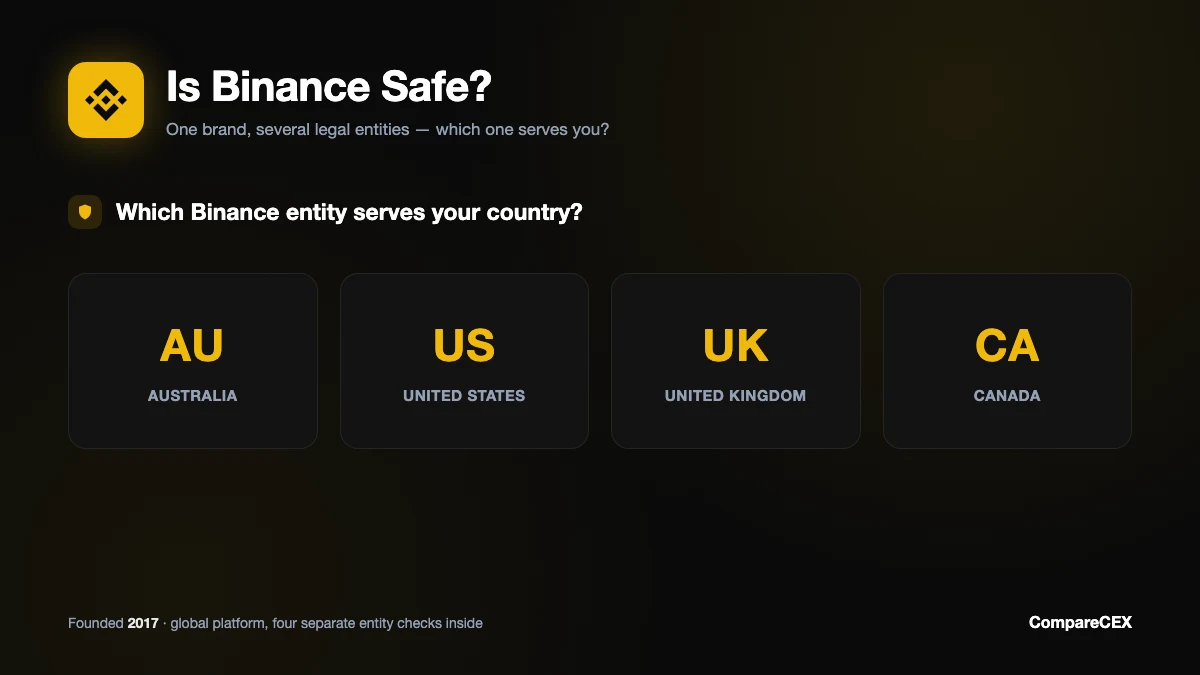
Binance is safe in a narrower sense than most reviews imply: "Binance" is not one company with one license, it is a global platform plus several separate legal entities, and which one actually serves you depends on where you live†. Binance Australia holds a real regulator registration, Binance.US is a distinct US company, and Binance itself is not currently permitted to run regulated activity in the UK, according to that country's regulator. This article checks licenses, custody, and Binance's 2023 regulatory settlement country by country, with sources and dates, instead of answering "is Binance safe" as one yes/no question.
DISCLOSURE: CompareCEX may earn a commission when you sign up through our links. This does not influence our editorial scores.
RISK: Crypto assets are volatile and unregulated in many jurisdictions. Not financial advice.
Is Binance One Company, or Several?
This is the question most "is Binance safe" articles skip, and it matters more than any single safety score. Binance was founded in 2017† and today operates as a global platform headquartered around Abu Dhabi Global Market (ADGM) in the UAE†, holding a financial-services license from ADGM's regulator, the FSRA†. But the account you actually sign up for is not always run by that same entity.
| Entity | Who it serves | What it is | Source |
|---|---|---|---|
| Binance (binance.com, global) | Most countries outside the exclusions below | The main international platform; FSRA-licensed in ADGM, UAE† | binance.com/en/about |
| Binance Australia (InvestbyBit Pty Ltd) | Australia | Separate Australian company operating under the Binance brand | binance.com/en-AU/legal/licenses, checked 2026-09-07 |
| Binance.US (BAM Trading Services, Inc.) | United States | Separate US company; smaller coin list than binance.com | support.binance.us, checked 2026-09-07 |
| Binance Markets Limited / Binance Group (UK) | United Kingdom | UK entity restricted by the regulator (see below) | fca.org.uk, checked 2026-09-07 |
If your country is not one of these four rows, you are almost certainly dealing with the global binance.com entity, and the ADGM license above is the one that applies†.
What Does Binance's License Actually Cover, Country by Country?
"Binance is licensed" is true and misleading at the same time, because the license that covers you changes by country, and in one major market it doesn't exist at all.
Australia: Binance Australia (InvestbyBit Pty Ltd) is registered with AUSTRAC, Australia's financial-crime regulator, as a Virtual Asset Service Provider, registration number 100576141-001. A separate Australian Financial Services Licence (AFSL) application with ASIC was still pending as of this check (binance.com/en-AU/legal/licenses, checked 2026-09-07) — AUSTRAC registration is an AML compliance bar, not the fuller ASIC authorization that remains pending.
United States: US customers use Binance.US, run by BAM Trading Services, Inc., a company legally distinct from binance.com. BAM Trading is registered as a Money Services Business with FinCEN and holds money transmitter licenses (or their equivalent) in more than 30 states and territories (support.binance.us, checked 2026-09-07). A handful of those states, including Kentucky and Virginia, note the license specifically does not cover virtual currency activity, so coverage isn't uniform even within the US.
United Kingdom: The sharpest contrast in this article. The FCA states directly that Binance Markets Limited is not currently permitted to undertake any regulated activity in the UK without the FCA's written consent, and that no other Binance Group entity holds any UK authorization, registration, or licence (fca.org.uk consumer warning, checked 2026-09-07). That's about regulatory permission, not a technical block on binance.com — no part of the Binance Group is currently authorized to run regulated crypto activity for UK customers.
Canada: Binance is widely reported to have withdrawn from the Canadian market around May 2023, citing new provincial guidance on stablecoins and investor limits. We could not find an official Binance announcement confirming this directly, only secondary reporting, checked 2026-09-07, so treat "does Binance serve Canada" as unresolved rather than confirmed.
| Country | Entity | Status | What it means |
|---|---|---|---|
| Australia | Binance Australia (InvestbyBit Pty Ltd) | AUSTRAC-registered VASP; AFSL pending | Meets an AML compliance bar; full financial-services authorization not yet granted |
| United States | Binance.US (BAM Trading Services, Inc.) | FinCEN MSB; state MTLs in 30+ jurisdictions | Separate company from binance.com; some state licenses exclude virtual currency |
| United Kingdom | Binance Markets Limited / Binance Group | Not permitted to conduct regulated activity (FCA) | No Binance Group entity currently authorized for UK regulated activity |
| Canada | Binance (global) | Reported exit, May 2023 (unofficial) | We could not verify current official status; no official Binance announcement found |
How Does Binance Handle Custody and Proof of Reserves?
Binance's own security page states proof of reserves as a stated practice†. Checking Binance's dedicated Proof of Reserves page directly (binance.com/en/proof-of-reserves, checked 2026-09-07), the mechanism is more specific: Binance says it holds user assets 1:1, including reserves, and publishes account-level verification using a Merkle tree (to prove an individual balance is included in the total liabilities snapshot) plus zk-SNARKs (a method that verifies inclusion without revealing account details). Users can look up their own balance against a stated verification date and receive a Record ID and Merkle Leaf.
Binance also runs a separate emergency reserve called the Secure Asset Fund for Users (SAFU), funded from a share of trading fees and intended to cover losses if Binance's own systems or security are compromised, not general market losses (binance.com SAFU FAQ, checked 2026-09-07).
| Custody question | What we found |
|---|---|
| Does Binance publish proof-of-reserves verification? | Yes, via Merkle tree and zk-SNARK verification, checkable per account (Binance PoR page, checked 2026-09-07) |
| Is there a separate emergency fund? | Yes, SAFU, funded from a share of trading fees; Binance states a rebalancing floor if the fund's market value drops (Binance SAFU FAQ, checked 2026-09-07) |
| Does Binance require ID verification? | Yes, required† |
| How many registered users does Binance report? | About 250 million, as of January 2025, per Binance's own figure† |
Proof-of-reserves verification proves Binance held the coins it claimed on the date checked. It does not prove reserves stay 1:1 every day between checks, and it does not cover money lost to a personal phishing attack or a scam outside Binance's own systems.
What Does "Binance Is Safe" Not Cover?
This is the part a licenses-and-custody summary leaves out: Binance and its founder have already been through a major US regulatory settlement, and it happened on the same day across three separate agencies.
On November 21, 2023, Binance Holdings Limited pleaded guilty to federal charges tied to the Bank Secrecy Act, failing to register as a money transmitting business, and the International Emergency Economic Powers Act, agreeing to a multibillion-dollar resolution with the US Department of Justice. Binance's founder, Changpeng Zhao, pleaded guilty personally to failing to maintain an effective anti-money-laundering program and resigned as CEO (US Department of Justice, November 21, 2023). On the same day, the Commodity Futures Trading Commission announced a separate multibillion-dollar civil settlement with Binance and Zhao over operating an unregistered derivatives exchange and evading US law (CFTC press release, November 21, 2023). Exact figures for both settlements are in the table below.
| Date | Agency | Action | Outcome |
|---|---|---|---|
| November 21, 2023 | US Department of Justice | Binance and CZ pleaded guilty to BSA, unregistered money transmission, and IEEPA violations | Binance to pay over $4 billion; CZ resigned as CEO (DOJ press release) |
| November 21, 2023 | US CFTC | Civil charges over an unregistered derivatives exchange and evading US law | Binance and CZ to pay $2.85 billion combined penalties (CFTC press release) |
That is a settled legal outcome, not an unresolved allegation, and it is separate from the proof-of-reserves and SAFU claims above — a platform can hold the coins it says it holds and still have broken money-laundering and registration law in the past. Registration in Australia or the US today does not erase that record; it means Binance operates under closer supervision than it did before 2023.
| What "Binance is safe" means | What it does NOT mean |
|---|---|
| Registered as a VASP in Australia; Binance.US separately licensed with FinCEN and US states | Full deposit insurance on your crypto balance anywhere |
| Publishes account-level proof-of-reserves verification | A live guarantee that reserves stay 1:1 every day |
| Runs a SAFU emergency fund funded from trading fees | Coverage for your own phishing loss or a market crash |
| Operating under closer regulatory supervision since 2023 | The 2023 DOJ/CFTC settlement being erased or reversed |
How Does Binance's Safety Profile Compare to Kraken?
Kraken publishes Proof of Reserves audits by an independent accounting firm, and clients can verify their own balance against the audit†, while Binance's own page describes a specific Merkle-tree verification method, as detailed above. Neither comparison should be read as "Kraken is less safe" on its own — see our full Is Kraken Safe? review and Binance vs Kraken for the licensing and fee picture side by side.
A Decision Checklist Before You Trust Any Exchange With Funds
- Find out which entity actually holds your account. "Binance" in your country may be the global platform, a licensed local subsidiary, or an entity the regulator says isn't authorized at all — the table above shows how different that answer is by country.
- Check the regulator's site directly, not a blog, for your own country's current status. Licenses and market access change; this article reflects checks made on 2026-09-07.
- Read what "proof of reserves" actually verifies. A Merkle-tree snapshot proves reserves on the date checked, not a live daily guarantee.
- Separate custody risk from legal-history risk. A platform can pass a reserves check and still carry a settled regulatory record, as Binance's 2023 case shows.
- Turn on the strongest account security offered (passkey or authenticator app, not SMS) — no license or reserve fund protects an account that gets phished.
- Never keep every coin on one exchange. The same discipline that says never put your whole account into one low-cap position without a backup applies to platforms too: keep a self-custody backup so one exchange's problem, or one country's regulatory action, doesn't touch everything you own .
Common Mistakes People Make When Judging Binance's Safety
- Assuming "Binance" means the same company everywhere. Binance Australia, Binance.US, and binance.com are different entities with different regulatory status, and the UK entity currently has none at all.
- Treating AUSTRAC registration as a full financial-services license. The AFSL application with ASIC was still pending as of this check; AUSTRAC registration alone is an AML compliance bar.
- Reading "proof of reserves" as a live, continuous guarantee. It verifies a snapshot on a checked date, not every day in between.
- Forgetting the 2023 settlement when judging current safety. Custody and licensing improvements since then don't undo the DOJ and CFTC settlement outcomes in the table above — they're two separate facts to weigh together.
- Assuming "not permitted in the UK" means the coins on the platform aren't real. The FCA's warning is about regulatory authorization, not the assets Binance reports holding.
Ready to try Binance?
Availability in your region is unclear — check local regulations.
CompareCEX may earn a commission when you sign up through our links. This does not influence our editorial scores.
Related guides
- Is Kraken Safe? — the same licensing-and-custody check applied to a US-headquartered exchange.
- Binance vs Kraken — full fee and feature comparison alongside the safety picture above.
- Best exchanges for beginners — where licensing and custody fit into picking a first platform.
- Best crypto broker for beginners — the full checklist to run before opening any first account, Binance included.
- Binance CEA Industries (BNCB) listing (Sept 2026) — a routine listing announcement, unrelated to the security questions on this page.
- Binance ETH wallet maintenance (Aug 2026) — a scheduled operational notice, not a security incident.
- Binance lists Hyperliquid (HYPE) with a Seed Tag (Sept 2026) — a routine listing announcement, not a security incident.
- Binance promo: XDP trading competition (Sept 2026) — a routine trading promotion, not a security incident.
- Binance to delist multiple USDⓈ-M perpetual futures contracts (Oct 2026) — a routine contract delisting, not a security incident.
FAQ
Is Binance legit?
Binance operates as a global platform founded in 2017†, with country-specific entities in Australia and the US holding their own registrations. "Legit" depends on which entity serves you: Binance Australia is AUSTRAC-registered, Binance.US is FinCEN-registered, and no Binance Group entity currently holds UK authorization, per the FCA (checked 2026-09-07). Legitimacy here means "operating and, in some countries, registered," not "risk-free" — read the 2023 settlement section above before assuming registration equals a clean record.
Was Binance ever fined or sued by regulators?
Yes. On November 21, 2023, Binance pleaded guilty to US Department of Justice charges and separately settled with the CFTC, both for multibillion-dollar sums, over money-laundering-program failures and running an unregistered derivatives exchange (see the exact figures and sources in the table above). Founder Changpeng Zhao pleaded guilty personally and resigned as CEO.
Can I use Binance in the UK?
The FCA states that Binance Markets Limited is not currently permitted to carry out regulated activity in the UK, and that no other Binance Group entity holds UK authorization (fca.org.uk, checked 2026-09-07). This is about regulatory permission, not a technical block on binance.com; confirm current rules directly with the FCA before assuming UK access is unaffected.
Does Binance's proof of reserves mean my funds are guaranteed safe?
No. Binance's Proof of Reserves page describes a Merkle-tree and zk-SNARK verification of account balances against reserves at a specific checked date (binance.com, checked 2026-09-07), plus a separate SAFU emergency fund for security-breach losses. Neither is deposit insurance, and neither protects against a personal phishing attack, a scam, or market losses.
See our best exchanges list for more comparisons, and read our affiliate disclosure for how we're funded.
RISK: Crypto assets are volatile and unregulated in many jurisdictions. Not financial advice.
Last updated: 2026-09-07
Affiliate link — we may earn a commission. How we're funded
Visit Binance