Bybit Review 2026: Fees, Copy Trading and Regulation Gap
An honest Bybit review: verified 0.10% fees, products, KYC and country access, plus the regulatory registration we could not find in any market we track.
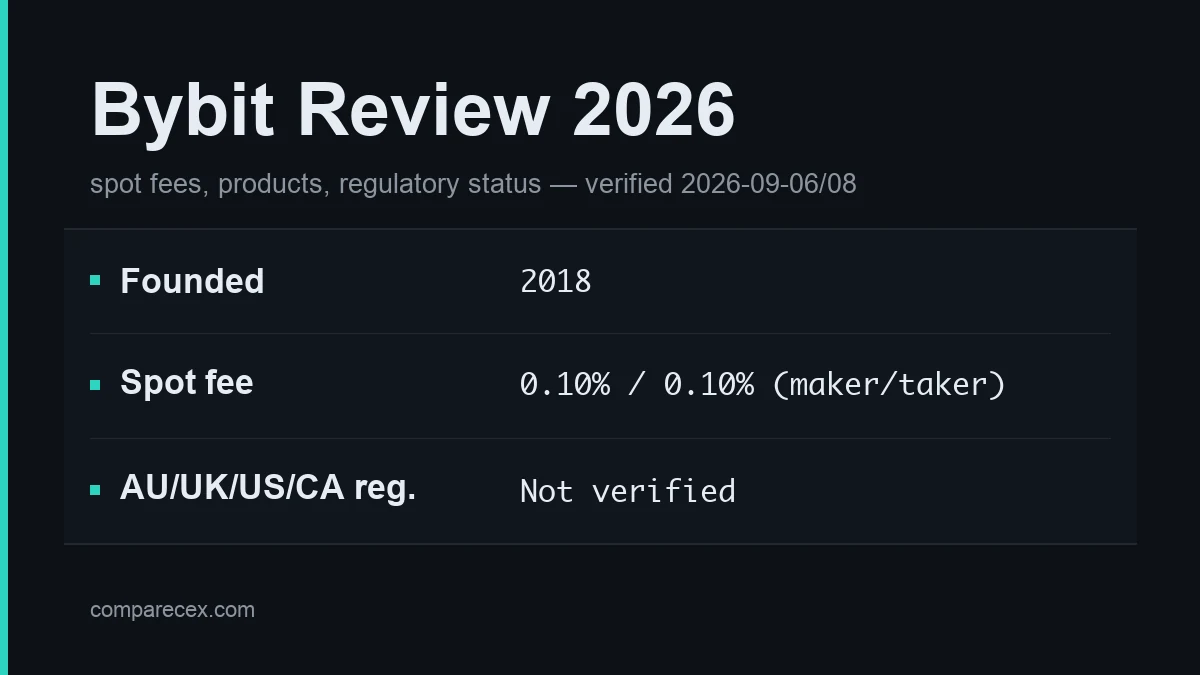
Bybit fits an active trader who wants spot, futures, margin and copy trading in one account at a flat 0.10% maker and 0.10% taker rate on the regular tier††. It is a poor fit if you are in the US or Canada, which Bybit itself lists as restricted, or if you want your exchange to hold a licence in your own market — we could not verify a single Bybit registration in the US, UK, Canada or Australia. This review covers what we confirmed about its fees, products, KYC and country access, and is honest about the gaps.
DISCLOSURE: This is educational content, not investment advice. CompareCEX may earn a commission when you sign up through our links. This does not influence our editorial scores.
RISK: Crypto assets are volatile and unregulated in many jurisdictions. Not financial advice.
Who Should Use Bybit, and Who Should Skip It?
Bybit suits a trader who already knows what they are doing and wants one account for spot, futures, margin, staking and copy trading rather than two or three†. The pricing supports that use case: a flat 0.10% on both sides of a spot trade at the regular tier, with a maker rebate available††, is at the cheap end of the market and does not punish you for trading often. The company has been operating since 2018† and is headquartered in Singapore†.
Skip Bybit if a regulator in your own country is part of what you are buying: nothing in our data shows a Bybit registration with any authority in the four markets we track, and its own restricted-countries page excludes the US and Canada. Skip it too if you want proof of reserves first — we hold no proof-of-reserves record for Bybit either way, which is not a "no" but an absence, and we will not fill it with a guess.
What Are Bybit's Trading Fees?
Bybit charges 0.10% maker and 0.10% taker on spot at its regular (VIP0) tier, with a maker rebate available on some pairs††. That is a flat rate rather than a volume ladder you have to climb, which matters more than the headline number: on tiered schedules most retail accounts sit permanently at the expensive end. If the distinction is new to you, our maker vs taker fees guide explains which one you actually pay.
Here is what a round trip — one market buy and one market sell, both taker orders — costs on a $2,000 position at each exchange's entry-level rate†††:
| Scenario | Taker rate (both sides) | Cost on $2,000 |
|---|---|---|
| Bybit, regular VIP0 tier | 0.2%† | $4 |
| Kraken, Tier 1 (under $2,500 30-day volume) | 1.6%† | $32 |
| Binance, VIP0 regular tier | 0.2%† | $4 |
The interesting gap is not Bybit against Binance — at the regular tier those two are identical at 0.10% per side††, so fees alone cannot separate them. It is Bybit against an entry-tier Kraken account, where the same round trip costs $32 instead of $4 because Kraken's Tier 1 taker rate is 0.80% per side†. Run that eight-times gap across fifty trades a year and it stops being a rounding error. Our lowest-fee crypto exchange guide ranks the same rates across more venues.
One number we cannot give you: withdrawal fees. We have no verified withdrawal-fee data for Bybit, so we will not estimate one — check the network fee on Bybit's own withdrawal screen before you move funds, since that cost can dwarf the trading fee on a small position.
Ready to try Bybit?
Not available in United States.
See a verified alternative →What Products Does Bybit Offer?
Bybit runs spot, futures, margin, staking and copy trading on one account, and does not offer P2P trading or a crypto card in our records†. Copy trading is the feature that separates it from both exchanges we price it against here: Kraken has no copy trading on file†, and Binance's product list does not include it either†. It is also the feature that deserves the most caution, for reasons covered in the mistakes section below.
Funding runs through bank transfer, card and crypto deposits†, with iOS and Android apps† and roughly ten interface languages†. Support is a help centre plus tickets, listed as 24/7†; we have no verified response time, so we will not quote one.
Is Bybit Regulated?
Not in any market we track. We looked for a Bybit registration with the SEC or FinCEN in the US, the FCA in the UK, provincial securities regulators in Canada and AUSTRAC in Australia, and found none as of 2026-09-06. Being headquartered in Singapore† since 2018† is a track record, not a licence.
For contrast, both comparison exchanges in this review have something on file. Kraken holds a FINRA self-regulatory membership and SIPC broker-dealer status in the US†. Binance holds an FSRA financial services licence through ADGM in Abu Dhabi† and has a proof-of-reserves record on file†. Neither of those is deposit insurance, and neither guarantees your funds — but both are a documented obligation to a named authority, which is exactly what we could not find for Bybit. See our ranking methodology for how we weight registration against fees and product breadth.
On the United Kingdom specifically: Bybit's own service-restricted countries page, checked 2026-09-12, does not name the UK among its excluded jurisdictions (the current list is the US, mainland China, Hong Kong, Singapore, Canada, North Korea, Cuba, Iran, Uzbekistan, Russian-controlled regions of Ukraine, Sevastopol, Sudan and Syria). That is consistent with Bybit's own December 2025 announcement, "Bybit Officially Launches In The United Kingdom" — not a contradiction between the two pages. Access to the UK does not by itself mean a UK registration: we still found no FCA record for Bybit itself.
What KYC Does Bybit Require?
Bybit requires identity verification on a standard account†. We have no verified, itemised document checklist from Bybit's own help pages, so we will not guess at proof-of-address rules, turnaround time, or pre-verification limits. Assume a government photo ID at minimum, and check Bybit's verification page for your country before depositing.
Is Bybit Available in My Country?
Here is every status we could verify for the four markets we track, checked 2026-09-06 against Bybit's own pages:
| Market | Status | Source |
|---|---|---|
| United States | Restricted — listed as a service-restricted country | Bybit restricted countries |
| Canada | Restricted — listed as a service-restricted country | Bybit restricted countries |
| United Kingdom | Not on the excluded list, checked 2026-09-12 — consistent with Bybit's own December 2025 UK launch announcement; no separate UK registration for Bybit found | Restricted list · UK launch post |
| Australia | Nothing found either way — no restriction and no registration located | — |
If your country is not one of these four, we have no verified coverage and will not extrapolate. Check Bybit's restricted-countries page yourself before signing up, and re-check it after any long gap — these lists change without notice.
What Are Bybit's Pros and Cons?
| Pros | Cons |
|---|---|
| Flat 0.10% maker and taker at the regular tier, with a maker rebate available† | No verified regulatory registration in the US, UK, Canada or Australia |
| Spot, futures, margin, staking and copy trading on one account† | No verified Bybit registration in the UK even though the UK is not excluded |
| Operating since 2018, headquartered in Singapore†† | No proof-of-reserves record on file either way — an absence, not a clean bill |
| iOS and Android apps, 24/7 help centre and ticket support†† | US and Canada restricted by Bybit's own list |
| Flat pricing beats Kraken's 0.80% entry-tier taker rate by a wide margin† | No P2P and no card†; withdrawal fees not verified in our data |
What Mistakes Do People Make When Choosing Bybit?
- Reading a low fee as a low total cost. The 0.10% per side is real†, but withdrawal and network fees are not in our verified data, and on a small position they can exceed the trading fee entirely.
- Treating an unregulated exchange as merely "less paperwork". No registration means no named authority you can escalate to if withdrawals stop. That is a structural difference from a venue with a FINRA membership or an FSRA licence††, not a technicality.
- Treating copy trading as risk transfer. Our knowledge base's card on externally enforced limits makes the point that the valuable part of a funded-account challenge is not the capital — it is that a third party imposes a hard loss threshold that ejects you and a profit threshold that stops you, so discipline no longer depends on willpower . Copy trading is the mirror image of that deal: it outsources the decision while imposing no limit at all. The lead trader's position sizing is calibrated to their capital and their tolerance, not yours, and nothing in the product removes you at a drawdown you would never have chosen. You hand over the judgment and keep every bit of the risk.
- Assuming UK access means a UK registration. Bybit is not excluded from the UK, but that is a country-access decision, not a licence — we still found no FCA record for Bybit itself.
- Skipping the country check because a friend uses it. Access is set by your residence and verification, not by whether the site loads.
How Do You Decide Between Bybit and a Registered Alternative?
- Check your own country against Bybit's restricted list first — if you are in the US or Canada, the fee comparison is irrelevant.
- Decide whether a licensed counterparty is part of what you are paying for. If it is, compare against an exchange with a documented registration, such as Kraken, and accept the higher entry-tier fee as the price of that.
- Run your real trade size through our fee calculator rather than trusting the headline rate, and see whether the gap is worth the trade-off in your case.
- If you intend to use copy trading, write down your own maximum loss before you follow anyone — and set it in the platform, not in your head. Following a trader is not a substitute for that limit.
Related guides
- Bybit vs Coinbase — flat low fees against a registered, tiered-fee US exchange.
- Bybit vs OKX — a head-to-head between two derivatives-first global platforms.
- Lowest-fee crypto exchange — verified maker and taker rates ranked across the market.
FAQ
Is Bybit available in the US or the UK?
Bybit's own restricted-countries page lists the United States and Canada as excluded. The UK is not on that list, consistent with Bybit's own December 2025 UK launch announcement — but access is not the same as a UK regulatory registration, which we did not find. Verify directly with Bybit before depositing.
Does Bybit require KYC?
Yes. Identity verification is required on a standard Bybit account†. We do not have a verified document checklist, so check Bybit's verification page for what your country needs.
Is Bybit cheaper than Kraken?
At entry level, considerably. Bybit charges 0.10% per side at its regular tier against Kraken's Tier 1 taker rate of 0.80%†† — $4 versus $32 on a $2,000 round trip. Kraken's Tier 1 maker rate is 0.40%†, still above Bybit's†. Regulatory status runs the other way.
See our low-fee exchange list and the Bybit exchange profile for more comparisons.
RISK: Crypto assets are volatile and unregulated in many jurisdictions. Not financial advice.
Last updated: 2026-09-13