MEXC Review 2026: Fees, Altcoin Breadth and Country Problem
An honest MEXC review: verified 0% maker and 0.05% taker fees, ~1,000 coins, KYC rules, and why US, UK and Canada are prohibited.
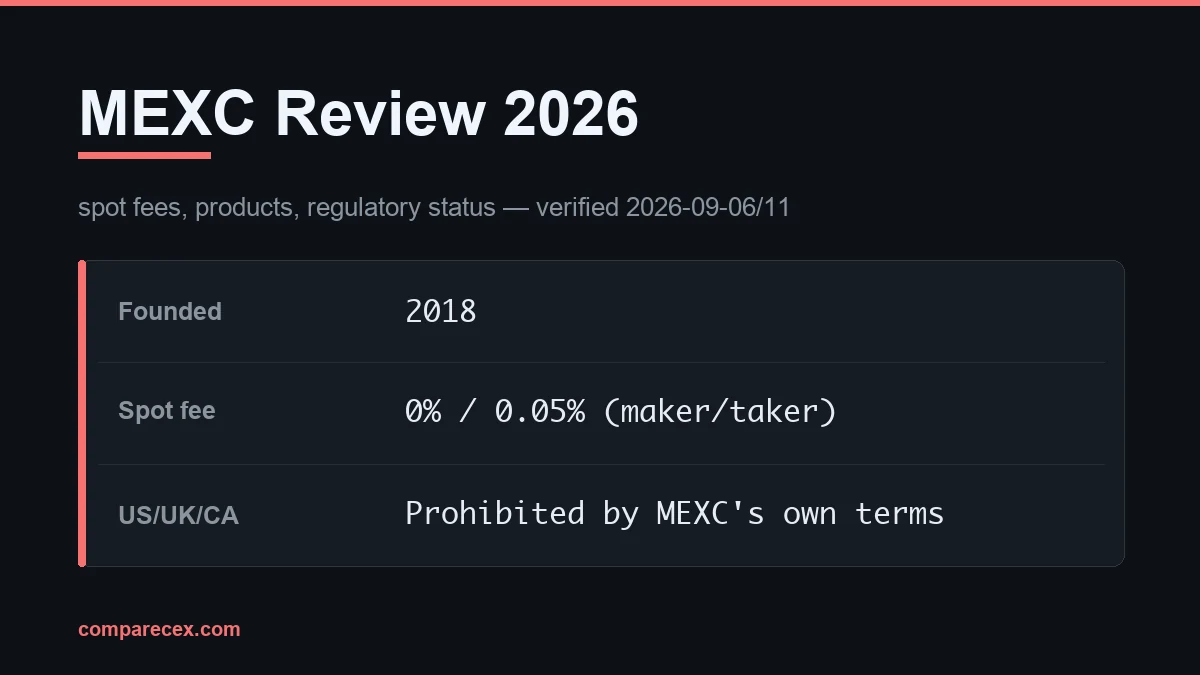
MEXC is a fit if you live outside the United States, United Kingdom and Canada, you want a very wide altcoin list, and the cheapest verified spot fees of the eight exchanges we track matter more to you than a named regulator behind the platform††. It is not a fit if you are in those three countries — MEXC's own terms prohibit all three — or if you want a licence you can look up before depositing. This review covers the fees, products, KYC and country restrictions that make MEXC the most closed-off exchange in this series.
DISCLOSURE: CompareCEX may earn a commission when you sign up through our links. This does not influence our editorial scores.
RISK: Crypto assets are volatile and unregulated in many jurisdictions. Not financial advice.
Who Should Use MEXC, and Who Should Skip It?
MEXC suits a trader who already knows what they are buying and needs a venue that lists it. Around 1,000 coins are available, among the highest altcoin counts in the market† — roughly double Kraken's approximate 600† and well past Binance's approximate 350†. Add 0% maker and 0.05% taker on spot†† and you have the cheapest headline schedule in our comparison set. MEXC has run since 2018 out of Singapore†† and calls itself "Your Gateway to the Altcoin World"†, which is an accurate description of what it is built for.
Skip MEXC outright if you are in the US, UK or Canada — its terms list all three as prohibited jurisdictions, so the exchange has made that decision for you. Skip it too if you want copy trading, a peer-to-peer market or a crypto card, none of which is in our records†. And weigh it carefully if safety ranks first: we found no regulatory registration in any market we track. MEXC does publish monthly Proof of Reserves reports audited by Hacken, and users can verify their balance is included† — but a reserves report is not a licence.
What Are MEXC's Trading Fees?
MEXC charges 0% maker and 0.05% taker on spot, per its own fee page††. A zero maker fee means a limit order that rests on the book costs no exchange commission — our maker vs taker fees guide explains which side your orders land on.
Here is what a 0.05% taker rate† means on a round trip — one market buy, one market sell, both paying the taker side — on a $2,000 position:
| Scenario | Taker Rate (both sides) | Cost on $2,000 |
|---|---|---|
| MEXC, standard spot | 0.1%† | $2 |
| Binance, flat regular tier (VIP0) | 0.2%† | $4 |
| Kraken, entry tier under $2,500 30-day volume | 1.6%† | $32 |
The gap is wide: $2 on MEXC against $32 on Kraken for the same round trip, a $30 difference driven entirely by 0.05% versus 0.8% on the taker side††. Twenty round trips in a month and the gap is $600††. Model your own sizes in the fee calculator or see the full field in our lowest fee crypto exchange guide.
One number we cannot give you: withdrawal fees. We have no verified withdrawal-fee data for MEXC and will not estimate one — and on a cheap-trading venue that gap matters, because withdrawal costs are where a low headline rate is often quietly recovered. Check MEXC's fee page for your coin and network before assuming the saving holds.
Ready to try MEXC?
Not available in United States.
See a verified alternative →What Products Does MEXC Offer?
Spot, futures, margin and staking are all present†. Copy trading, peer-to-peer trading and a crypto card are absent† — worth knowing if you planned to mirror another trader's positions.
The headline product is listing breadth. Roughly 1,000 coins† means MEXC often carries small-cap tokens larger exchanges never listed or have delisted. That cuts both ways: useful when you have researched a specific token and cannot find it elsewhere, risky because it also puts thinly traded, high-spread markets in front of anyone browsing without a plan. The count says what is available, not what is sound.
Supporting details: iOS and Android apps†, around 20 interface languages†, funding by bank transfer, card or crypto†, and 24/7 help centre and ticket support† — no live chat.
Is MEXC Regulated?
No, not in any of the four markets we track. We looked for a MEXC registration with FinCEN or the SEC in the US, the FCA in the UK, the Canadian Securities Administrators' provincial members, and AUSTRAC in Australia, and found none as of 2026-09-06. Singapore since 2018†† is a length of service, not an authorisation.
What makes MEXC's position sharper than the other unregistered exchanges we have reviewed is that the missing licence is paired with explicit exclusion: three of the four markets are not merely unmentioned, they are named as prohibited jurisdictions in MEXC's Terms. There is no grey area to read either way.
Both comparison exchanges have something on the record. Kraken holds a FINRA self-regulatory membership and SIPC broker-dealer status in the US†. Binance holds an FSRA financial services licence via ADGM in Abu Dhabi† and publishes a proof-of-reserves record†. Neither is deposit insurance. What they give you is a named authority with a stated obligation — which we could not locate for MEXC, along with no proof-of-reserves record.
What KYC Does MEXC Require?
Identity verification is required on a MEXC account†. We have no verified, itemised document checklist from MEXC's help pages — ID alone, ID plus selfie, or ID plus proof of address — so we will not invent specifics. Assume a government photo ID and budget time for review. If that is a dealbreaker, it rules out most of the field rather than MEXC alone: Kraken requires government ID and proof of address too†.
Is MEXC Available in My Country?
Every status we could verify for the four markets we track, checked 2026-09-06 against MEXC's own Terms:
| Market | Status | Source |
|---|---|---|
| United States | Prohibited jurisdiction — named in MEXC's Terms | MEXC Terms |
| United Kingdom | Prohibited jurisdiction — named in MEXC's Terms | MEXC Terms |
| Canada | Prohibited jurisdiction — named in MEXC's Terms | MEXC Terms |
| Australia | Not on the prohibited list, and no AUSTRAC registration found | MEXC Terms |
Three exclusions out of four markets is the most restricted country profile in this review series. For US, UK and Canadian readers the review ends there: whatever the fee schedule says, the platform is not open to you, and a VPN around a jurisdiction block risks a frozen account and balance. Australia is the one market MEXC does not exclude, but read that row precisely — "not prohibited" describes MEXC's terms, not a registration, and no Australian authority has taken on a duty toward your funds. Outside these four markets we have no verified coverage.
What Are MEXC's Pros and Cons?
| Pros | Cons |
|---|---|
| Cheapest verified spot fees in our set: 0% maker, 0.05% taker†† | US, UK and Canada all named as prohibited jurisdictions in MEXC's own Terms |
| Around 1,000 coins listed, among the highest altcoin counts† | No regulatory registration found in any of the four markets we track |
| Spot, futures, margin and staking on one account† | Monthly Proof of Reserves reports audited by Hacken exist†, but they do not stand in for a licence |
| iOS and Android apps, ~20 languages, 24/7 help centre††† | Withdrawal fees not verified in our data — check before moving funds |
| Bank transfer, card and crypto funding routes† | No copy trading, no P2P market, no crypto card† |
What Mistakes Do People Make When Choosing MEXC?
- Comparing only the visible surface. Our knowledge base treats trading as an iceberg: the visible part — clicking buy and sell, watching charts, hunting more coins and lower fees — rewards you instantly, so everyone does it, while the submerged ~70% rewards nobody today and so almost nobody does it, which is why most people lose . Exchange choice has the same shape. A coin count and a taker rate are the visible 30% a five-minute comparison shows you. A verifiable registration, a proof-of-reserves record and a withdrawal you have actually tested are the submerged 70% that decides whether your funds are reachable two years from now.
- Reading "cheapest fees" as "cheapest to use". The trading rate is verified; the withdrawal cost is not in our data, and an end-to-end cost you have not measured is not a saving.
- Treating a long listing page as a shortlist. Roughly 1,000 listed coins† is an inventory, not a recommendation, and thin markets carry spreads that dwarf any fee difference.
- Routing around a prohibited jurisdiction. A VPN does not change the terms you agreed to; it changes how the account looks when a compliance review reads it.
- Assuming country status is fixed. Prohibited-jurisdiction lists get edited without announcement — re-read the terms every few months.
How Do You Decide Between MEXC and a Registered Alternative?
- Check your country against MEXC's terms first. If you are in the US, UK or Canada, stop — nothing else in the comparison matters.
- Write down what you are optimising for. If it is a specific small-cap coin, MEXC's listing breadth† is a genuine reason to use it. If it is a regulator you can name, no fee saving closes that gap.
- Price your real annual volume, not one trade. Put your numbers through the fee calculator and see whether the gap against a registered venue is worth the trade-off.
- Test a small withdrawal before sizing up. Deposit a little, trade it, withdraw it, note the cost and the time.
- Consider splitting. A registered exchange for long-term holdings and a broader-listing venue only for what you cannot get elsewhere is a legitimate answer.
Related guides
- Bybit vs MEXC — head-to-head against another wide-listing global exchange.
- KuCoin review — another unregistered venue, different country restrictions.
- Lowest fee crypto exchange — where MEXC's taker rate sits in the full field.
- Best crypto futures: which exchanges actually offer it — MEXC confirmed alongside 8 other exchanges that offer the product.
- Best crypto exchange with low fees — MEXC's entry-tier rate is the cheapest of the six exchanges compared.
- Best app for futures trading crypto — MEXC ranked cheapest of six on the fee metric that actually differs.
- Best place to purchase cryptocurrency — MEXC's taker fee against 3 other exchanges and a fiat on-ramp alternative.
- Bitfinex review — the only exchange in our data that beats MEXC's taker fee outright.
FAQ
Is MEXC available in the US?
No. MEXC's Terms name the United States as a prohibited jurisdiction, and the same applies to the United Kingdom and Canada. Of the four markets we track, only Australia is absent from that list — and absence from a prohibited list is not a registration.
Is MEXC cheaper than Binance?
On the verified spot schedule, yes: 0% maker and 0.05% taker†† against Binance's flat 0.1% both sides at the regular VIP0 tier†† — $2 versus $4 on a $2,000 round trip††. Withdrawal fees are not verified in our data, so this covers trading costs only.
Does MEXC require KYC?
Yes. Identity verification is required†. We have no verified document-by-document checklist from MEXC's help pages, so we will not list requirements or a turnaround time.
See our best exchanges list for more comparisons, and read our affiliate disclosure for how we're funded.
RISK: Crypto assets are volatile and unregulated in many jurisdictions. Not financial advice.
Last updated: 2026-09-11