Head-to-head
Binance vs Kraken
Availability in United States is unclear — Từ terms footer, báo cáo ghi cần xác minh đầy đủ tại Binance Help Center.
Source · checked 2026-09-04

Which is better for beginners?
Binance scores higher for beginners (82.1 vs 64.5 out of 100).
Side-by-side
Availability in your region is unclear — check local regulations.
CompareCEX may earn a commission when you sign up through our links. This does not influence our editorial scores.
CompareCEX may earn a commission when you sign up through our links. This does not influence our editorial scores.
Binance vs Kraken: Which Exchange Wins in 2026?
Binance vs Kraken compared on fees, regulation, coins, and security using verified data. See which one fits beginners, active traders, and UK users.
Last verified: See our sources
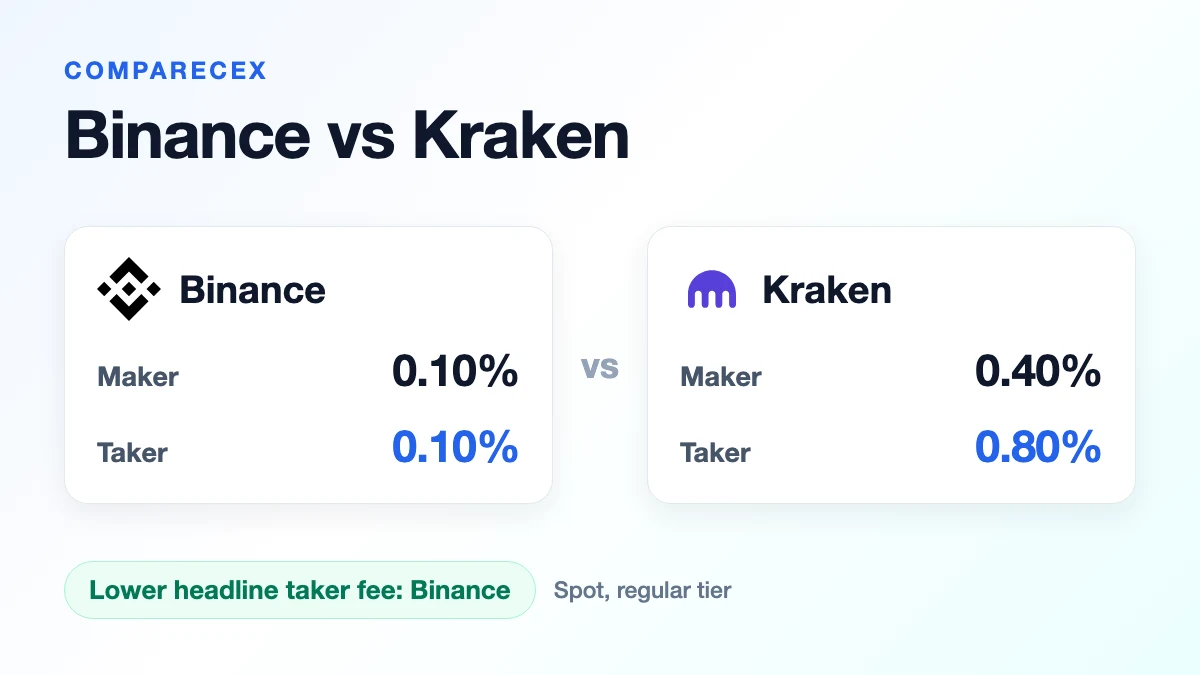
Binance and Kraken are both large, global crypto exchanges, but they are not the same product. Binance was founded in 2017, is based in Abu Dhabi under ADGM/FSRA licensing, and charges a regular-tier fee of 0.10% maker and 0.10% taker†††††. Kraken was founded in 2011, is based in San Francisco under FINRA/SIPC status, and its standard Tier 1 fee (under $2,500 in 30-day volume) is 0.40% maker and 0.80% taker†††††. In short: Binance is usually cheaper and has more coins, while Kraken has a longer track record and a simpler product line.
DISCLOSURE: CompareCEX may earn a commission when you sign up through our links. This does not influence our editorial scores. RISK: Crypto assets are volatile and unregulated in many jurisdictions. Not financial advice.
Binance vs Kraken: Which Exchange Is Right for You?
If you mainly want low trading costs and the widest coin selection, Binance's data points that direction: about 350 coins listed and a 0.10%/0.10% regular-tier fee†††. If you want a US-regulated, longer-running platform with a simpler feature set, Kraken's 2011 founding date and FINRA/SIPC-linked entity may matter more to you than the higher standard fee††. Neither exchange is "better" for everyone — it depends on what you trade, how often, and which rules you're comfortable operating under.
One thing worth remembering before you compare any two exchanges: a ranking or review reflects the reviewer's own capital, goals, and risk tolerance — not automatically yours . Use this article as a starting filter, then check the official fee and terms pages yourself.
How Do Binance and Kraken Fees Compare?
This is the most searched part of any binance vs kraken fees comparison, so here are the numbers side by side.
| Criterion | Binance | Kraken |
|---|---|---|
| Founded | 2017† | 2011† |
| HQ / entity | Abu Dhabi, ADGM† | San Francisco, Payward Inc.† |
| Regulation | FSRA (ADGM) financial services license† | FINRA self-regulatory status; SIPC broker-dealer† |
| Regular maker fee | 0.10% (VIP0 tier)† | 0.40% (Tier 1, <$2.5K/30d)† |
| Regular taker fee | 0.10% (VIP0 tier)† | 0.80% (Tier 1, <$2.5K/30d)† |
| KYC | Required† | Required (ID + proof of address)† |
| Coins listed | ~350 (approx.)† | ~600 (approx.)† |
| Core products | Spot, futures, margin, staking, P2P, card, NFT† | Spot, futures, margin, staking, card† |
| Proof of reserves | Yes† | Not stated; emphasis on self-custody wallet† |
| Support | Live chat + help center, 24/7† | Help center + ticket, 24/7† |
Example 1 — maker order of $1,000: On Binance's regular tier, 0.10% maker fee costs about $1.00†. On Kraken's Tier 1, 0.40% maker fee costs about $4.00† — four times more on the same trade size.
Example 2 — taker order of $1,000: Binance's 0.10% taker fee costs about $1.00†. Kraken's 0.80% taker fee costs about $8.00†. Fees compound with frequency, so an active trader feels this gap far more than someone who trades once a month.
For your own trade sizes and frequency, run the numbers through our fee calculator instead of estimating by memory.
Why Do Binance vs Kraken Fees Look Different on Reddit?
If you've searched binance vs kraken fees reddit or binance vs kraken pro fees, you've probably seen conflicting numbers. Part of the reason is that the rate you pay depends on your tier: Kraken's entry tier is 0.40% maker / 0.80% taker, and it falls as your 30-day volume rises††. Older third-party pages still quote a lower starting rate that no longer matches Kraken's published schedule, which is where most of the conflicting numbers come from — check the current fee page for your own tier, and see our Kraken profile for the dated source we cite. Binance's figures are more consistent across sources at 0.10%/0.10% for the regular VIP0 tier††, but they too can shift with volume tiers and payment method.
This is a good example of why you shouldn't trust a screenshot from a forum thread: fee schedules change, and old Reddit posts don't update themselves. Always confirm on the exchange's live fee page before you trade.
What Is Kraken Pro, and How Does It Compare to Binance?
Kraken Pro is Kraken's advanced order-book interface, aimed at users who want the same account but professional-style charting and order types — this is the interface the 0.40% maker / 0.80% Tier 1 schedule above applies to††. It is not the same fee structure as the standard Kraken app: Kraken's own fee schedule states the standard app charges a flat 1% fee on instant and recurring buys and a 1.5% fee on custom orders, on top of a spread built into the displayed price (source: kraken.com/features/fee-schedule, checked 2026-09-08). So "Kraken vs Kraken Pro" is not just an interface choice — it's a real fee difference, and switching to Kraken Pro for the same trade can cut the cost by more than half. People searching binance vs kraken pro or binance vs kraken pro reddit are usually comparing Binance's standard view against Kraken Pro specifically, not the standard Kraken app. Based on the confirmed feature data, both platforms offer spot, futures, margin, and staking††, so beyond the app-vs-Pro fee gap on Kraken's side, the practical difference is interface and fee tier rather than product range. Binance additionally lists P2P trading and NFT support, which Kraken's feature data does not confirm††.
Binance vs Kraken vs Coinbase: How Do They Stack Up?
Coinbase is now in our Knowledge Graph — its spot fees are tiered by 30-day volume, 0%–0.40% maker and 0.05%–0.60% taker†† — so the three-way picture is no longer guesswork. What we can say from confirmed data: Binance has more listed coins (~350) than Kraken (~600 is Kraken's own figure, so Kraken actually lists more)††, and Binance's regular-tier fees are lower than Kraken's Tier 1 fees††††. For a full three-way breakdown, see our dedicated pages at Binance vs Coinbase and /compare/coinbase-vs-kraken/.
Are Binance and Kraken Available in the UK?
We do not have UK-specific licensing data verified in our Knowledge Graph for either exchange, so we won't state a UK regulatory status here — that would be guessing. What is confirmed is Binance's ADGM/FSRA license (Abu Dhabi) and Kraken's FINRA/SIPC-linked US entity††, neither of which is a UK authorization by itself. If you're searching binance vs kraken uk, check each exchange's current UK compliance page directly before signing up, since regulatory status can change faster than review articles get updated.
Step by Step: How to Choose Between Binance and Kraken
- List what you actually need. Spot only, or also futures/margin/staking? Both platforms cover these††, so this step mostly narrows by fee tier and coin list.
- Estimate your monthly trade volume. Run it through the fee calculator using the maker/taker rates above.
- Check your region's access and KYC requirements. Both require identity verification††; confirm your country isn't restricted on the official site.
- Read the current fee schedule yourself, not a forum screenshot — fee tiers shift with volume and change over time.
- Decide your risk rules before you fund an account, not after. This matters more than which exchange you pick.
- Open the account using our review pages for Binance and Kraken, which break down each platform in more depth.
If you're still unsure which fits your situation, our exchange finder tool asks a few questions and narrows the list for you.
Common Mistakes When Comparing Binance and Kraken
- Trusting a remembered fee number instead of checking the source. Fee tiers change, and relying on memory or an old thread is how people overpay. A practical habit borrowed from trading discipline: log the actual fee you paid on each trade the way you'd log a trade outcome, rather than assuming you know the rate .
- Picking an exchange because a forum said so, without checking if it fits your own capital and goals. Advice — including this article — is filtered through someone else's situation, not yours automatically .
- Turning on margin or futures immediately because the option exists. Both exchanges offer margin and futures††, but access isn't a recommendation to use them. A useful (if unusual) discipline trick: set yourself a hard monthly stop, for example "stop trading if I'm down 5% or up 10% this month," the same external-limit logic that funded-account challenges force on traders — you can apply it to your own account without joining any challenge .
- Assuming lower headline fees always mean lower total cost. Withdrawal fees, spreads, and payment method surcharges aren't captured in the maker/taker numbers above and should be checked separately on each exchange's official fee page.
- Skipping the regulation and security section entirely. Proof-of-reserves status and licensing differ between the two†††† and matter more than they seem to when something goes wrong.
Verdict by User Type
- Cost-focused active traders: Binance's regular-tier fees (0.10%/0.10%) are lower than Kraken's Tier 1 (0.40%/0.80%)††††, which adds up quickly at volume.
- Users who prioritize a long track record and US regulatory ties: Kraken's 2011 founding date and FINRA/SIPC-linked entity may weigh more than the fee gap††.
- Coin hunters: Kraken's own figure of ~600 listed coins is higher than Binance's ~350††.
- Beginners who want an all-in-one app: Binance's broader feature set (P2P, card, NFT, in addition to spot/futures/margin/staking) covers more use cases in one account†.
Read the full reviews before deciding: Binance review and Kraken review. See how we score exchanges in our methodology, and how affiliate links work on this site in our affiliate disclosure.
Ready to try Binance?
Availability in your region is unclear — check local regulations.
CompareCEX may earn a commission when you sign up through our links. This does not influence our editorial scores.
Ready to try Kraken?
CompareCEX may earn a commission when you sign up through our links. This does not influence our editorial scores.
Related guides
- lowest-fee crypto exchanges — where Binance and Kraken land once platforms are ranked on cost alone.
- maker vs taker fees explained — why Kraken publishes two different rates for the same trade.
- Binance vs OKX — another Binance matchup if regulation is less of a deciding factor for you.
FAQ
Is Kraken cheaper than Binance?
Not at the regular/Tier 1 level: Binance's regular tier is 0.10% maker / 0.10% taker, while Kraken's Tier 1 is 0.40% maker / 0.80% taker††††. Higher-volume tiers on both exchanges lower these rates — check the live schedules for your tier.
Does Kraken have more coins than Binance?
Based on each platform's own figures, yes: Kraken lists roughly 600 coins versus Binance's roughly 350††, though both counts are approximate and change over time.
Is my crypto safer on Binance or Kraken?
Binance states it publishes proof of reserves; Kraken's public data emphasizes self-custody wallet options rather than confirming proof of reserves††. Neither claim in our data set covers insurance funds or historical incident response — check each exchange's security page directly for that.
Can I use Binance and Kraken at the same time?
Nothing in the verified data suggests either exchange restricts holding accounts on both. Many users split holdings across exchanges for access to different coins or fee structures — just remember each account needs its own KYC and security setup††.
Updated September 4, 2026. This article is for education, not investment advice. Always confirm current fees, coin lists, and regulatory status directly on the exchange's official website before signing up.
Affiliate link — we may earn a commission. How we're funded
Visit Binance