Bitget Review 2026: Fees, Copy Trading, and the Licence Gap
An honest Bitget review: verified 0.10% fees, products, KYC and country access, plus the regulatory registration we could not find anywhere.
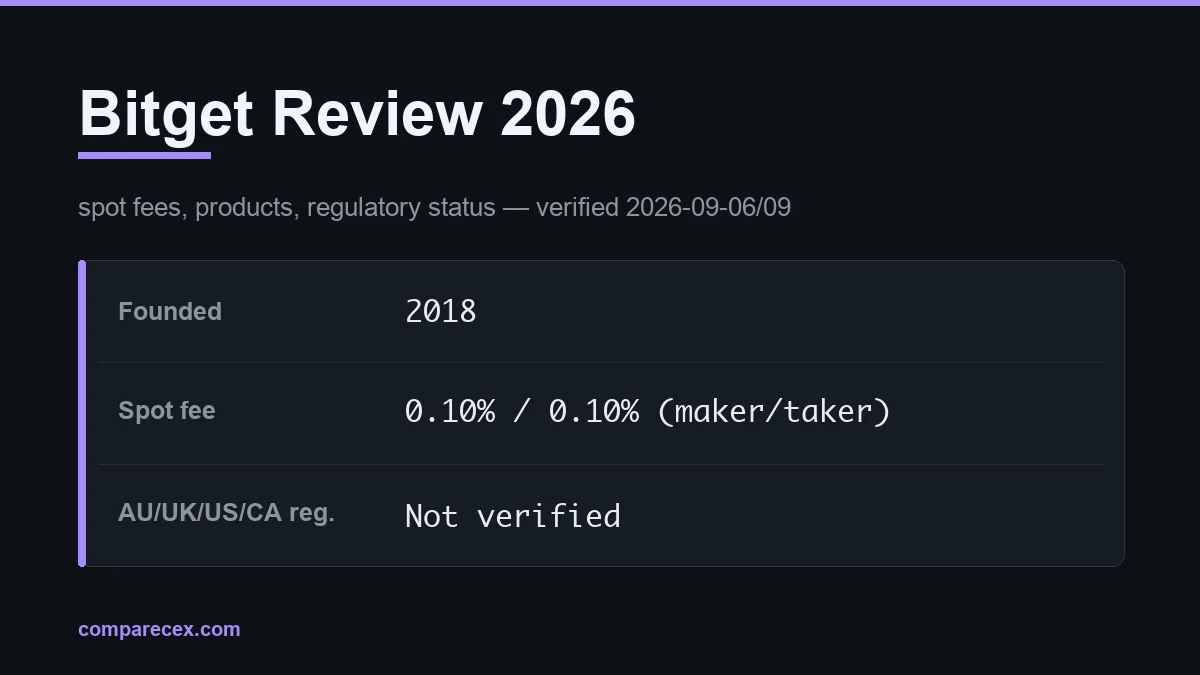
Bitget fits an active trader who wants spot, futures, margin, staking and copy trading on a single account at a flat 0.10% maker and 0.10% taker rate on the regular tier††. It is a poor fit if you are in the United States, which Bitget's own Terms of Use list as a prohibited country, or if you want a regulator in your own market standing behind the venue — we found no Bitget registration in any of the four markets we track. This review covers the fees, products, KYC and country access we could verify, and names the gaps instead of filling them.
DISCLOSURE: This is educational content, not investment advice. CompareCEX may earn a commission when you sign up through our links. This does not influence our editorial scores.
RISK: Crypto assets are volatile and unregulated in many jurisdictions. Not financial advice.
Who Should Use Bitget, and Who Should Skip It?
Bitget suits a trader who already has a method and wants one login for spot, futures, margin, staking and copy trading rather than accounts at three venues†. The pricing matches that profile: a flat 0.10% per side at the regular VIP0 tier††, which does not penalise frequent trading the way a volume ladder does. The company has operated since 2018† and is headquartered in Singapore†.
Skip Bitget if a licensed counterparty is part of what you are buying: nothing in our data shows a Bitget registration with any authority in the US, UK, Canada or Australia. Skip it too if you want a proof-of-reserves attestation first — we hold no such record for Bitget in either direction, and we will not invent the answer. Beginners who only buy and hold will find the derivatives-heavy interface more machinery than they need; our best exchanges for beginners list is a better starting point.
What Are Bitget's Trading Fees?
Bitget charges 0.10% maker and 0.10% taker on spot at the regular VIP0 tier††. The flat structure matters more than the headline number: on a tiered schedule most retail accounts never generate enough monthly volume to leave the expensive rung, so the advertised "as low as" rate is not the rate they pay. Our maker vs taker fees guide explains which side you actually end up on.
Here is a round trip — one market buy and one market sell, both taker orders — on a $2,000 position at each exchange's entry-level rate†††:
| Scenario | Taker rate (both sides) | Cost on $2,000 |
|---|---|---|
| Bitget, regular VIP0 tier | 0.2%† | $4 |
| Kraken, Tier 1 (under $2,500 30-day volume) | 1.6%† | $32 |
| Binance, VIP0 regular tier | 0.2%† | $4 |
Fees cannot separate Bitget from Binance: both charge 0.10% per side at the regular tier, so the round trip costs $4 on either††. The real gap is an entry-tier Kraken account, where Tier 1 taker pricing of 0.80% per side turns that $4 into $32† — an eight-times difference that compounds across every trade in a year. Maker orders narrow it without closing it: Kraken's Tier 1 maker rate is 0.40% against Bitget's 0.10%††. Our lowest-fee crypto exchange guide ranks the same verified rates across more venues.
One cost we cannot quote: withdrawal and network fees. We have no verified withdrawal-fee data for Bitget and will not estimate one. Check the figure on Bitget's own withdrawal screen before moving funds — on a small balance it can outweigh everything you saved on trading fees.
Ready to try Bitget?
Not available in United States.
See a verified alternative →What Products Does Bitget Offer?
Bitget runs spot, futures, margin, staking and copy trading on one account, and has no P2P marketplace and no crypto card in our records†. Copy trading is the feature that distinguishes it from both comparison exchanges here: Kraken has none on file†, and Binance's product list does not include it either, though Binance does carry P2P and a card that Bitget lacks†.
Funding runs through bank transfer, card and crypto deposits†. There are iOS and Android apps†, roughly fifteen interface languages†, and support through a help centre, a ticket system and live chat, listed as 24/7†. We have no verified average response time, so we will not quote one.
Is Bitget Regulated?
Not in any market we track. We looked for a Bitget registration with FinCEN or the SEC in the US, the FCA in the UK, the provincial members of the Canadian Securities Administrators, and AUSTRAC in Australia. We found none as of 2026-09-06. Operating from Singapore† since 2018† is a track record, not a licence, and the two are not interchangeable.
Say it plainly, because the softer framing misleads: "not prohibited in your country" is not the claim "registered in your country". The UK and Australia rows below mean only that Bitget's Terms of Use do not list those markets as prohibited. No authority in either has authorised the platform in anything we could verify, or taken on any duty toward your balance there.
Both comparison exchanges have something documented. Kraken holds a FINRA self-regulatory membership and SIPC broker-dealer status in the US†. Binance holds an FSRA financial services licence through ADGM in Abu Dhabi† and a proof-of-reserves record on file†. Neither is deposit insurance and neither guarantees your funds. What they give you is a named authority with a stated obligation — the thing we could not locate for Bitget. See our ranking methodology for how we weight registration against fees and product breadth.
What KYC Does Bitget Require?
Bitget requires identity verification on a standard account†. We have no itemised document checklist verified from Bitget's own help pages, so we will not guess at proof-of-address rules, pre-verification withdrawal limits or turnaround times. Assume a government-issued photo ID at minimum, and read Bitget's verification page for your country before you deposit rather than after.
Is Bitget Available in My Country?
Here is every status we could verify for the four markets we track, checked 2026-09-12 against Bitget's own Terms of Use:
| Market | Status | Source |
|---|---|---|
| United States | Prohibited — listed as a prohibited country | Bitget Terms of Use |
| Canada | Prohibited — listed as a prohibited country, the whole country, not a single province | Bitget Terms of Use |
| United Kingdom | Not prohibited — absent from the prohibited-countries list, with no UK registration found | Bitget Terms of Use |
| Australia | Not prohibited — absent from the prohibited-countries list, with no AUSTRAC registration found | Bitget Terms of Use |
Read the Canadian row plainly: Canada is named as a whole country on Bitget's prohibited list, alongside the US, mainland China, Hong Kong, Singapore and others — there is no province-by-province carve-out. If you are Canadian, this platform is not open to you regardless of where you live in the country. If your country is not one of these four, we have no verified coverage and will not extrapolate.
What Are Bitget's Pros and Cons?
| Pros | Cons |
|---|---|
| Flat 0.10% maker and taker at the regular VIP0 tier†† | No verified regulatory registration in the US, UK, Canada or Australia |
| Spot, futures, margin, staking and copy trading on one account† | United States listed as a prohibited country in Bitget's own terms |
| Operating since 2018, headquartered in Singapore†† | Canada listed as a prohibited country in full, alongside the US |
| iOS and Android apps, roughly 15 languages, 24/7 help centre, tickets and live chat††† | No proof-of-reserves record on file either way — an absence, not a clean bill |
| Flat pricing far below Kraken's 0.80% entry-tier taker rate† | No P2P and no card†; withdrawal fees not verified in our data |
What Mistakes Do People Make When Choosing Bitget?
- Mistaking a wide product menu for a trading plan. Our knowledge base makes a distinction that applies directly here: knowledge only tells you whether something is true in theory, never what to do next, and the missing part is tactics — including the third order state most people forget exists, which is placing no order at all . An account with spot, futures, margin and copy trading side by side† gives you four buttons for "act" and none for "sit still". A platform that can express any position you imagine is most dangerous on the days your reason for taking one is thin.
- Reading a low trading fee as a low total cost. The 0.10% per side is verified†, but withdrawal and network fees are not in our data, and on a small position those can exceed the trading cost entirely.
- Treating "not on the prohibited list" as regulatory approval. For the UK and Australia, absence from Bitget's prohibited-countries list is the only thing we verified. No authority in either market has registered the platform in anything we found.
- Assuming a "province-by-province" reading applies here. Bitget's terms name Canada as a whole country on the prohibited list — there is no province that is exempt.
- Comparing Bitget to Binance on fees alone. Both sit at 0.10% per side at the regular tier††, so the decision has to be made on licences, products and country access instead — see Binance vs Bitget for that side by side.
How Do You Decide Between Bitget and a Registered Alternative?
- Check your own country first. If you are in the US or Canada, the fee table is irrelevant — both are prohibited under Bitget's own terms.
- Decide whether a supervised counterparty is part of the price. If it is, compare against a venue with a documented registration such as Kraken, and treat the higher entry-tier fee as what that supervision costs you.
- Run your real order size through the fee calculator rather than trusting a headline rate, then check the withdrawal fee on the platform itself.
- Write down your own maximum loss before you use copy trading or futures — in the platform's own risk settings, not in your head. Following another trader moves the decision, not the exposure.
Related guides
- Binance vs Bitget — two flat-fee exchanges separated by licences and product menu, not price.
- Lowest-fee crypto exchange — verified maker and taker rates ranked across the market.
- Bybit vs MEXC — the same trade-off between low flat fees and thin regulatory coverage.
FAQ
Is Bitget available in the US?
No. Bitget's own Terms of Use list both the United States and Canada as prohibited countries, checked 2026-09-12 — Canada in full, not one province.
Is Bitget cheaper than Kraken?
At entry level, substantially. Bitget charges 0.10% per side at its regular VIP0 tier against Kraken's Tier 1 taker rate of 0.80%††, which is $4 versus $32 on a $2,000 round trip. Kraken's Tier 1 maker rate of 0.40% is still four times Bitget's 0.10%††. Regulatory standing runs the other way.
Does Bitget require KYC?
Yes. Identity verification is required on a standard Bitget account†. We have no verified document checklist from Bitget's help pages, so check its verification page for what your country needs before signing up.
See our low-fee exchange list and the Bitget exchange profile for more comparisons.
RISK: Crypto assets are volatile and unregulated in many jurisdictions. Not financial advice.
Last updated: 2026-09-13