Bybit Fees Explained: What You Actually Pay Per Trade
Bybit's regular spot fee is 0.10% maker and taker, tying Binance and beaten only by OKX's 0.08% maker rate, verified with $1,000 and $5,000 examples.
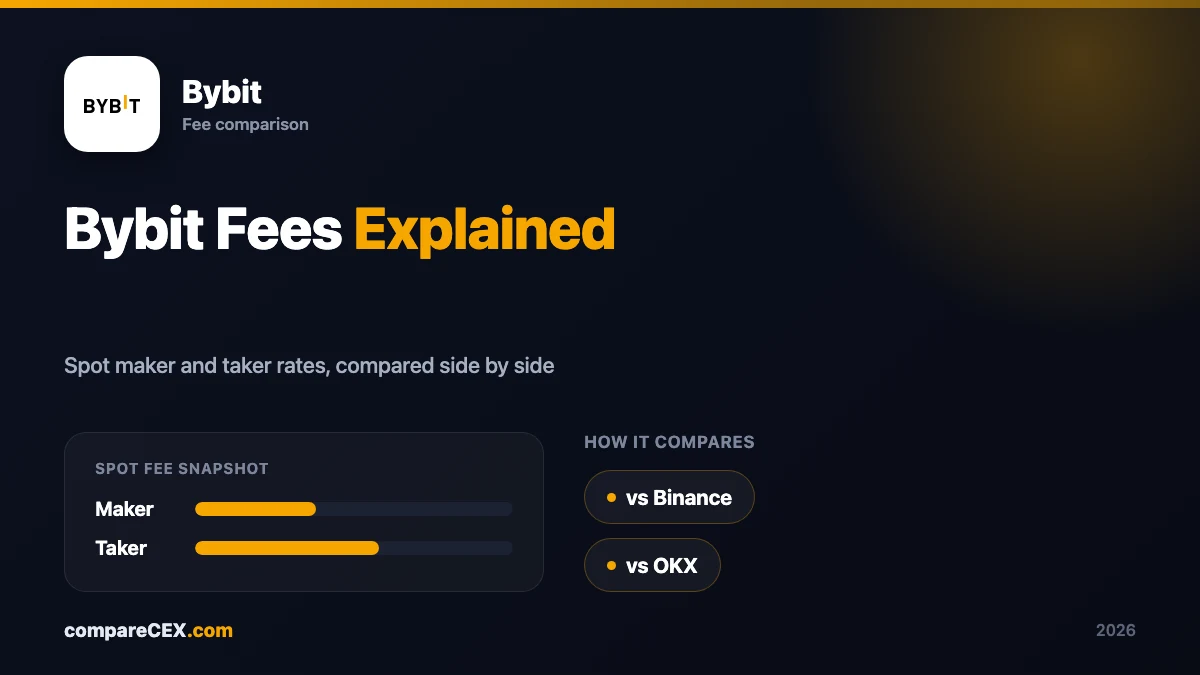
Bybit's regular spot trading fee is a flat 0.10% for maker orders and 0.10% for taker orders, with no 30-day volume minimum required††. That ties Binance's regular rate of 0.10% maker and 0.10% taker††, while OKX undercuts both on the maker side at 0.08%, even though its taker rate is the same 0.10%††. Below, we turn those percentages into dollars at $1,000 and $5,000, explain how funding rates work on Bybit's perpetual contracts, and compare all three exchanges side by side.
DISCLOSURE: CompareCEX may earn a commission when you sign up through our links. This does not influence our editorial scores.
RISK: Crypto assets are volatile and unregulated in many jurisdictions. Not financial advice.
What Are Bybit's Regular Trading Fees?
Bybit's entry-level tier, sometimes labeled "regular" or VIP0, applies from the moment you open an account — there is no volume threshold to unlock it.
| Item | Rate | Source |
|---|---|---|
| Maker fee (Regular/VIP0) | 0.10%† | Bybit official Spot Trading Fee article |
| Taker fee (Regular/VIP0) | 0.10%† | Bybit official Spot Trading Fee article |
| KYC | Required† | Bybit help center |
| Derivatives/futures fees | Not verified in our data | bybit.com derivatives fee schedule, checked 2026-09-13 |
| Withdrawal fees | Not verified in our data | Varies by network and asset; check Bybit's current withdrawal page before moving funds, checked 2026-09-13 |
The 0.10%/0.10% figure covers spot trading at the regular tier††. Bybit's own fee page also notes that maker orders can earn a rebate at higher volume tiers, but we do not have a verified percentage for that rebate, so this article sticks to the confirmed regular-tier rate rather than guessing at a discount (bybit.com/en/help-center/article/Spot-Trading-Fee, checked 2026-09-13). We could not confirm exact numbers for derivatives (futures) fees or withdrawal fees from our data sources — check Bybit's official fee schedule directly (bybit.com/en/help-center, checked 2026-09-13) before trading or withdrawing.
How Much Does a Smaller Trade Actually Cost You?
Here is a round-trip calculation with the assumptions stated up front: both the entry and the exit filled as market (taker) orders, at each exchange's regular, non-discounted rate.
- Bybit, taker round trip: 0.10% taker × 2 sides = 0.20% of $1,000 = $2.00†
- Binance, taker round trip: 0.10% taker × 2 sides = 0.20% of $1,000 = $2.00†
- OKX, taker round trip: 0.10% taker × 2 sides = 0.20% of $1,000 = $2.00†
At the taker rate, all three exchanges land on the exact same $2.00 round-trip cost, because Bybit, Binance, and OKX all charge 0.10% taker at their entry tier†††. The gap only shows up when you use limit (maker) orders instead of market orders:
- Bybit, maker round trip: 0.10% maker × 2 sides = 0.20% of $1,000 = $2.00†
- Binance, maker round trip: 0.10% maker × 2 sides = 0.20% of $1,000 = $2.00†
- OKX, maker round trip: 0.08% maker × 2 sides = 0.16% of $1,000 = $1.60†
If your strategy relies on limit orders, OKX's lower maker rate saves you $0.40 per $1,000 round trip compared with Bybit or Binance††. That gap is small in dollar terms at this size, but it scales directly with your trade volume.
How Does the Cost Compare on a Larger Trade?
Same method, scaled up to a bigger position, full round trip:
- Bybit, taker round trip: 0.20% of $5,000 = $10.00†
- Binance, taker round trip: 0.20% of $5,000 = $10.00†
- OKX, taker round trip: 0.20% of $5,000 = $10.00†
- Bybit, maker round trip: 0.20% of $5,000 = $10.00†
- Binance, maker round trip: 0.20% of $5,000 = $10.00†
- OKX, maker round trip: 0.16% of $5,000 = $8.00†
At $5,000, the taker-order cost is identical across all three exchanges, and the maker-order gap between OKX and Bybit widens to $2.00††. Run your own position size through our fee calculator instead of assuming which exchange is cheaper for your specific order type and size.
Ready to try Bybit?
Not available in United States.
See a verified alternative →What Is a Funding Rate on Bybit's Perpetual Contracts?
A perpetual contract has no expiry date, so exchanges need a mechanism to keep its price tethered to the underlying spot price. That mechanism is the funding rate: a small payment exchanged periodically (commonly every eight hours) directly between traders holding long positions and traders holding short positions — Bybit does not keep this payment as a fee.
When the funding rate is positive, long-position holders pay short-position holders; when it is negative, the payment flows the other way. The rate itself is calculated from the gap between the perpetual contract's price and the spot price, plus an interest rate component, and it resets on a fixed schedule rather than being announced in advance. We are not going to state what the current or future funding rate on any pair is, or predict which direction it will move — that number changes continuously and any specific figure printed here would be stale within hours. Our knowledge base's core stance on this is to treat the market as something you read, not something you forecast: work from what the data is showing right now, and set your plan around the nearest concrete checkpoint rather than a guess about what happens next . Before opening a perpetual position, check the live funding rate on Bybit's own contract page, since it is only meaningful at the moment you're about to hold the position through a funding interval.
Does Bybit or Binance Charge Less Overall?
| Exchange | Maker fee | Taker fee | KYC |
|---|---|---|---|
| Bybit | 0.10%† | 0.10%† | Required† |
| Binance | 0.10%† | 0.10%† | Required† |
| OKX | 0.08%† | 0.10%† | Required† |
On taker orders, Bybit and Binance are tied at 0.10%, and OKX matches them at the same 0.10%†††. The only spot-fee difference among the three at the regular tier is OKX's lower 0.08% maker rate†, which only matters if you place limit orders rather than market orders. For a full head-to-head beyond fees, see our Bybit vs Binance comparison and our Bybit vs OKX comparison.
What Mistakes Do Traders Make About Bybit's Fees?
- Assuming Bybit is automatically cheaper than Binance. At the regular tier, both charge the identical 0.10% maker and 0.10% taker rate†††† — there is no spot fee advantage either way until you reach higher volume tiers.
- Overlooking OKX's maker discount. OKX's 0.08% maker rate† is lower than Bybit's or Binance's 0.10% maker rate, but only for limit orders that actually get filled as maker.
- Quoting a maker rebate percentage that isn't verified. Bybit's fee page mentions maker rebates exist at higher tiers, but we do not have a confirmed number for it, so treat any specific rebate percentage you see elsewhere with caution until you check Bybit's current schedule directly.
- Confusing spot fees with derivatives fees. The maker/taker rates in this article cover spot trading only††; Bybit's futures fee schedule is separate and not verified in our data.
- Treating the funding rate as a fee you can predict. It changes on a fixed schedule based on live market conditions, not a static number — check it at the time you actually open a perpetual position.
- Checking only one side of a round trip. A single order pays the fee once; a full round trip pays it twice, which is why every example above uses two-sided math.
How Do You Lower Your Bybit Fee Bill?
- Use limit orders where your strategy allows it. Bybit's maker rate is the same 0.10% as taker at the regular tier†, but placing a limit order still risks not getting filled.
- Compare your real trade size against Binance and OKX using our fee calculator — the maker-side gap only shows up once you factor in order type, as shown above.
- Read our guide on maker vs taker fees to understand why the same trade can be charged two different rates depending on how the order fills.
- Read the methodology behind how we verify exchange fee data, and cross-check Bybit's current schedule directly, since rates and tiers can change over time.
Our Binance fees guide breaks down Binance's own schedule using the same worked-example method, and our Bybit exchange profile covers what else the platform offers beyond fees.
FAQ
Are Bybit's fees really just 0.10%?
At the regular tier, yes — 0.10% maker and 0.10% taker on spot trades, with no volume requirement††. Rates below that require higher volume tiers most retail accounts don't reach, and we don't have a verified number for those tiers.
Does Bybit charge less than Binance?
No — at the regular tier, both charge the identical 0.10% maker and 0.10% taker rate on spot trades††††. See our Bybit vs Binance comparison for the full picture beyond fees.
Does Bybit charge withdrawal fees?
We do not have verified data on withdrawal fees for specific assets and networks, so we will not state a number here. Check Bybit's current withdrawal fee schedule directly before moving funds off the exchange.
Is Bybit available to US residents?
Bybit's own help center publishes a list of service-restricted countries tied to its KYC requirements†, but we could not confirm a current, specific statement on US availability from our data sources. If you are in the US, check Bybit's restricted countries page directly (bybit.com/en/help-center/article/Service-Restricted-Countries, checked 2026-09-13) rather than assuming access.
See our best low-fee exchanges list for more comparisons, and read our affiliate disclosure for how we're funded.
RISK: Crypto assets are volatile and unregulated in many jurisdictions. Not financial advice.
Last updated: 2026-09-13
Related guides
- OKX Fees Explained: Spot Maker, Taker and What You Actually PayOKX charges 0.08% maker and 0.10% taker on regular spot trades, checked against Binance and Bybit with $1,000 and $5,000 examples.
- Best Crypto Exchange Australia: 3 AUSTRAC-Registered PicksThe three exchanges we verified as AUSTRAC-registered, compared on spot fees, product menu and the structural limits that hold undisciplined traders back.
- Best Crypto Exchange Canada: 2 CSA Restricted Dealers ComparedThe only two exchanges verified as registered Restricted Dealers in Canada, compared on spot fees, product limits, and the margin-trading ban.