Coinbase Review 2026: Fees, Security, and Who It's Actually For
An honest Coinbase review: verified fees, security, licences and KYC data, plus who Coinbase suits and who should look elsewhere.
Last verified: See our sources
Coinbase review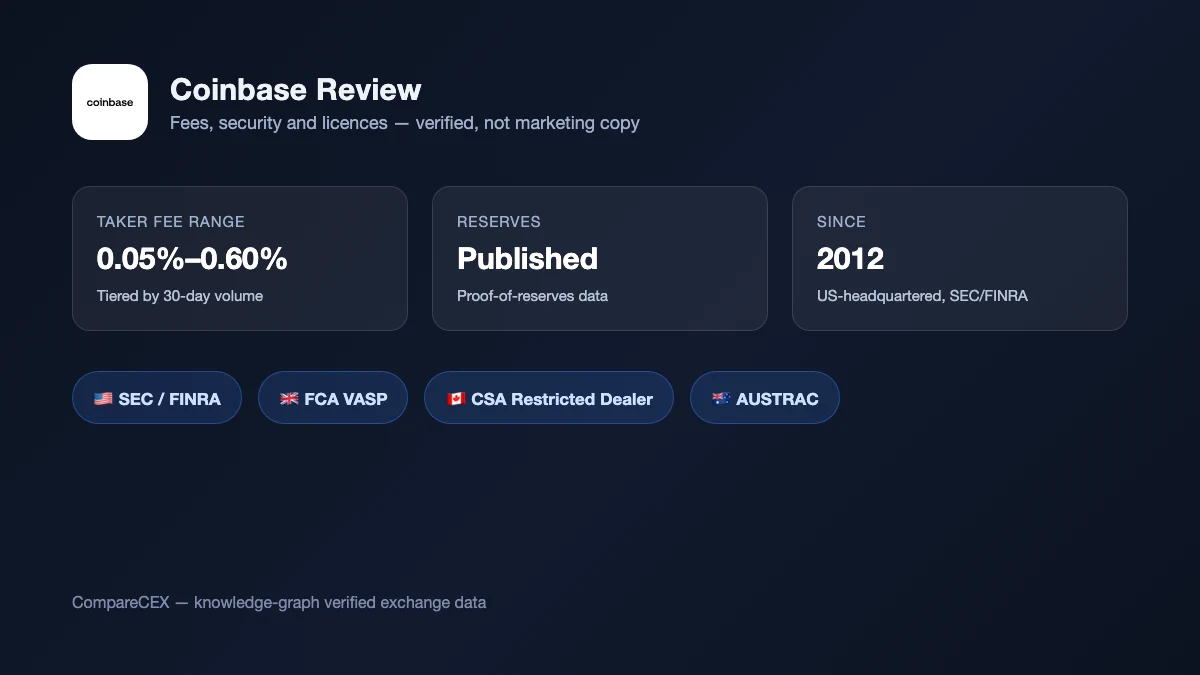
Coinbase is a good fit if you want a long-running, publicly listed, US-headquartered exchange with a straightforward app, and you are not chasing the lowest possible trading fee. It is a poor fit if you trade often, want futures or margin on the same account, or need the cheapest taker rate you can find, since its fee schedule sits well above flat-rate competitors at low volume†. This review walks through what we could verify about its fees, products, licences, KYC process and country coverage, so you can decide before you sign up.
DISCLOSURE: CompareCEX may earn a commission when you sign up through our links. This does not influence our editorial scores.
RISK: Crypto assets are volatile and unregulated in many jurisdictions. Not financial advice.
Who Should Use Coinbase, and Who Should Skip It?
Coinbase suits a beginner or a long-term holder who trades infrequently, values a company that has operated since 2012† and publishes proof of reserves for its wrapped tokens such as cbBTC†, and does not mind paying more per trade for that track record. It is headquartered in the US† and holds a broker-dealer registration with the SEC and a self-regulatory membership with FINRA†.
Skip Coinbase, or at least use it only for the cheaper "Advanced Trade" order book, if you place frequent market orders, since its taker fee runs up to 0.60% at low monthly volume† — several times what flat-fee competitors like Binance charge at 0.10%†. It also carries no futures or margin trading in our records†, so active derivatives traders will need a second platform regardless of how they feel about Coinbase's fees.
What Are Coinbase's Trading Fees?
Coinbase charges a tiered maker fee of 0% to 0.40% and a tiered taker fee of 0.05% to 0.60%, based on your rolling 30-day trading volume††. Most retail accounts trade small enough volume in a month to sit at the expensive end of that range, not the cheap end. We cover the full schedule, a worked dollar example, and a side-by-side against two lower-fee exchanges in our Coinbase fees guide — this review only needs the headline numbers to judge fit.
Here is what that tiered range† means in practice on a round trip of one buy and one sell, both market orders, at a mid-size order amount:
| Scenario | Taker Rate (both sides) | Cost on $2,000 |
|---|---|---|
| Coinbase, high end of tier (typical low-volume account) | 1.2%† | $24 |
| Coinbase, low end of tier (requires high 30-day volume) | 0.1%† | $2 |
| Kraken, entry tier under $2,500 30-day volume | 1.6%† | $32 |
| Binance, flat regular tier | 0.2%† | $4 |
A second number worth knowing: Coinbase's own high-tier taker rate of 0.60% is 12 times its low-tier rate of 0.05%†. That gap is entirely about your monthly volume, not your account size or how long you've been a customer — a $500 order and a $50,000 order at the same tier pay the identical percentage.
Ready to try Coinbase?
Please check local regulations before signing up.
What Products Does Coinbase Offer?
Coinbase runs a spot market, staking, and an "Earn" program, plus an advanced order-book interface alongside its simplified consumer buy flow†. It does not offer futures or margin trading and has no copy-trading feature in our records† — a meaningful gap if you're comparing it against exchanges that bundle spot and derivatives into one account. Both iOS and Android apps are available†, and funding methods include bank transfer, card, and crypto deposits†.
Support runs through email, a support ticket system, and a help center, with 24/7 availability†. We do not have a verified number for average response time, so we won't estimate one.
Is Coinbase Regulated and Secure?
In the US, Coinbase holds a broker-dealer registration with the SEC and is a FINRA member†, and the company publishes proof of reserves only for its wrapped tokens such as cbBTC, not an exchange-wide proof of customer balances† — and even where it exists, proof of reserves shows a snapshot of holdings, not an ongoing guarantee, and we have not independently audited it.
Outside the US, Coinbase has registered with regulators in each of the three other markets we track for this review, based on the exchange's own announcements (checked 2026-09-06):
| Market | Registration | Source |
|---|---|---|
| United Kingdom | VASP registration with the FCA; its payments entity, CB Payments Ltd, holds an EMI licence (MLR reference 900635) | Coinbase UK VASP announcement |
| Canada | Registered as a Restricted Dealer with the Canadian Securities Administrators | Coinbase Canada announcement |
| Australia | AUSTRAC registration covering both VASP and remittance activity | Coinbase Australia licences page |
A registration like this is an anti-money-laundering and reporting obligation, not deposit insurance and not a promise that your funds are safe from a hack or an operational failure. For the deeper security question — past incidents, custody design, and what "regulated" does and does not cover — see our dedicated is Coinbase safe guide.
What KYC Documents Does Coinbase Require?
Coinbase requires identity verification (KYC) on every standard account; there is no way to trade meaningfully without it†. In practice this typically means a government-issued photo ID and a selfie match, though we do not have a verified, itemized document checklist from Coinbase's own help pages to list here, so we won't guess at specifics like proof-of-address requirements or verification turnaround time.
Is Coinbase Available in My Country?
Coinbase operates with a registered presence in the US, UK, Canada, and Australia, based on the sources above. For four countries under international sanctions — Iran, North Korea, Syria, and Cuba — the only status we have on file comes from a third-party tracker, not Coinbase's own help center, so we could not verify an official position and will not claim either way. If your country isn't one of the four markets above, check Coinbase's own country-availability page directly before signing up, since regional access changes over time and we do not have exhaustive verified coverage for every country.
Coinbase: Pros and Cons
| Pros | Cons |
|---|---|
| Operating since 2012, one of the longest track records in the industry† | Taker fee up to 0.60% at low volume, several times flat-rate competitors† |
| SEC broker-dealer registration and FINRA membership in the US† | No futures or margin trading† |
| Registered with FCA (UK), CSA (Canada), and AUSTRAC (Australia) | Simplified buy flow reportedly carries an extra, unverified spread on top of listed fees |
| Publishes proof of reserves for wrapped tokens such as cbBTC (not exchange-wide customer balances)† | Withdrawal fees not verified in our data — check Coinbase directly before moving funds |
| iOS and Android apps, 24/7 support channels†† | Requires full KYC before meaningful use, with no anonymous tier† |
What Mistakes Do People Make When Choosing Coinbase?
- Judging the fee schedule by its lowest advertised number. The 0.05% taker rate is real, but it applies only at high 30-day volume; most retail accounts pay closer to the 0.60% end†.
- Picking a platform on fees alone and ignoring platform risk as a risk-management decision. Our knowledge base's core trading principle draws a hard line between an investor and a gambler by whether risk is measured and capped, not by how the trade feels . Choosing where your funds sit — a registered, longer-running exchange versus a cheaper, less-verified one — is the same kind of capped-risk decision, not a side note to the fee comparison.
- Assuming "regulated" means insured. A VASP or broker-dealer registration is a reporting and compliance obligation on Coinbase, not a guarantee that your holdings are protected if something goes wrong.
- Using the simplified buy flow and comparing its price to the advanced order-book fee schedule. The two interfaces are not verified to carry the same cost structure; check which one you're actually using before assuming the numbers in this article apply.
- Treating country availability as permanent. Registration status and country access both change; re-check Coinbase's own pages before depositing if you have not used the platform in the last few months.
How Do You Decide Between Coinbase and a Cheaper Alternative?
- Estimate your realistic monthly trading volume rather than assuming you'll reach Coinbase's lowest fee tier — most retail accounts don't.
- Run your actual trade size through our fee calculator to see the dollar gap between Coinbase and a flat-fee exchange at your volume.
- Decide whether futures or margin matter to you — if they do, Coinbase's spot-only product menu† rules it out as your only exchange.
- Confirm your own country's current status directly on Coinbase before funding an account, since this article's country data is current only as of the checked date above.
Related guides
- Coinbase fees explained — the full tiered schedule and a worked dollar example.
- Is Coinbase safe? — security track record and custody design in depth.
- Coinbase vs OKX — a head-to-head against a lower-fee global exchange.
- Best Crypto Exchange Canada — Coinbase as one of only two exchanges verified as a registered Restricted Dealer there.
- Best crypto broker for beginners — the criteria behind the "good for beginners" verdict above, applied to any platform.
- Best exchange for staking — Coinbase's mostly-flexible staking style weighed against six other exchanges.
FAQ
Is Coinbase good for beginners?
It can be, mainly because of its simplified buy flow and long operating history since 2012†. The trade-off is a fee schedule that runs up to 0.60% at low volume†, higher than several competitors aimed at more active traders.
Is Coinbase safe to use?
Coinbase publishes proof of reserves only for its wrapped tokens such as cbBTC, not across customer balances, and holds a broker-dealer registration with the SEC in the US††, plus registrations with the FCA, CSA, and AUSTRAC abroad. None of that is deposit insurance. See our is Coinbase safe guide for the fuller security picture.
Does Coinbase support futures trading?
No. Our records show spot trading, staking, and an Earn program, but no futures and no margin†.
Is Coinbase available in my country?
It has a registered presence in the US, UK, Canada, and Australia based on the exchange's own announcements. For any other country, check Coinbase's country-availability page directly, since we do not have verified coverage beyond these four markets.
See our best exchanges list for more comparisons, and read our affiliate disclosure for how we're funded.
RISK: Crypto assets are volatile and unregulated in many jurisdictions. Not financial advice.
Last updated: 2026-09-07