Best Crypto Exchange Canada: 2 CSA Restricted Dealers Compared
The only two exchanges verified as registered Restricted Dealers in Canada, compared on spot fees, product limits, and the margin-trading ban.
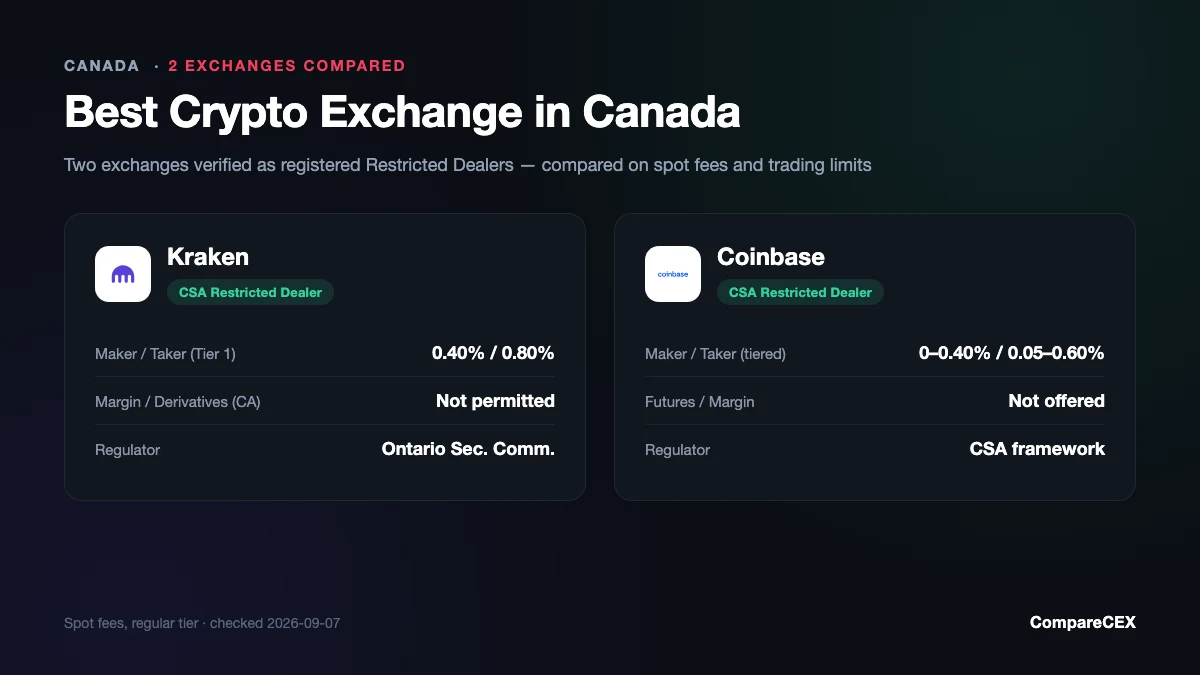
Of the eight exchanges we track, only two hold a registration we could verify directly on the operator's own page as a Canadian Restricted Dealer: Kraken and Coinbase. We name no single winner, because the two differ on price and on what you are structurally allowed to trade. Kraken is registered with the Ontario Securities Commission and regulators in every Canadian province and territory, and separately as a Money Services Business with FINTRAC under Payward Canada, Inc., per Kraken's availability page, checked 2026-09-07. Coinbase obtained its own Restricted Dealer registration under the CSA framework, per Coinbase's announcement, checked 2026-09-06. Binance is widely reported to have exited the Canadian market in 2023, but we found no official Binance announcement confirming it, so the rest of this page treats that status as unresolved rather than confirmed.
DISCLOSURE: CompareCEX may earn a commission when you sign up through our links. This does not influence our editorial scores.
RISK: Crypto assets are volatile and unregulated in many jurisdictions. Not financial advice.
Which Crypto Exchanges Are Actually Registered in Canada?
Registration as a Restricted Dealer is a securities-registration status, checked directly on each operator's page:
- Kraken — Registered Restricted Dealer with the Ontario Securities Commission and with securities regulators in all Canadian provinces and territories, and a Money Services Business with FINTRAC (Payward Canada, Inc., registration M19343731), per Kraken's availability page, checked 2026-09-07.
- Coinbase — Registered as a Restricted Dealer in Canada, per Coinbase's own announcement, checked 2026-09-06.
Be clear about what a Restricted Dealer registration is and is not. It is a securities-registration status that lets a platform legally serve Canadian residents under provincial oversight. It is not deposit insurance, not CDIC or CIPF coverage, and not a promise that your holdings are safe if the exchange fails. Both exchanges also require identity verification before you can trade††. Our ranking methodology sets out how we weight registration.
We do not have verified data on which CAD-specific funding rails — Interac e-Transfer, EFT, wire — each exchange supports for Canadian accounts, so we will not state one here. Check each platform's own deposit page before funding an account.
What Do the Two Registered Exchanges Charge on a Spot Trade?
Every rate below is one side of one trade, at the regular or entry tier, spot only.
| Exchange | Maker Fee | Taker Fee |
|---|---|---|
| Coinbase (tiered) | 0–0.40%† | 0.05–0.60%† |
| Kraken (entry tier) | 0.40%† | 0.80%† |
Kraken's Tier 1 pricing applies below $2,500 of 30-day volume, where nearly every new Canadian account sits†. Coinbase is a range rather than a rate: 0–0.40% maker and 0.05–0.60% taker, moving with your 30-day volume††. A retail account with no volume history sits near the ceiling of that range, not the floor — quoting Coinbase at 0.05% quotes a tier you have not earned. For the mechanics of both sides of a trade, see Maker vs Taker Fees; for all eight exchanges ranked on cost, see our lowest fee crypto exchange breakdown.
What Does a Round Trip Actually Cost You in Dollars?
A percentage on a fee page is half a trade; a real position has two sides. Figures are in USD, because we have no verified CAD conversion rate to apply here. Both sides are assumed filled as taker (market) orders at the regular or entry tier.
| Exchange | $1,000 round trip | $10,000 round trip |
|---|---|---|
| Coinbase (high volume, bottom of tier) | $1.00† | $10.00† |
| Coinbase (retail, top of tier) | $12.00† | $120.00† |
| Kraken (entry tier) | $16.00† | $160.00† |
The arithmetic is taker fee times two sides times position size. Kraken's entry tier: 0.80% x 2 = 1.60%, so $1,000 x 1.60% = $16.00†. Coinbase at the retail ceiling: 0.60% x 2 = 1.20%, or $12.00; at the high-volume floor, 0.05% x 2 = 0.10%, or $1.00 on the same trade†. Multiply by ten for the $10,000 column.
At $1,000 the gap between the cheapest and dearest option here is $15.00; at $10,000 it is $150.00. As a ratio, Kraken's entry tier costs 16x Coinbase's cheapest tier on an identical trade, 1.60% against 0.10%††. Even against Coinbase's own most expensive tier, Kraken's entry rate still costs about a third more, $16.00 versus $12.00. Be honest about what that means at your size: if you buy twice a year and hold, four to fifteen dollars will not decide your outcome; if you round-trip weekly it compounds. Our fee calculator does that arithmetic at your own size.
What Trading Limits Come With Registration in Canada?
This is the part a fee table hides. Kraken's own availability page states plainly that clients residing in Canada cannot trade using margin and cannot trade derivatives, alongside a long list of specific assets that cannot be deposited, held or traded from a Canadian account [source: Kraken availability page, checked 2026-09-07]. That is a narrower menu than Kraken's own product list suggests it can offer, which globally includes futures and margin†: the products exist on the platform, they are simply switched off for you specifically.
Coinbase's restriction runs the other way: our records show no futures and no margin in its product set at all, in any market†, so there is no gap between what the platform can do and what a Canadian account can do. Their proof-of-reserves practices differ in scope: Coinbase publishes proof of reserves only for its wrapped tokens such as cbBTC, not an exchange-wide proof of customer balances†; Kraken publishes Proof of Reserves audits by an independent accounting firm, and clients can verify their own balance against the audit†.
Which Exchange Fits the Discipline You Actually Have?
The most valuable thing about a funded-account challenge is not the capital. It is that a third party enforces the rules your willpower will not: losses capped by someone else, profits force-stopped whether you feel finished or not . The rule lives outside your head, which is the only place it survives a bad afternoon.
Canada's registration regime does something similar to Kraken's Canadian accounts, whether you asked for it or not. The margin and derivatives ban [source: Kraken availability page, checked 2026-09-07] is not a feature you opt into — it is a structural limit on the account, the same logic as a funded-account rule but applied by a regulator instead of a prop firm. Coinbase carries no futures or margin anywhere on the platform†, so the same outcome exists there without a country-specific carve-out at all.
If you have ever caught yourself thinking "just this once" about position size, the practical reality in Canada is that neither registered option lets you act on it with leverage. That removes a decision you might otherwise get wrong. See Coinbase's full fee breakdown for the pricing side of that same choice.
Ready to try Kraken?
CompareCEX may earn a commission when you sign up through our links. This does not influence our editorial scores.
Ready to try Coinbase?
Please check local regulations before signing up.
What About Binance, KuCoin, MEXC, Bitget, OKX and Bybit in Canada?
None of these five have a verified Canadian registration, and most are explicitly restricted rather than merely unregistered:
- Binance — widely reported to have withdrawn from the Canadian market around May 2023 over new stablecoin and investor-limit guidance, but we could not find an official Binance announcement confirming this as of our 2026-09-07 check, so we are not treating it as confirmed. Check Binance's current terms directly before assuming access either way.
- KuCoin — only Ontario and British Columbia are named on its Restricted Locations list; other provinces are not listed either way, per the KuCoin terms of use.
- Bitget — only Alberta is named as a prohibited jurisdiction; other provinces are not listed, per the Bitget terms of use.
- MEXC — Canada is listed as a Prohibited Jurisdiction nationwide, per the MEXC terms.
- OKX — Canada is listed among Restricted Locations, per OKX's risk and compliance disclosure.
- Bybit — Canada is listed as a restricted country, per the Bybit Service Restricted Countries article.
A province-specific block is not the same as a national ban, and neither is the same as a registration. Why these venues still tempt Canadians is worth stating rather than hiding: MEXC quotes 0% maker and 0.05% taker††; KuCoin and Bitget each quote 0.10% maker and 0.10% taker††††; Bybit also quotes 0.10% maker and 0.10% taker††; OKX quotes 0.08% maker and 0.10% taker††. Every one of those rates beats both registered options on this page, and that is the trade being offered: a lower fee against a regulatory position we either cannot verify or that is explicitly restricted for your account.
What Mistakes Do Canadian Traders Make Picking an Exchange?
- Assuming Binance still serves Canada. It is widely reported to have withdrawn nationally in 2023, but we have no official Binance confirmation of that or of its current status — check directly before assuming either way.
- Reading a province-specific block as full national availability. KuCoin blocking only Ontario and British Columbia, or Bitget blocking only Alberta, is not the same as "available across Canada" — the remaining provinces are simply not listed either way.
- Treating Restricted Dealer registration as deposit insurance. It is a securities-registration status, not CDIC or CIPF coverage, and says nothing about what happens to your holdings if the exchange fails.
- Ranking on headline fee while ignoring the margin and derivatives ban. At four trades a year, Kraken's 0.80% taker against Coinbase's floor of 0.05%†† is a rounding error next to what you can and cannot trade with leverage in the first place.
- Assuming Coinbase's advertised low end is your rate. The 0.05% taker floor is a high-volume tier, not a starting rate for a new account†.
Related guides
- Coinbase Fees Explained — the full tiered schedule and where a new account actually lands.
- Lowest Fee Crypto Exchange — all eight exchanges ranked by regular-tier cost.
- Maker vs Taker Fees — the mechanics behind every rate on this page.
- Best Crypto Exchange Australia — the same registered-exchange approach applied to a different market.
- Best Crypto Exchange UK — the same two exchanges, this time cleared by the FCA instead of the CSA.
- Best Crypto Exchange USA — a third licensed pick, OKX, that Canada's Restricted Dealer bar excludes.
- Best EU Crypto Exchange — the same criteria-first approach for EU users, without Canada's Restricted Dealer check.
FAQ
Is Binance available in Canada?
Not confirmed either way. Binance is widely reported to have withdrawn from the Canadian market around May 2023 over new stablecoin and investor-limit guidance, but we found no official Binance announcement confirming this as of our 2026-09-07 check. Check Binance's current terms directly before assuming access.
Does Restricted Dealer registration mean my crypto is protected in Canada?
No. It is a securities-registration status that lets Kraken and Coinbase legally serve Canadian residents under provincial oversight [source: Kraken, Coinbase]. It is not deposit insurance and does not guarantee solvency. Coinbase publishes proof of reserves only for its wrapped tokens such as cbBTC, not across customer balances†; Kraken publishes Proof of Reserves audits by an independent accounting firm that clients can check against their own balance†.
Can I trade with margin or leverage on a registered exchange in Canada?
Not on Kraken: clients residing in Canada cannot trade using margin or derivatives, per Kraken's own availability page, checked 2026-09-07, even though the platform offers both products elsewhere†. Coinbase has no futures or margin on the platform in any market, so the same result holds there without a country-specific rule†.
Which crypto exchange is cheapest for a small Canadian trader?
Of the two registered options, Coinbase can be cheaper at high volume, down to a 0.05% taker floor†, but a new account with no volume history sits closer to its 0.60% ceiling. Kraken's flat entry-tier rate is 0.80% taker†. Venues without a verified Canadian registration quote lower still — MEXC at 0% maker and 0.05% taker†† — which is the trade-off covered above. Run your own size through the fee calculator.
RISK: Crypto assets are volatile and unregulated in many jurisdictions. Not financial advice.
Last updated: 2026-09-07
Affiliate link — we may earn a commission. How we're funded
Visit Kraken