Best Crypto Exchange USA: 3 Licensed Picks, State by State
The three exchanges we verified as licensed to serve US customers, compared on spot fees, product menu, and the New York BitLicense gap between them.
Watch the video version
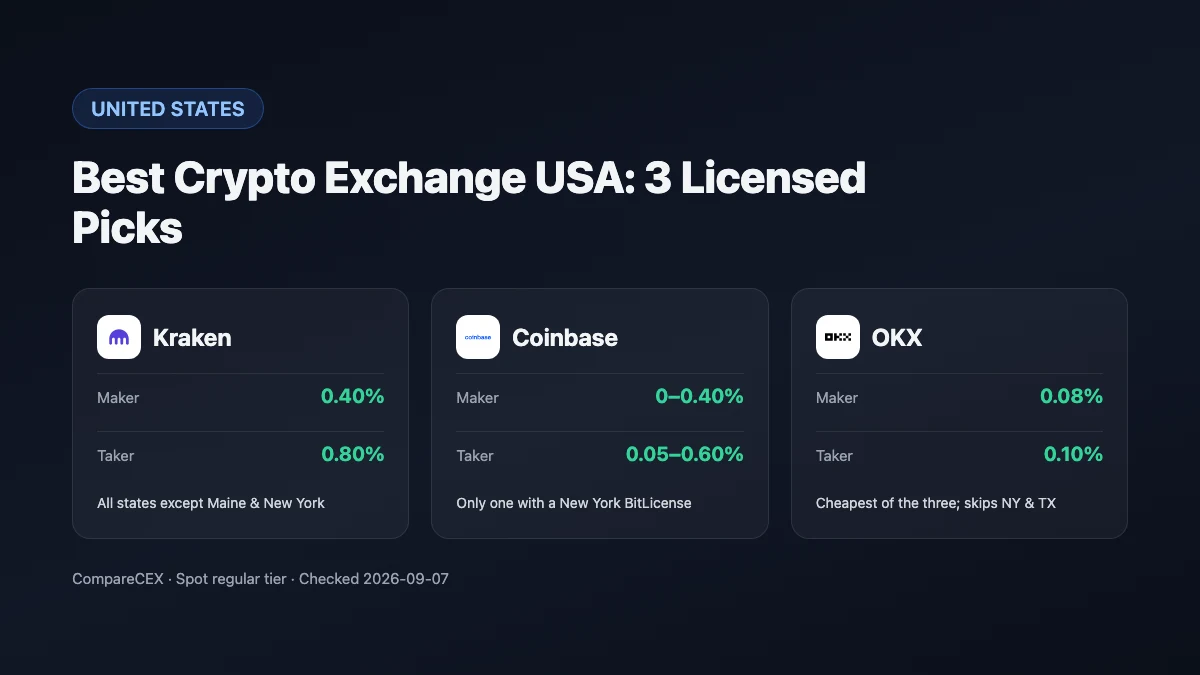
Three of the exchanges we track are licensed to serve US customers on terms we could verify against an official page: Kraken, Coinbase and OKX. We do not name a single overall winner, because the three lead on different things and the right pick depends on your state, your trade frequency and your own self-control. Kraken serves every state except Maine and New York Kraken's country availability page; Coinbase alone holds a New York BitLicense, per NYDFS's 2017 announcement and Coinbase Global's FY2024 Form 10-K; OKX is the cheapest of the three at 0.08% maker and 0.10% taker†† but skips New York, Texas and several US territories, per OKX's US licenses page. Which fact matters most depends on where you live and how often you trade.
DISCLOSURE: CompareCEX may earn a commission when you sign up through our links. This does not influence our editorial scores.
RISK: Crypto assets are volatile and unregulated in many jurisdictions. Not financial advice.
Which Crypto Exchanges Are Actually Licensed to Operate in the US?
Only three exchanges we track have US licensing we could verify on an official page or regulator site, checked 2026-09-06 and 2026-09-07. US licensing is a patchwork of state-by-state money transmitter rules, not one national permit — an exchange can be licensed in 48 states and still closed to you in the other two.
- Kraken — operated by Payward, Inc. (San Francisco)†, available in all US states except Maine and New York, per Kraken's country availability page.
- Coinbase — Coinbase, Inc. holds money transmitter licenses "in the states where such licenses or equivalent are required," plus DC and Puerto Rico, plus a New York BitLicense from NYDFS, per Coinbase Global's FY2024 Form 10-K and confirmed independently by NYDFS's own 2017 announcement. Coinbase's own legal/licenses pages returned a 403 error when we tried to fetch them, so we cite the SEC filing and the regulator instead — the one state Kraken and OKX both exclude.
- OKX — operated by OKX INC., registered with FinCEN as a money services business (NMLS# 1767779) with money transmitter licenses in 48 US jurisdictions, excluding New York, Texas, American Samoa, Guam, the Northern Mariana Islands and the US Virgin Islands, per OKX's US licenses page.
A money transmitter license is a state-level requirement to register, bond and report to state banking regulators. It is not deposit insurance, and it is not a guarantee your funds are safe if the company fails. All three require identity verification before you can trade†††. Our ranking methodology sets out how we weight licensing against everything else.
What Do the Three Licensed Exchanges Charge on a Spot Trade?
Every rate below is one side of one trade, at the regular or lowest tier, spot only. Derivatives and card purchases price differently, and Coinbase and Kraken's schedules move with your 30-day volume.
| Exchange | Maker Fee | Taker Fee |
|---|---|---|
| OKX | 0.08%† | 0.10%† |
| Coinbase (tiered) | 0–0.40%† | 0.05–0.60%† |
| Kraken (entry tier, under $2,500 30-day volume) | 0.40%† | 0.80%† |
The table is ordered cheapest first, the reverse of how brand recognition usually ranks these three in the US. OKX's 0.08% maker and 0.10% taker apply at its lowest tier with no volume threshold to clear first††. Coinbase is a range, not a rate: a retail account with no 30-day volume history sits near the 0.60% taker ceiling, not the 0.05% floor — quoting the floor to a new user quotes a tier they have not earned†. Kraken's entry tier, where nearly every new US account sits, is the priciest of the three on both sides††. For the mechanics behind maker and taker, see Maker vs Taker Fees; for the full Coinbase schedule broken down by tier, see Coinbase Fees Explained.
What Does a Round Trip Actually Cost You in Dollars?
A percentage on a fee page is half a trade — a real position has two sides, so the round trip is the number that matters. Both sides are assumed filled as taker (market) orders at the regular or entry tier.
| Exchange | $1,000 round trip | $10,000 round trip |
|---|---|---|
| OKX | $2.00† | $20.00† |
| Coinbase (retail, top of tier) | $12.00† | $120.00† |
| Coinbase (high volume, bottom of tier) | $1.00† | $10.00† |
| Kraken (entry tier) | $16.00† | $160.00† |
The arithmetic is taker fee times two sides times position size. OKX: 0.10% x 2 = 0.20%, so $1,000 x 0.20% = $2.00†. Coinbase at the retail ceiling: 0.60% x 2 = 1.20%, or $12.00†. Kraken's entry tier: 0.80% x 2 = 1.60%, or $16.00†.
At $1,000 the gap between cheapest and dearest is $14.00; at $10,000 it is $140.00††. If you trade twice a year, that gap will not decide your outcome; if you round-trip weekly, it compounds fast. Our fee calculator does the math at your own size.
What Is Each of the Three Best For?
There is no overall number one below, on purpose. Each pick leads on one thing we can point to in our records or an official filing:
OKX — best on cost. A 0.08% maker and 0.10% taker at the lowest tier, with the widest product menu of the three: spot, futures, margin, staking, copy trading, P2P and earn†††. It publishes proof of reserves†. The catch: it skips New York, Texas and several territories, and the widest menu asks the most of your own discipline.
Ready to try OKX?
CompareCEX may earn a commission when you sign up through our links. This does not influence our editorial scores.
Coinbase — the only one confirmed for New York. No futures and no margin in our records†, the most structurally limited of the three. It publishes proof of reserves only for its wrapped tokens such as cbBTC, not for customer balances exchange-wide†, and has operated since 2012†. The cost of that narrowness is a tiered schedule where a new account sits nearer 0.60% taker than 0.05%†.
Ready to try Coinbase?
Please check local regulations before signing up.
Kraken — longest track record. Operating since 2011†, with 24/7 support in our records†, and futures, margin and a card but no P2P or copy trading†. The trade-off: most expensive of the three at the entry tier, 0.40% maker and 0.80% taker††, and not available in Maine or New York.
Ready to try Kraken?
CompareCEX may earn a commission when you sign up through our links. This does not influence our editorial scores.
On reserves: OKX publishes proof of reserves†, and Kraken publishes Proof of Reserves audits by an independent accounting firm, and clients can verify their own balance against the audit†. Coinbase publishes proof of reserves only for its wrapped tokens such as cbBTC; there is no exchange-wide proof of customer balances†. That is what the record says, no more and no less.
Which Exchange Fits the Discipline You Actually Have?
The most valuable thing about a funded-account challenge is not the capital. It is that a third party enforces the rules your willpower will not: losses capped by someone else, profits force-stopped whether you feel finished or not . That rule lives outside your head, the only place it survives a bad afternoon.
Apply the same logic here. A narrow product menu is not a limitation you tolerate; it is a rule layer you are buying. Coinbase has no futures and no margin in our records† — a structural cap on how badly one impulsive session can end. Kraken carries futures and margin†; OKX carries futures, margin, copy trading and P2P†. The wider the menu, the more the outcome rests on your self-control alone.
One test transfers directly: if you cannot hold a rule at the small version, do not assume you will hold it in a fast market with leverage one tap away . An experienced trader with a written risk process loses nothing by choosing the wider venue, since the extra products stay dormant unless used — this section is for everyone not yet that person. For the two widest menus side by side, see OKX vs Coinbase.
What About Binance, KuCoin, MEXC, Bitget and Bybit in the US?
None of these five are part of the picks above, and unlike the exchanges above, this is not a licensing gap we simply could not verify — each one has told US users directly that it is not available to them:
- Binance (the global platform) is not licensed for US customers. Binance.US is a separate legal entity; we have no verified fee or feature data specific to it, so we are not covering it here.
- KuCoin closed US accounts starting January 23, 2025, per KuCoin's own announcement.
- MEXC and Bitget each list the United States as a prohibited jurisdiction in their own terms, per MEXC's terms and the Bitget terms of use.
- Bybit lists the United States as a Restricted Location, per Bybit's own page.
These four are cheaper than any exchange ranked above, but that comparison is moot if the platform will not open a US account or has already closed the one you had. Outside the US, our lowest fee crypto exchange roundup ranks all of them on cost.
What Mistakes Do US Traders Make Picking an Exchange?
- Assuming one license covers the whole country. US crypto licensing runs state by state — Kraken and OKX are each missing New York; OKX also skips Texas and several territories. Check your own state before signing up.
- Ranking on headline fee when you place four trades a year. At that frequency, Kraken's 0.80% taker against OKX's 0.10%†† is a rounding error next to one badly sized position.
- Opening the widest-menu account first. Futures, margin and copy trading availability† is a capability, not a plan. With no written rule for when you would use leverage, having it available is a liability dressed as a feature.
- Assuming the advertised low end is your rate. Coinbase's 0.05% taker floor is a volume tier, not a starting rate†.
Related guides
- Coinbase Fees Explained — the full tiered schedule behind the numbers above.
- OKX vs Coinbase — the widest menu against the narrowest, head to head.
- Lowest Fee Crypto Exchange — how OKX and Kraken rank against exchanges not available in the US.
- Best Crypto Exchange Australia — the same registered-exchange check applied outside the US.
- Best Crypto Exchange Canada — the neighboring market where only two exchanges clear the Restricted Dealer bar.
- Best EU Crypto Exchange — the same criteria-first approach for EU users, without the specific registration checks this page runs for the US.
FAQ
Is Coinbase legal to use in every US state, including New York?
Yes. Coinbase, Inc. holds a New York BitLicense and money transmitter license granted by NYDFS in January 2017, plus licenses "in the states where such licenses or equivalent are required," per NYDFS's announcement and Coinbase Global's FY2024 Form 10-K. A license is a reporting and bonding obligation, not a guarantee your funds are safe.
Which crypto exchange is cheapest for a small US trader?
Of the three we could verify as licensed for US customers, OKX, at 0.08% maker and 0.10% taker at its lowest tier††. Run your own trade size through our fee calculator before assuming which tier or exchange fits you.
Can I use Kraken or OKX if I live in New York?
No. Kraken excludes New York (and Maine) from its service area, per Kraken's own availability page. OKX excludes New York, Texas and several US territories, per OKX's US licenses page. Of the three ranked here, only Coinbase is confirmed available in New York.
Do any of these exchanges give tax advice?
No, and neither do we. A US license is a money-transmission and reporting requirement, not tax guidance. Consult a tax professional about how your trades are reported and taxed.
RISK: Crypto assets are volatile and unregulated in many jurisdictions. Not financial advice.
Last updated: 2026-09-07
Affiliate link — we may earn a commission. How we're funded
Visit OKX