Best Crypto Exchange Australia: 3 AUSTRAC-Registered Picks
The three exchanges we verified as AUSTRAC-registered, compared on spot fees, product menu and the structural limits that hold undisciplined traders back.
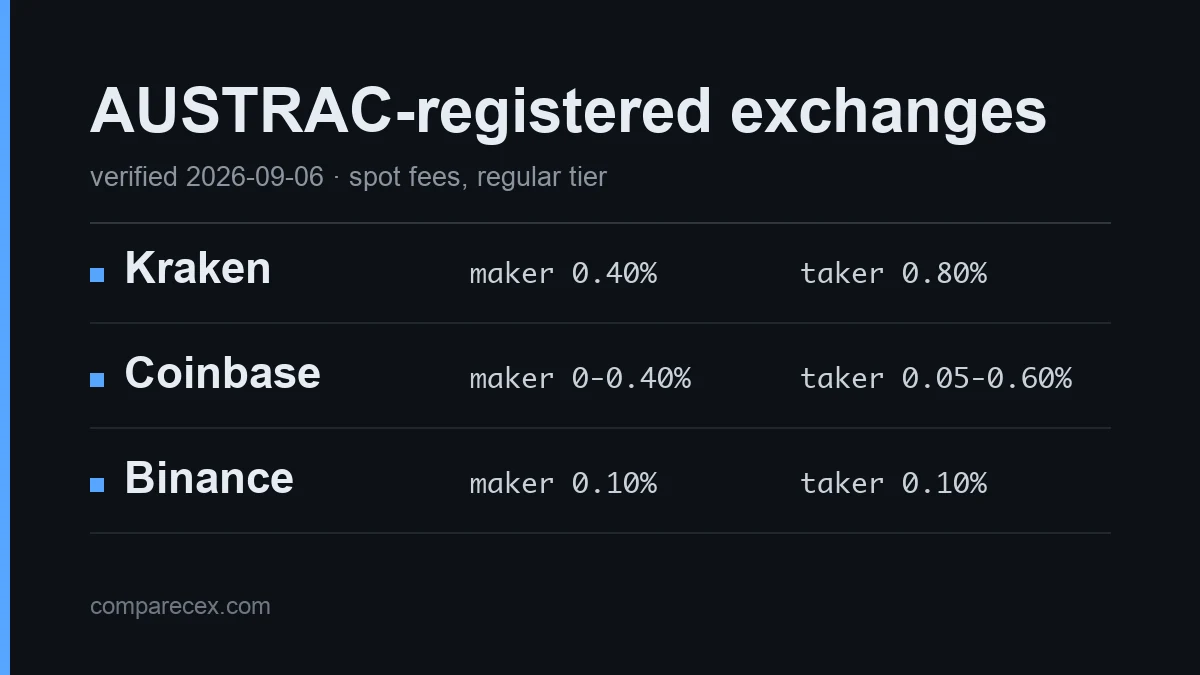
Three of the exchanges we track are registered with AUSTRAC and verifiable on the operator's own disclosure page: Binance Australia, Coinbase and Kraken. We deliberately do not name a single overall winner, because the three lead on different things and the right pick depends on your trade frequency and your own self-control. Binance Australia is the cheapest of the three at a flat 0.10% maker and 0.10% taker††; Coinbase has the narrowest product menu, with no futures and no margin in our records†; Kraken has the longest track record, operating since 2011†, and is also the dearest at the entry tier at 0.40% maker and 0.80% taker††. Which fact matters most to you is the decision.
DISCLOSURE: CompareCEX may earn a commission when you sign up through our links. This does not influence our editorial scores.
RISK: Crypto assets are volatile and unregulated in many jurisdictions. Not financial advice.
Which Crypto Exchanges Are Actually Registered in Australia?
Only three of the exchanges we track have an Australian registration we could verify on an official page, checked 2026-09-06. Be clear about what registration is: an anti-money-laundering and reporting obligation on the operator. It is not deposit insurance, not a promise of solvency, and not a guarantee your money is safe.
- Kraken — AUSTRAC-registered digital currency exchange, per Kraken's country availability page.
- Coinbase — AUSTRAC registered as both a digital currency exchange and a remittance provider, per Coinbase's Australian licences page.
- Binance — operated in Australia by InvestbyBit Pty Ltd (ABN 98 621 652 579) trading as Binance Australia, AUSTRAC registration 100576141-001. An ASIC AFSL application is pending, per Binance's licences page. Pending is pending: an application, not a licence held.
All three require identity verification before you can trade†††. Handing over a government ID is the price of a venue that answers to a regulator, not a hurdle. Our ranking methodology sets out how we weight it.
What Do the Three Registered Exchanges Charge on a Spot Trade?
Every rate below is one side of one trade, at the regular or entry tier, spot only. Derivatives and card purchases price differently.
| Exchange | Maker Fee | Taker Fee |
|---|---|---|
| Binance Australia | 0.10%† | 0.10%† |
| Coinbase | 0–0.40% (tiered)† | 0.05–0.60% (tiered)† |
| Kraken (entry tier) | 0.40%† | 0.80%† |
The table is ordered cheapest first, the reverse of the order most Australian round-ups put these three in. That gap between price and reputation is the argument of this article.
Kraken's Tier 1 pricing applies below $2,500 of 30-day volume, where nearly every new Australian account sits†. Coinbase is a range rather than a rate: 0–0.40% maker and 0.05–0.60% taker, moving with your 30-day volume††. A retail account with no volume history sits near the ceiling, not the floor: quoting Coinbase at 0.05% quotes a tier you have not earned. Binance Australia is the flat one at 0.10% both sides at VIP0††.
On fees alone, Binance wins this table outright, and there is no honest way to read it otherwise†. The rest of this page is about why fees alone is the wrong first question. For the mechanics of the two sides, see Maker vs Taker Fees; for all eight exchanges ranked on cost, see our lowest fee crypto exchange breakdown.
What Does a Round Trip Actually Cost You in Dollars?
A percentage on a fee page is half a trade: a real position has two sides, so the round trip is the number that matters. Figures are in USD, because we have no verified FX rate for an AUD conversion. Both sides are assumed filled as taker (market) orders at the regular or entry tier.
| Exchange | $1,000 round trip | $10,000 round trip |
|---|---|---|
| Binance Australia | $2.00† | $20.00† |
| Coinbase (retail, top of tier) | $12.00† | $120.00† |
| Coinbase (high volume, bottom of tier) | $1.00† | $10.00† |
| Kraken (entry tier) | $16.00† | $160.00† |
The arithmetic is taker fee times two sides times position size. Binance: 0.10% x 2 = 0.20%, so $1,000 x 0.20% = $2.00†. Coinbase at the retail ceiling: 0.60% x 2 = 1.20%, or $12.00; at the high-volume floor, 0.05% x 2 = 0.10%, or $1.00 on the same trade†. Kraken's entry tier: 0.80% x 2 = 1.60%, or $16.00†. Multiply by ten for the $10,000 column.
At $1,000 the gap between the cheapest and dearest registered option is $14.00; at $10,000 it is $140.00††. As a ratio, Kraken's entry tier costs 8x Binance's on an identical trade, 1.60% against 0.20%††. Be honest about what that means at your size: if you buy twice a year and hold, fourteen dollars will not decide your outcome; if you round-trip weekly it compounds. Our fee calculator does that arithmetic at your own size†.
What Is Each of the Three Best For?
There is no overall number one below, on purpose. Each pick leads on one thing we can point at in our records:
Binance Australia — best on cost. A flat 0.10% maker and 0.10% taker at the regular tier, with no volume threshold to reach first††. It publishes proof of reserves† and carries the widest product menu of the three: spot, futures, margin, P2P and a card†. That wide menu is the catch, and the next section is about it.
Ready to try Binance?
Availability in your region is unclear — check local regulations.
CompareCEX may earn a commission when you sign up through our links. This does not influence our editorial scores.
Coinbase — narrowest product menu. Our records show no futures and no margin†, making it the most structurally limited of the three. It publishes proof of reserves only for its wrapped tokens such as cbBTC, not for customer balances exchange-wide†, and has operated since 2012†. The cost of that narrowness is a tiered schedule where a new account sits nearer 0.60% taker than 0.05%†.
Ready to try Coinbase?
Please check local regulations before signing up.
Kraken — longest track record of the three. Operating since 2011†, AUSTRAC registered as a digital currency exchange, with 24/7 support channels in our records†. The trade-off, plainly: it is the most expensive of the three at the entry tier, 0.40% maker and 0.80% taker††, and it carries futures and margin†.
Ready to try Kraken?
CompareCEX may earn a commission when you sign up through our links. This does not influence our editorial scores.
On reserves: Binance publishes proof of reserves†, and Kraken publishes Proof of Reserves audits by an independent accounting firm, and clients can verify their own balance against the audit†. Coinbase publishes proof of reserves only for its wrapped tokens such as cbBTC; there is no exchange-wide proof of customer balances†. That is what the record says, no more and no less.
Which Exchange Fits the Discipline You Actually Have?
The most valuable thing about a funded-account challenge is not the capital. It is that a third party enforces the rules your willpower will not: losses capped by someone else, profits force-stopped whether you feel finished or not . The rule lives outside your head, which is the only place it survives a bad afternoon.
Apply the same logic to picking an exchange. A registered venue with mandatory identity checks, local record-keeping and a narrow product menu is not a limitation you tolerate; it is a rule layer you are buying. Coinbase has no futures and no margin in our records† — a structural cap on how badly one impulsive session can end. Kraken carries futures and margin†; Binance carries futures, margin, P2P and a card†. The wider the menu, the more the outcome rests on your self-control alone.
One test transfers directly. If you cannot hold a rule at the small version — the smaller position rather than the bigger one you talked yourself into — do not assume you will hold it in a fast market with leverage one tap away . If you have ever told yourself "just this once" about position size, the right pick is the venue that structurally cannot offer you the leverage, not the cheapest one that can.
Honestly, though: an experienced trader with a written risk process loses nothing by choosing the wider venue, since the extra products stay dormant unless used. This section is for everyone not yet that person. For the two widest menus side by side, see Binance vs Kraken.
What About KuCoin, MEXC, Bitget, OKX and Bybit?
These five are not part of the picks above: we could not verify an Australian registration for any of them. What we did verify is narrower:
- KuCoin — Australia does not appear on its Restricted Locations list, per the KuCoin terms of use.
- MEXC — Australia does not appear on its Prohibited Jurisdictions list, per the MEXC terms.
- Bitget — Australia does not appear on its Prohibited Countries list, per the Bitget terms of use.
- OKX and Bybit — we found nothing either way for Australia.
"Not prohibited" is not the same as "registered here". Why these venues still tempt Australians should be stated rather than hidden: MEXC quotes 0% maker and 0.05% taker††; KuCoin, Bitget and Bybit each quote 0.10% maker and 0.10% taker††††††; OKX quotes 0.08% maker and 0.10% taker††. That is cheaper than every registered option here, and it is the trade being offered: lower fees against a regulatory position we cannot verify for you. Our MEXC exchange profile records what we hold on the cheapest of them.
What Mistakes Do Australian Traders Make Picking an Exchange?
- Treating "not banned here" as "regulated here". The KuCoin, MEXC and Bitget terms pages only tell you Australia is not on an exclusion list — the absence of a prohibition, not the presence of a registration.
- Ranking on headline fee when you place four trades a year. At that frequency, Kraken's 0.80% taker against Binance's 0.10%†† is a rounding error next to one badly sized position.
- Opening the widest-menu account first. Futures and margin availability† is a capability, not a plan. With no written rule for when you would use leverage, having it available is a liability dressed as a feature.
- Assuming the advertised low end is your rate. Coinbase's 0.05% taker floor is a volume tier, not a starting rate†.
Related guides
- Binance vs Kraken — the two widest product menus from this page, compared head-to-head.
- Coinbase Fees Explained — the full tiered schedule behind the Coinbase numbers used above.
- Lowest Fee Crypto Exchange — all eight exchanges named on this page ranked on cost alone.
- Best Crypto Exchange Canada — a stricter registration bar that only Kraken and Coinbase clear.
- Best Crypto Exchange UK — the same two exchanges hold the equivalent FCA registration there.
- Best Crypto Exchange USA — OKX joins Kraken and Coinbase as a third licensed pick in this market.
- Best EU Crypto Exchange — the same criteria-first approach for EU users, without Australia's AUSTRAC check.
FAQ
Is Binance legal to use in Australia?
Binance is operated in Australia by InvestbyBit Pty Ltd (ABN 98 621 652 579), trading as Binance Australia, holding AUSTRAC registration 100576141-001. An ASIC AFSL application is pending rather than granted, per the Binance licences page. Registration is a reporting obligation, not an endorsement of the platform.
Which crypto exchange is cheapest for a small Australian trader?
Of the three registered options, Binance Australia, at 0.10% maker and 0.10% taker on spot at the regular tier††. Venues without a verified Australian registration quote lower still — MEXC at 0% maker and 0.05% taker†† — which is the trade-off this page covers. Run your own size through the fee calculator.
Does AUSTRAC registration mean my crypto is protected?
No. Registration is an anti-money-laundering and reporting obligation on the operator; it is not deposit insurance and says nothing about solvency. On reserves, Binance publishes proof of reserves† and Kraken publishes Proof of Reserves audits by an independent accounting firm that clients can check against their own balance†; Coinbase publishes proof of reserves only for its wrapped tokens such as cbBTC, not across customer balances†.
RISK: Crypto assets are volatile and unregulated in many jurisdictions. Not financial advice.
Last updated: 2026-09-07
Affiliate link — we may earn a commission. How we're funded
Visit Binance